
 Cast your mind back to April 2025.
Trump lobbed punitive tariffs at half the world and the market lost its mind.
You could pick up Micron around US$60, SanDisk around US$30, Nvidia around US$92, and Nebius at US$18.
Microsoft traded at US$350, Amazon US$160, and Google US$142.
It was an investor’s dream.
The market had grossly overreacted, selling down companies with exceptionally strong businesses that were still growing at a pace rarely seen.
Fifteen months later, you’re unlikely to see most of those prices again.
That’s fine.
On the metrics that actually drive value, several of these companies are cheaper today than they were then.
Nvidia finished last week around US$207, on roughly 23 times forward earnings.
Its five-year average is about 72 times.
Over that same stretch, second-quarter earnings across the semiconductor industry are expected to grow by 131 %.
The share price has gone nowhere this year while earnings have run away and the multiple has halved.
That is what cheap looks like.
Yet more than US$1 trillion has been wiped off the sector’s market value.
I own Nvidia and Amazon, so weigh that as you see fit.
Forget AI, America’s No.1 forecaster says a bigger boom is coming:
“I’ve invested $1 million of my own money to prepare for this…”
He predicted the Financial Crash, both Trump victories and 2025’s record rare metals surge that saw stocks soar as much as 645%
Now discover the move he is making as America seeks to unlock a home grown fortune potentially worth trillions on Friday, May 15th
Find out what that move is right here >>
Capital at risk
The bears have a case this time
Last April was a tariff panic and not much more.
This time feels different because the sceptics have a reasonable case. It’s worth taking it apart piece by piece.
Here’s how it works…
Hyperscalers write off AI servers and the “chips” within over five or six years.
The sceptics argue that GPU’s have an economic life of only two or three years, meaning today’s reported profits are being flattered.
Michael Burry — of the big short fame – is one of the most vocal sceptics on this point.
Then there is the funding.
Incremental annual debt has risen from 9% of hyperscaler capital expenditure in the 2024 financial year to 32% over the past 12 months.
Alphabet also priced an US$84.75 billion equity raise in June.
Moody’s has flagged about US$662 billion of signed but not yet commenced data centre leases that don’t appear in capital expenditure figures at all.
Then there is the circularity.
Nvidia sells the chips and also holds equity stakes in some of the companies buying them.
To critics, that echoes the vendor financing that helped bring down Lucent and Nortel in 1999.
There’s also the number that really makes people nervous.
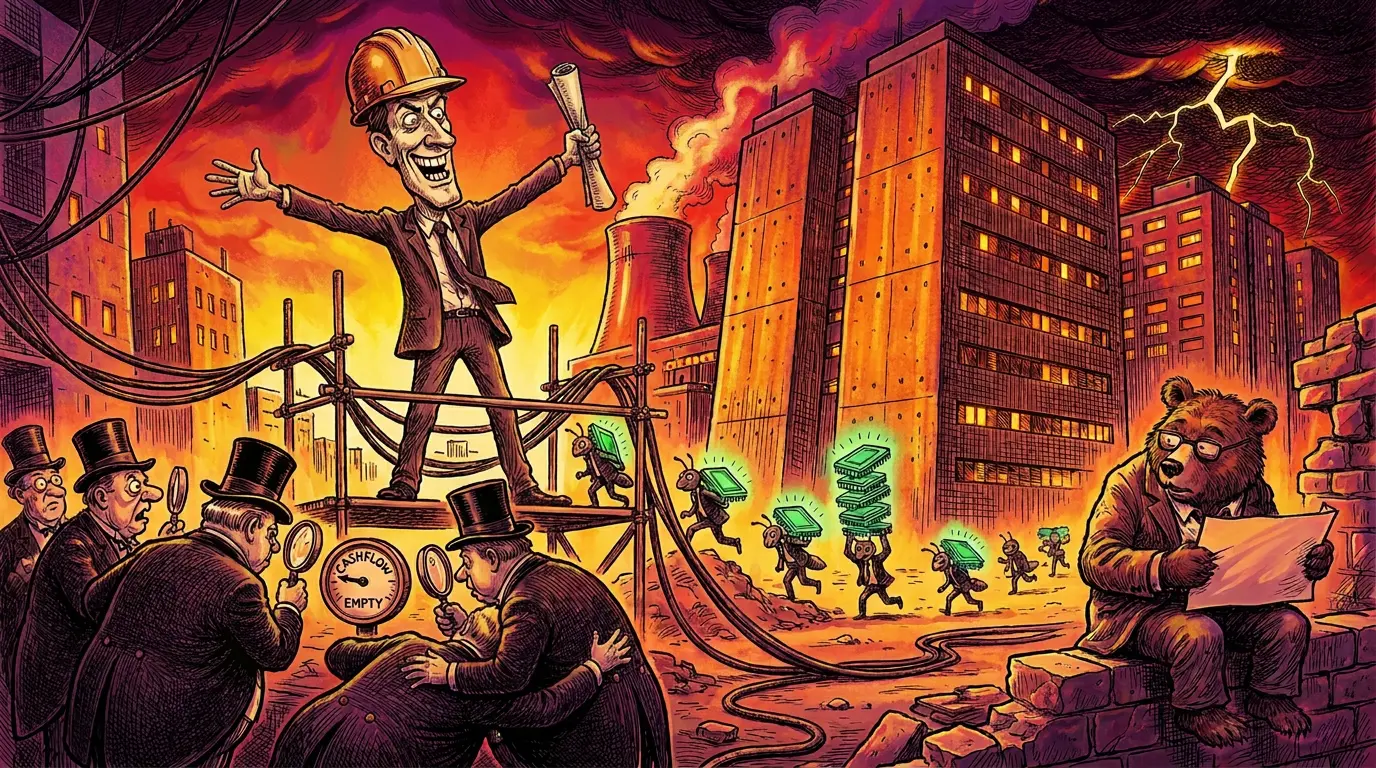
Combined free cash flow across the five biggest hyperscalers is forecast to fall 91% this year to around $16 billion, even as combined net income rises 25% to roughly $506 billion.
This is where the calls of “BUBBLE!” come from.
Right about today, wrong about 2028
The sceptics are right about one thing.
None of this pays off today. Then again, it was never supposed to.
|
President and CEO of Amazon, Andy Jassy, explained exactly why in his annual letter, and I think most of the market has forgotten it.
Amazon spends cash on land, power, buildings, chips, and servers six to 24 months before it earns a dollar of revenue from them.
Those assets then earn for five or six years in the case of chips and servers, and 30 years or more for the data centres themselves.
When growth is rapid, capital expenditure outruns revenue and early free cash flow gets punished.
Then the cycle turns.
Amazon has already been through that cycle once during AWS’s (Amazon Web Services) first wave of explosive growth.
It’s simply doing it again.
I would liken what they’re doing today with where the company was in 2015, when it had only just begun reporting AWS as a standalone business.
Back then, you could buy Amazon stock for around $15.
I think the company has that same kind of growth trajectory ahead of it over the next decade.
As Jassy wrote, Amazon isn’t committing roughly US$200 billion to 2026 capital expenditure “on a hunch.”
Much of that investment is already matched by customer commitments, both announced and unannounced.
They know what they’re doing folks.
That means that collapsing free cash flow is evidence that the strategy is working, not breaking.
You can’t spend $760 billion building out the most impactful infrastructure project in history and post healthy free cash flow in the same 12 months.
The question about the lifespan of these technologies is also a fair one.
Are companies signing up for a never-ending cycle of higher capital expenditure just to keep pace with advances in AI?
To a degree, yes.
But GPU leasing rates and second hand prices for H100s and A100s, chips that launched three to six years ago, remain remarkably strong.
If the useful life really were two or three years, those prices would have cratered by now.
They have not.
Applied Digital provided one of the clearest examples just this week.
Revenue grew 167% over the year, yet the company lost money because it put US$2.8 billion into property and equipment against US$681 million the year before.
CEO Wes Cummins described it as the early innings of the biggest infrastructure buildout in modern economic history.
Microsoft and Google both say demand is running well ahead of available capacity. High bandwidth memory is sold out through most of 2027.
Kimi K3 launched in China and filled its available capacity so fast it had to pause new subscriptions.
I’m inclined to trust the CEOs of the world’s biggest technology companies.
They’re the ones actually building this infrastructure.
They’re all investing in remarkably similar ways.
As Jassy put it, “not on a hunch.”
That doesn’t mean the stock prices go vertical from here though.
Timing in this market is brutal sometimes, and there’s a good chance the fear gets its way a little longer.
If it does, it only reinforces my view that these companies look cheap over the long term.
Pre-market prices already suggest the semis and AI names could give up another 4% or 5% before the week is out.
What you can control is how you buy.
If you’re comfortable with the volatility and the risk, buy in tranches rather than all at once. And lean towards the companies whose revenue is contracted rather than hoped for.
The bears will be right about free cash flow this year.
On the surface, that looks ugly.
But once you understand the size and scale of what’s being built… and the speed and magnitude of the returns once those assets are fully utilised… I think this market offers an outstanding opportunity for long-term investors.
Until next time,

Sam Volkering
Investment Director, Southbank Investment Research
PS Nvidia built the picks and shovels for the AI boom. James Altucher, editor of Altucher’s Investment Network, believes robotics could create the next generation of winners. He’s identified one tiny company he thinks is central to the story. Learn everything you need to know here.