 In today’s Issue:
- AI will change the game of war
- Defence tech breakthroughs have polarising effects
- May the best AI win…but how?
Dear Reader,
The media’s AI panic has luddites in a furore. We’re told AI is encouraging suicide, plotting world domination, seizing autonomous control…even launching nuclear weapons.
At this rate, AI will soon be behaving worse than governments.
Given the behaviour of printers over my lifetime, I can sympathise with the idea of machines trying to drive us mad. But none of my many printers have ever tried to kill me outright.
So let’s state the obvious: humans using AI to kill each other remains a far bigger threat than AI going rogue. After all, we have a much longer history of trying to do each other harm.
Perhaps that’s why we fear AI so much. We know it’s trying to stop us from our own worst inclinations…
For now, though, AI remains a tool that can be used for both good and evil. Not that anyone can agree on what constitutes either.
With open war back in the news again, we also need to ponder whether the age of AI has already begun reshaping the very human battlefield.
Another tech-tonic shift in war
Back in 2019, The Fleet Street Letter predicted that drones would reshape warfare and thereby the world.
Since then, drones have become the spearhead weapon on all sorts of battlefields. That includes the economic warfare of disrupting infrastructure. But on the weekend the US used suicide drones as a weapon for the first time.
Drone stocks were amongst the stock market’s top performers over the past five years as drones’ use grew exponentially. But their true impact still hasn’t been felt yet.
Our specific thesis in our 2019 report was about power asymmetry. We used the history of the AK-47 to convey the nature of the coming shift. Just as the AK-47 had upended the very nature of warfare by causing a power imbalance, drones would too, we wrote.
An AK-47 allows a child to hold off a platoon of well-trained soldiers. The proliferation of AK-47s changed not just how wars were fought, but who could fight them. It triggered a wave of conflicts where vastly inferior combatants were able to win against technologically superior enemies. Cost and ease of use were the key weapons, not bullets themselves.
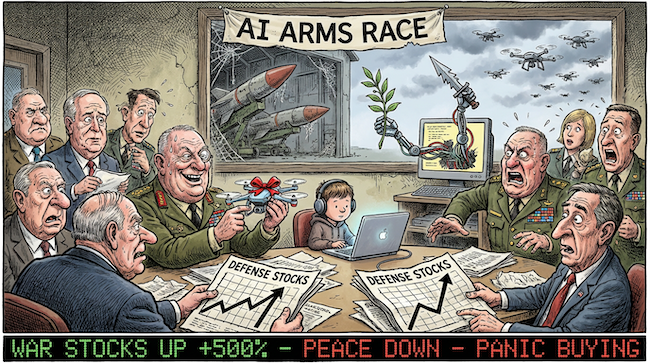
Drones are similar. They allow a 12-year-old to shut down an international airport with a Christmas present and walk away unseen.
Drones represent another radical shift in the asymmetry of war — and in who is capable of waging it.
Technological breakthroughs can cause peace or sow chaos
What’s intriguing about drones and AK-47s is how they disrupted the world. They made it a more dangerous place to live.
Your holiday could be disrupted by a child carrying a machine gun or a drone that keeps your flight grounded.
That contrasts with how technological advances usually work. They tend to be very expensive and lethal on a larger scale. That favours governments, not individuals — and tends to impose an uneasy peace rather than chaos.
All of Japan was subdued by two very expensive bombs.
The Cold War stayed peaceful, but for some proxy conflicts featuring AK-47s. That’s because it was a standoff caused by new weapons technology threatening the end of the world. Governments faced off at great distances. Dissidents weren’t on streets pointing nuclear weapons at each other.
What type of technological innovation will AI warfare be? We all know it will change things. But will it destabilise and trigger conflict? Or will it impose a new Cold War style peace because the stakes of destruction are too high? Or will it give one side total victory over another?
Does AI give large state actors with vast budgets power to fight each other, which they’ll never use? Or does it give 12-year-olds with an internet connection the opportunity to wreak chaos in some new way?
No doubt you can smell the civil servants coming your way. If they can ban social media, do you think they’ll let you access AI once it proves its power?
May the best AI win
If AI becomes so powerful that it threatens humanity, we may be on the cusp of another Cold War style conflict. The major AI powers of the world won’t be able to launch their weapons without risking…everything. So they won’t.
If AI becomes an asymmetric tool for disruption like drones and AK-47s were, we’re in trouble. Conflict and governments’ attempts to suppress it will grow to a whole new level. The world will become a dangerous place as terrorism spreads over fibreoptic cables.
Here’s a peculiar example of the distinction in action that doesn’t involve war…
You might think that AI enables banks to detect mortgage fraudsters. If your mortgage application claims to have double the income you actually do, AI should be able to detect that.
But Australia’s Commonwealth Bank recently discovered that AI had the opposite impact. It enabled large scale mortgage fraud by making it easy to create false documents. So far, the bank found half a billion pounds worth of potential fraud.
The point is that AI can be used either way. As a disruptive tool that creates an asymmetric power imbalance – a measly borrower can defraud their all-powerful bank easily.
Or as a stabilising force – the bank can detect mortgage fraud easily.
Which will it be in the defence realm?
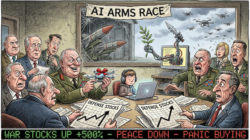
I’m not sure yet. But here’s what I do know. The incentives are so large that an AI arms race is well underway. The best AI could dominate the future. Not just economically but geopolitically and in terms of our quality of life.
The AI arms race must be won by a set of nations friendly to ideas of freedom, capitalism and democracy. Otherwise, we’re in big trouble, comrades.
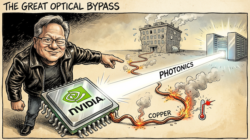
But what exactly makes one AI better than another?
This technology. And you have a chance to own a stake in it.
Until next time,

Nick Hubble
Editor at Large, Investor’s Daily
P.S. Nvidia doesn’t make surprise moves lightly. When it acts, it tends to reshape entire segments of the AI supply chain. James’s “Blue Spike” alert isn’t random noise, it’s flashing on a small California company that could sit at the centre of Nvidia’s next strategic step. If this deal materialises, the stock could move before the headlines catch up. That’s why you should watch the full briefing now — not after the announcement.