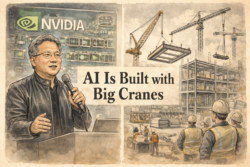
I livestreamed Jensen Huang’s GTC 2026 keynote on Monday, with some live commentary.
If you missed it, the replay is available on our YouTube page. It’s worth watching for reasons I’ll get into today…
Just not for the reasons you might expect.
The keynote was impressive. And the headline numbers were staggering.
One trillion dollars in expected chip orders through 2027. The Vera Rubin platform moving into full production. Groq’s inference technology is now integrated into Nvidia’s roadmap as the Groq 3 LPU, delivering up to 35x performance gains at extreme token speeds, underscoring the strategic rationale behind the $20 billion acquisition.
Then came the partnerships. BYD, Hyundai, Nissan, Geely. A Disney robot on stage. Even a brief mention of a future data centre in space.
It was, in typical Jensen fashion, a masterclass in making the future feel like it’s already here and a masterclass in salesmanship.
But it wasn’t the chips and the crazy year-on-year product cycle that amazed me.
It was the cranes.
The key to this is big cranes
During the keynote, Nvidia played a series of clips. Industrial robots assembling components at speed. Autonomous vehicles reasoning through real-world driving scenarios. And then, the construction of AI factories.
You can see the screenshot from my livestream,
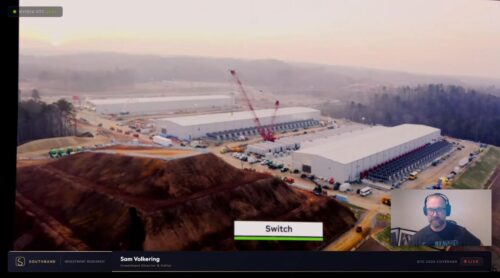
It’s not just about what Nvidia is putting inside these facilities, it’s also about what it takes to build the facilities themselves.
When you look at a massive AI factory being assembled, you start to see beyond the racks of GPUs and the blinking lights.
You see giant cranes lifting structural steel, concrete being poured in thousands of tonnes, aluminium frameworks, copper cabling, titanium-grade components, specialised alloys, electrical transformers, cooling systems, plumbing, ventilation, lighting, access roads, substations and power lines running for miles.
One hyperscale data centre can require upwards of 10,000 tonnes of steel.
Microsoft’s 80MW facility in Chicago used around 2,100 tonnes of copper alone. The World Economic Forum recently noted that large multi-building AI campuses can demand more than 200,000 tonnes of steel. And copper intensity per square metre in these buildings runs 13 to 130 times higher than standard commercial construction.
These are industrial megaprojects. And we’re not building one or two of them. The world is building hundreds, all at once, across every major economy on the planet.
Jensen himself called it “the largest infrastructure rollout in history.” He’s right. But I think the market is distracted by the “tokens” and “compute” that AI grabs headlines and misses the physical play here.
The trillion-dollar shopping list
Everyone’s focused on the chips, compute and AI tokens.
The GPUs, the LPUs, inference chips, memory, and networking silicon. And rightly so, those are phenomenal businesses and I’ve been banging on about them for years.
But none of that means anything if you can’t physically build the infrastructure it relies on.
S&P Global has warned of a “substantial shortfall” in copper supply, projecting a deficit that could reach 10 million metric tonnes by 2040.
Copper prices have already surged past US$11,000 per tonne on the London Metal Exchange, up more than 30% in the past year.
Aluminium is heading into deficit as well. Bank of America projects a supply shortage of around 292,000 tonnes in 2026, with prices now over US$3,400 per tonne.
Then there’s the rare earths…
Here’s the year-on-year performance of,
- Neodymium: up 76%
- Rhodium: up 96%
- Indium: up 62%
- Palladium: up 58%
- Cobalt: up 55%
You don’t just buy these materials off the shelf.
Copper mines take a decade to develop. Aluminium smelters need enormous power supply commitments years in advance. You think these rare earths are called as such because they’re easy to mine and produce at scale?
The companies that secure offtake agreements, lock in supply, and get their fill early are the ones that stand to benefit most as this wave of construction accelerates.
And then there are the companies that actually discover, explore, mine and produce all these critical infrastructure materials.
Think about it this way. Nvidia can design the most advanced AI chip on Earth. They can build the software, train the models, and create the inference architecture. But without the physical metals for the cabling, the structure, the cooling, the foundations, the whole thing falls apart.
The AI revolution is being built by compute, and by construction.
Yes, Jensen showed us AI’s future on Monday. From incredible chips to autonomous vehicles, humanoid robots, agents that think and act for us, it was all extraordinary.
But behind each of these breakthroughs is a shopping list. Steel, copper, aluminium, titanium, rare earths, cement, power infrastructure, cooling systems, and the engineering to tie it all together.
That shopping list is the best place to invest in today.
Until next time,

Sam Volkering
Investment Director, Southbank Investment Research