 In today’s Issue:
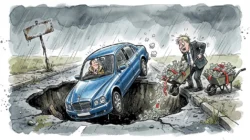
- The only source of hope and change in British politics: crisis
- Crisis-level government spending before a crisis hits
- This won’t be a quick fix
How bad will it have to get this time?
That’s the crucial question for British investors today.
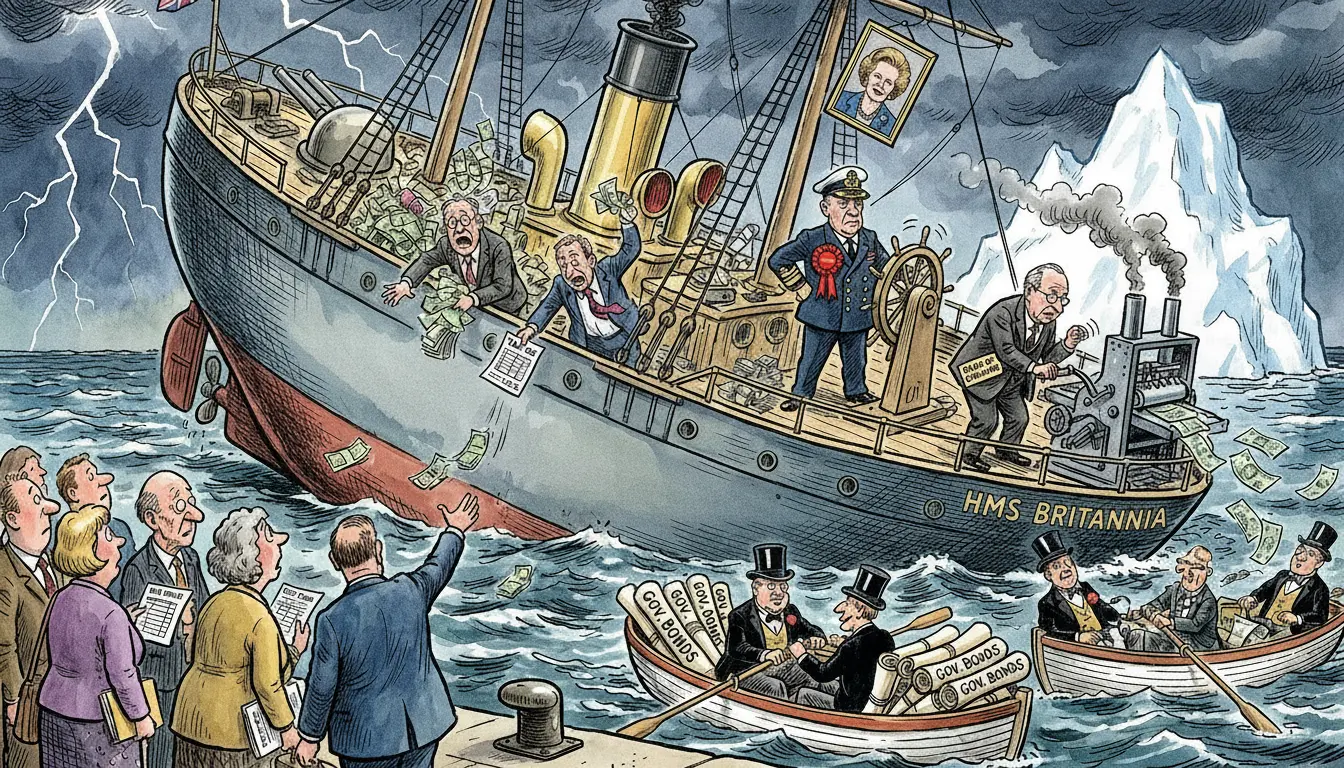
We all know the UK is on course to hit a fiscal iceberg.
The government’s deficits are in perilous territory, at 4.3% of GDP.
The debt is in alarming, above 90%.
The bond yields are in the danger zone, above 4%.
And you know what’s craziest of all?
We’re not even in a crisis.
There is no recession.
Energy prices remain mild.
The UK’s deficit is largely structural. That means it’s going to be very tough to cut.
But imagine if something bad did happen. A financial crisis, another war (maybe even closer to home), or a new pandemic (hanta virus anyone?). It’d tip us over the edge, without the resources to deal with the problem.
Britain’s Investment Letter Since 1938
In 1938, The Fleet Street Letter warned its readers that war was coming to Europe — and even identified September as the critical month.
Since then, its readers have been warned ahead of Black Monday, the dotcom crash and the 2008 financial crisis.
Today, Britain’s longest-running investment advisory is still looking for the “news behind the news” — and the investment opportunities others could be missing.
Click here to discover what The Fleet Street Letter sees coming next.
Capital at risk.
What Does Britain’s Oldest Investment Letter See Coming Next?
It warned readers ahead of Black Monday.
The dotcom crash.
And the 2008 financial crisis.
Now, nearly 90 years after it was founded, The Fleet Street Letter is still searching for the “news behind the news” — and the investment opportunities that could emerge from the next major turning point.
Click here to discover what its editors are seeing now.
Capital at risk.
Change is coming
The good news is that Britain is familiar with fiscal crises. We’ve been here before. The country simply needs to relearn the lessons it was forced to confront in the 1970s.
By the 1980s, we had started to.
That is not a terrible outcome, by the way. Argentina took much longer to accept that mathematics also applies to government finances. As Margaret Thatcher famously put it: “The trouble with socialism is that you eventually run out of other people’s money.”
Could we elect someone with that message today?
Not yet.
And the fact that we have forgotten those lessons doesn’t reflect especially well on us.
Still, we know what lessons we need to learn.
We know we’re capable, having learned them in the past.
The only real question is when we rediscover them.
And that’s where the news gets less good…
Be careful what you wish for
There’s one simple truth about fiscal turning points: they always require a financial crisis.
The Greeks needed the European sovereign debt crisis. The Cypriots needed a banking crisis. The Irish experienced high unemployment during an emigration crisis. Germany needed hyperinflation.
Countries always get their house in order, eventually. But rarely before HL Mencken’s famous quote about democracy is proven right first:
Democracy is the theory that the common people know what they want, and deserve to get it good and hard.
I don’t think we’ve had that yet.
So we can expect things to get worse before they get better.
How?
Usually, what economists call an “exogenous shock.” An energy crisis, war, or pandemic, for example. It blows down the house of cards. And gets all the blame for the fiscal crisis that follows, of course. Just as 2008 was blamed for the subsequent austerity.
But exogenous shocks happen. It’s the house of cards that’s the problem.
History proves economic orthodoxy wrong
So far, the Labour government has tried to tax its way out of trouble.
But if the economy wasn’t growing fast enough before the taxes were increased, then it certainly won’t grow fast enough after tax increases.
And we all know what a pro-growth tax-cutting budget did to the bond market.
Yet that is the only way out of a mess like this. Ireland did it in the early 80s. Germany in 1948. Argentina is doing it now. Tax cuts and deregulation might panic the bond market, but they’re the only way out.
We know they work, whatever the economists might say. Indeed, they said it every time it was tried before, too.
When Ludwig Erhard liberalised the German post-war economy, US commander General Lucius Clay told Erhard, “My advisers tell me you’re making a terrible mistake.”
Erhard replied, “Don’t listen to them, General. My advisers tell me the same thing.”
Erhard was proven right so fast that the American general backed him against all economic orthodoxy.
Decades later, it was Milton Friedman who freed the UK from the same interventionist ilk.
The point is that you need a crisis first.
It’s not just finances, by the way.
France built its nuclear fleet because of an energy crisis. China stockpiled resources because the US tried to boycott its supply of microchips. Japan has healthy oil reserves because… well, let’s not go there.
The point is that governments and voters only learn the hard lessons out of a crisis.
And so we’re in for one.
What the crisis looks like
The UK bond market relies on foreign investors. About a third of our government bonds are owned overseas.
The trouble is that foreign bondholders are always the first to flee. And losing a third of your buyers is big enough to cause a panic.
The government can do lots of things to pressure UK financial institutions to own more bonds. But it can’t pressure foreigners to stick around.
So the crisis will begin as foreigners flee. And the government will respond to the crisis by… blaming them.
There’s something very ironic about that. The bond vigilantes and speculators that the government will be criticising were the ones paying for their political promises. You’d want to coax them back in, not vilify them.
But if politics and financial management had mixed well, we wouldn’t be in this mess in the first place.
The trouble with rising bond yields (falling bond prices) is that bonds are used as the bedrock of the financial system and bond yields as a reference rate. If the bond market wobbles, everything in the economy and financial system wobbles, including the stock market. So we’d expect a crash.
The next step is a central bank bailout.
The Bank of England might not want to print money to rescue the government. But because bonds are so systemically important to the financial system, which the Bank of England definitely does want to rescue, the Bank will have no choice.
This creates a bizarre, perverse incentive. The worse the financial crisis caused by a bond market meltdown gets, the faster the government will get bailed out by the Bank of England’s money printing.
And so the crisis will get worse.
Next, politicians must find someone to blame for the stagflation.
A crashing economy and high inflation are supposed to be impossible in economic theory. Never mind that it’s common in history. Nobody brings that up in political debates or think tank policy papers.
And so the stagflation will get worse.
What we’re left with is the question we began with: How bad does this need to get before people are willing to vote for a government that can do basic maths?
Even if it means huge cuts to spending and tax cuts? Because that’s what the maths demands.
And it’s only a matter of time before you give in to it.
How long?
I don’t know. But it could take decades.
Which is why it might be time to invest your money elsewhere. That’s what one of our editors is doing with a million of his own money. Find out where he’s investing it, and how you can too, here.
Until next time,

Nick Hubble
Editor, The Fleet Street Letter
PS The uncomfortable reality is that governments can ignore maths for a surprisingly long time… until markets force them not to. And when that moment comes, the people who prepared early tend to fare very differently from everyone else.
That is why one of our editors, a man with decades of experience around global markets, politics, and financial crises, has already positioned more than $1 million of his own money for what he believes comes next.
Not because he thinks things will improve quickly. Quite the opposite.
He believes the next phase of this crisis could create one of the biggest shifts in wealth and opportunity we’ve seen in years.
And he is prepared to show you exactly where he is putting his money, and why.