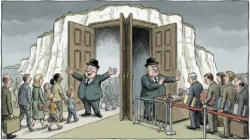
 Net migration hit 906,000 in the year-to-June 2023. We now call it the “Boriswave.”
Even after a crackdown, 813,000 people arrived in 2025.
And British nationals?
They’re leaving in droves. Apparently, 136,000 Brits left in 2025… people are realising it may be better to get off the sinking ship…
But once, the British Empire was on top of the world.
In 1642, the king raised his standard at Nottingham, and the wars that followed killed about 250,000 people, nearly 5% of the population. World War I took a smaller share than that.
Then came plague in 1665… fire in 1666… and a crown so broke it stopped paying its own debts.
But for all the trials Britain continued to build.
The Bank of England opened in 1694 to fund the war with France and put the state’s credit back together.
Then on 22 July 1706, the commissioners signed the Articles of Union. From 1 May 1707, England and Scotland were “united into one Kingdom by the name of Great Britain.”
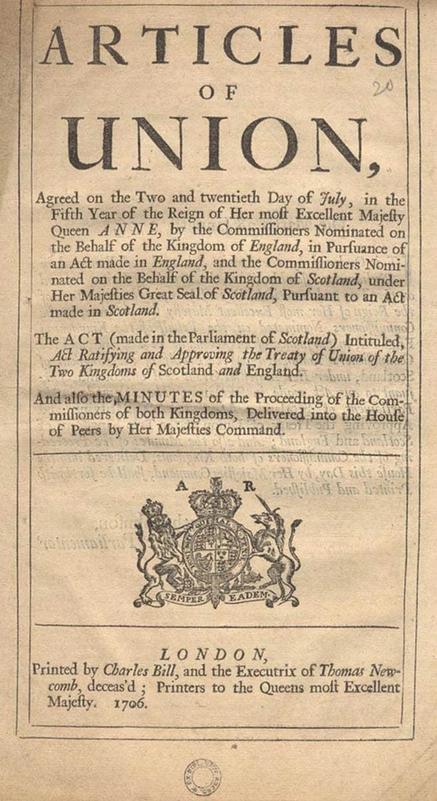
Source: Articles of Union, printed by Charles Bill, London, 1706
Great Britain.
The Great in the name was a stroke of marketing genius. It was also true. The best marketing is often the most honest.
By 1880 this one small, often cloudy, but resolute and unwavering island made 22.9% of everything manufactured on Earth.
Sterling was the world’s money.
The Royal Navy kept the sea lanes open for the trade that paid for it all.
Three hundred years at the top, give or take.
And then somewhere in the past 15 years it all slipped back to being just Britain.
What happened to the Great?
How Great Britain became just… Britain
You can actually measure the demotion.
Since the end of 2019, the UK economy has grown 6.3%. GDP per person has grown 2.2%.
About two-thirds of that “growth” was just extra people, not better lives.
British industry also pays 26.63p per kilowatt hour for electricity. That’s the highest of 25 countries reporting to the International Energy Agency, and 63% above the median.
It’s no wonder big industry is leaving.
Port Talbot’s last blast furnace went cold on 30 September 2024.
Grangemouth stopped refining oil on 29 April 2025.
In April 2025, Parliament sat on a Saturday to seize British Steel at Scunthorpe. Lose it, and Britain becomes the only G7 country that cannot make steel from scratch.
The central hub of global finance is heading for the exits too.
The London Stock Exchange is down to 1,534 listed companies, a decade-low, from 2,429 in 2015.
In the first half of 2026 London managed seven floats raising US$780 million, while the US did 72 for US$128 billion.
Sterling, the old master currency, is down to 4.6% of world reserves.
None of this is by accident.
It’s a byproduct of trying to combat the enemy from the east…
In 1938, The Fleet Street Letter warned its readers that war was coming to Europe — and even identified September as the critical month. Since then, its readers have been warned ahead of Black Monday, the dotcom crash and the 2008 financial crisis. Today, Britain’s longest-running investment advisory is still looking for the “news behind the news” — and the investment opportunities others could be missing. Click here to discover what The Fleet Street Letter sees coming next. Capital at risk. It warned readers ahead of Black Monday. The dotcom crash. And the 2008 financial crisis. Now, nearly 90 years after it was founded, The Fleet Street Letter is still searching for the “news behind the news” — and the investment opportunities that could emerge from the next major turning point. Click here to discover what its editors are seeing now. Capital at risk. Britain’s Investment Letter Since 1938
What Does Britain’s Oldest Investment Letter See Coming Next?
Great China?
China picked up the Victorian playbook, and changed its manufacturing base from cheap and nasty to quality at a price nobody can refuse.
China now makes over 30% of everything manufactured on Earth, with projections on that rising to 45% by 2030.
Its 2025 trade surplus was a record US$1.19 trillion, and its factories cut prices for 40 straight months to January this year.
A BYD Seagull, a proper little EV, was listed at about US$9,650 until and last year’s price war.
Now it’s listed at under US$8,000.

The irony is that names that were once unmistakable British, like MG, are now owned by China and are more exciting and reliable than they’ve ever been.
This wasn’t an overnight takeover. And the British powers-that-be saw it coming.
So, rather than fix the problems at home, they opted for creating a bigger problem…
Cheap labour.
By the planeload.
The economics never stacked up either.
On the OBR’s own model, a low-wage migrant arriving at the age of 25 costs about £151,000 net by the time they turn 66.
According to the government’s own estimate, 1.3 million to 2.2 million immigrants will settle in the UK between 2026 and 2030, each carrying lifetime access to public funds.
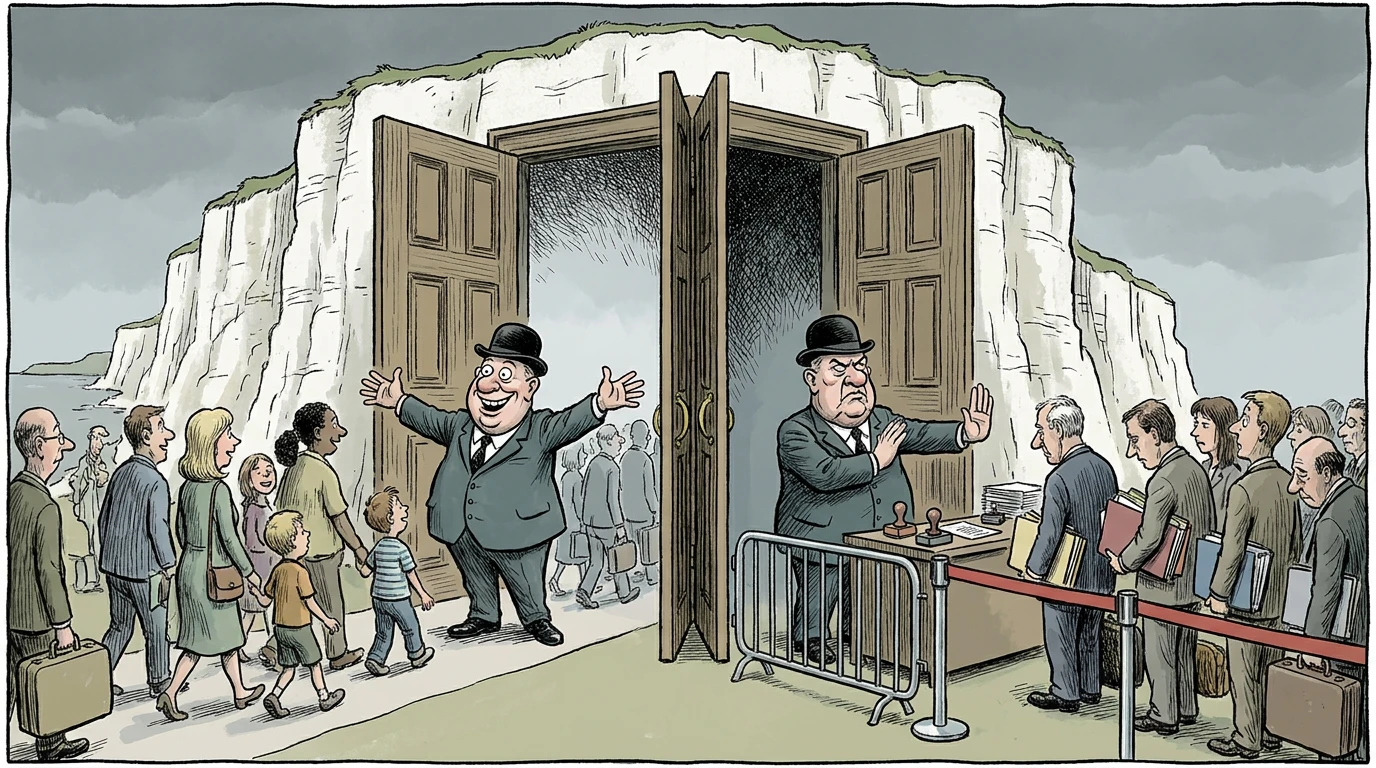
The white paper promising 10-year “earned settlement” arrived on 12 May 2025. A year and a half later it still is not law. And then a rule change this month skips it, and the five-year door stands open while people race through.
I know these doors well.
I spent a decade trying to get through them, only to be denied after a decade dedicated to life in the UK because, according to the Home Office, my first visa didn’t count towards time spent with my spouse (even though we arrived together, lived together, and shared financial responsibilities together… and certainly paid our fair share of taxes).
Ten years of renewals done the right way to live and work in Britain, with my wife and kids, who are British by birth, only to then be denied.
The health surcharge is £1,035 a year per adult, before anyone sees a GP, and settlement itself now costs £3,226. By the time my time was up in the UK, I’d spent around £12,000 on visa applications and healthcare surcharges.
My visas also said “No Recourse to Public Funds” which was fine. I never expected to, nor was I able to, claim any government assistance anyway. But I also paid tax year on year on year well into the high six figures by the end of it.
And the other queue?
Since 2018, some 205,000 people have been detected crossing the Channel in small boats, a record 41,472 of them last year.
Maybe I’m a little jaded by it all, but I probably have some claim to be.
I dearly love Britain. As I said, my kids are British, my wife is British, heck even my dog is British. I just wish that it was Great Britain again.
But when the legal route in gets fleeced, and the illegal route gets housed, you know there’s a great imbalance.
Would you agree? Disagree?
Let me know at feedback@southbankresearch.com.
Wanting Britain to be competitive on a global scale again, economically powerful, and a force to be reckoned with on the high seas is a pursuit all Brits should desire.
It is how the welfare state everyone claims to defend gets paid for, grows, and looks after its people.
David Betz, professor of war in the modern world at King’s College London:
At the time of writing the countries that are most likely to experience the outbreak of violent civil conflict first are Britain and France… In a country where the conditions are present the chances of actual civil war occurring is four per cent per year… the chances of it occurring are 18.5 per cent over five years…
Critics call it “speculative extrapolation of invented numbers,” and maybe they are right.
Then again, the generation before 1642 laughed too.
This is rather gloomy and doomy stuff, I know. But it pays to be a realist too about the fact that that the path and trajectory are unsustainable.
The revival trade
Thankfully a fix is on order, and can help make Great Britain great again.
Cheap power is the absolute first port of call.
Why can a British factory pay so much more for electricity than a French one?
|
Rolls-Royce (LSE: RR) signed the contract for Britain’s first small modular reactors on 13 April 2026. That is £2.6bn for three units at Wylfa, providing power for about three million homes.
Naval strength and a return to Great Britain ruling the waves are then the order of the day.
BAE Systems (LSE: BA) reported a record £84bn order backlog on 30 July.
Babcock (LSE: BAB) floated off its first two Type 31 frigates and reopened Devonport’s 15 Dock.
These are the titans of naval strength that can help Britain regain that strength.
They might not be minnows, nor unknown names flying under the radar. But that’s not what Britain needs right now. It needs what’s left of Great British industry to fire up, and return things to the way they should be.
Britain has run this rebuild before, out of far worse, and it bought 300 years at the top.
Lining things up for the next rebuild and 300 more years at, or at least near the top again is something all should aspire to.
And it starts with a big clean-out of the house.
Until next time,

Sam Volkering
Investment Director, Southbank Investment Research
PS If Britain really is going to put the Great back in Great Britain, someone is going to have to build it. Power. Defence. Infrastructure. Industry.
The harder question for investors is figuring out which companies could benefit most from that rebuild. That’s exactly the sort of problem I built my stock-picking system to solve. It ranks opportunities across the market using five different signals, boiling thousands of stocks down to the handful I think are actually worth paying attention to.
And the whole thing comes down to one formula – five terms, five weights, and one Greek letter sitting in the middle of it.
I’ll show you exactly how it works HERE.