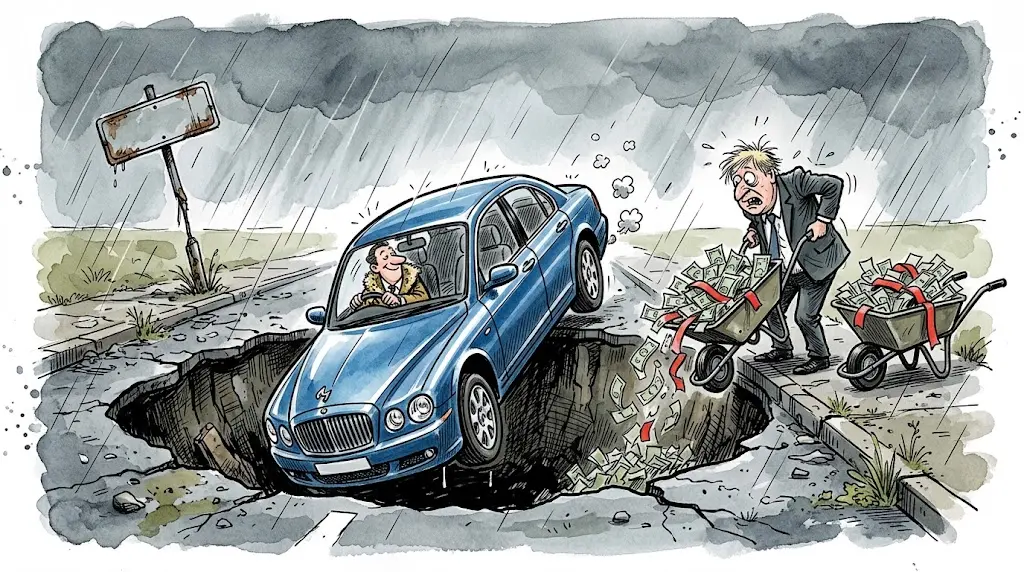
 A woman in Liverpool told the benefits office she was too anxious to leave the house, or even to wash herself.
Soon she was getting about £700 a month in disability payments.
Then she put down a small deposit and drove off in a BMW, through the “motability” scheme the taxpayer pays for.
Funny thing though…
For all that social anxiety, she still managed to take that BMW to the hair salon, out to restaurants, to a Pride parade in Brighton, and to a theme park…
Her story is one of many.
And a Wall Street Journal piece this weekend titled, “The Welfare State Is Crushing Britain,” ripped into the gigantic rort happening under your nose.
The numbers the WSJ reported are far worse than “Catherine’s” BMW.
Some seven million people, more than 10% of the country, now claim at least one sickness or disability benefit.
Among people of working age, that number has jumped from 2.9 million in 2019 to 4.7 million.
Britain will still spend more than £100 billion this year on benefits for the sick and disabled. That’s about a third more than it spends on defence.
Then there’s the motability scheme.
Motability lets anyone on the higher mobility rate of Personal Independence Payment (PIP) swap that money for a new car on a three-year lease.
In April 2025, 589,550 people on PIP had one.
Government figures showed 40 of those cars went to people whose condition was tennis elbow. Another 20 went to people with constipation.
Mercedes, BMW, and Audi made up 13,000 of last year’s new Motability cars.
Plenty of people on that scheme legitimately need help, and these things are a necessity for them. They can’t get to work or to the hospital without it.
But they’re also the ones getting short-changed when the money goes to someone’s tennis elbow.
And if the government is about to walk into the first budget with Chancellor Healey and the alleged £35 billion “black hole,” how about they take a look first at the incessant waste and rorting happening in the welfare system?
By the way, have you seen this happening first hand?
Do you know someone on the “welfare take” that’s rorting the system?
Do you think it’s fair the way the system like motability currently works?
Let us know investorsdaily@southbankresearch.com.
Britain’s Investment Letter Since 1938
In 1938, The Fleet Street Letter warned its readers that war was coming to Europe — and even identified September as the critical month.
Since then, its readers have been warned ahead of Black Monday, the dotcom crash and the 2008 financial crisis.
Today, Britain’s longest-running investment advisory is still looking for the “news behind the news” — and the investment opportunities others could be missing.
Click here to discover what The Fleet Street Letter sees coming next.
Capital at risk.
What Does Britain’s Oldest Investment Letter See Coming Next?
It warned readers ahead of Black Monday.
The dotcom crash.
And the 2008 financial crisis.
Now, nearly 90 years after it was founded, The Fleet Street Letter is still searching for the “news behind the news” — and the investment opportunities that could emerge from the next major turning point.
Click here to discover what its editors are seeing now.
Capital at risk.
20 years of the wrong cheque
Is this just a few bad apples casting a shadow on what’s essentially a good scheme?
Not on the numbers from the Centre for Social Justice (CSJ), which publishes State of Dependency today.
It’s a 250-page report from an inquiry chaired by former work and pensions secretary Sir Iain Duncan Smith.
Between 2006/07 and 2024/25, Britain spent £1.1 trillion more on working-age benefits than it put into transport, science and technology, housing, economic development, and community facilities combined.
Benefits now run at about 4.6% of GDP, while public investment sits at just 2.9%.
The welfare bill getting paid to working-age adults is £136.1 billion this year, compared to £86.5 billion in 2019/20.
That rise alone – £49.6 billion a year – is more than the hole the Chancellor is trying to fill this budget.
And boy isn’t it going to be some budget on 28 October.
There are already claims it will be a “work of fiction” without a plan.
Defence spending as I wrote about last week is a high priority. But paying for that is only now done one of two ways: cuts somewhere… or more taxes.
I bet you know which one this government chooses…
A £36 billion tax rise to fill the hole is the same as putting the basic rate of income tax up by 3%.
And this comes as the IMF (International Monetary Fund) also cuts the UK growth projections for next year to a paltry 1.2%.
Even Andy Haldane, the Bank of England’s former chief economist, was blunt with his take on it all saying the best way for this government to win back trust is to, “take the knife to public spending.”
So where does the knife go?
Start with the car scheme and the ease of access to PIP.
The Tories already want to stop free cars for mild anxiety and ADHD, and end the VAT break on cars that haven’t been adapted.
Then turn to the border problem…
The Home Office spent £2.1 billion on asylum hotels in 2024/25.
Asylum housing that was meant to cost £4.5 billion over 10 years is now forecast at £15.3 billion.
Then the payroll…
The civil service hit 524,000 full-time staff in March, its biggest level since 2005.
And 6.2 million people now work in the public sector.
None of those fills £35 billion on its own. But when you’re methodical about waste and rorts and corruption you get there easily, and still have more money to lift defence spending over 3% of GDP.
It’s not a difficult problem to solve. It’s just that none of the parties have the courage to solve it.
Merry Christmas?
Well, maybe one of them might. And you might get a chance to decide sooner than you first thought.
Andy Burnham has ruled out an early election. I was pretty certain he’d run one early to get his own mandate in while Labour still had a decent chance of retaining enough seats to snatch a majority.
But now there’s talk that if they wait any longer, they’ll bleed seats and guarantee defeat.
Kemi Badenoch told The Mail on Sunday:
“I’ve instructed the Conservative Party to be ready for an election at any point.”
Rumours are that “any point” means before Christmas.
I think the only way to figure this mess out is to let the people decide now.
You’ve seen the worst of both sides. The Tories and their mess with Cameron, May, Johnson, Truss, and Sunak. Now Labour’s mess under Starmer and Burnham.
What I would suggest though is that when considering the fate of the near future of the UK, the question to ask is where does the growth come from?
Where does the meaningful investment go that reignites Britain?
The opportunities are very clear: AI, energy (nuclear and oil & gas), and defence are three areas where Britain can excel and in fact lead the world… if the policy points that way.
The big date to come is 28 October, when Healey will get his chance in what might be the most important budget the UK has seen ever.
How it lands will determine if Burnham keeps on until 2029, or if it’s time to hit the polls within the next 10 weeks.
Speaking of…
|
Until next time,

Sam Volkering
Investment Director, Southbank Investment Research
PS I mentioned above that energy could be one of the keys to getting Britain growing again. Well, what if we’re sitting on an opportunity that dwarfs the original North Sea oil boom? An official government report points to potentially enormous oil reserves beneath the Weddell Sea. And I’ve identified one little-known British company that I believe could benefit if those resources are eventually opened up for development. I’ve put together a special presentation explaining the opportunity, the risks, and why 14 October could be an important date. Watch it here.