 In today’s Issue:
- What is dirty power?
- How renewables cause electric pollution
- Why the cover up?
Back in 2024, I made some startling claims about Britain’s electricity systems in our Fleet Street Letter.
Thanks to whistleblowers at the National Energy System Operator, many of those concerns have since been exposed in the mainstream media.
So today, let’s look back at what I said. It helps explain what was happening behind the scenes…
The idea of “dirty power” may not sound terribly exciting or scientific. In fact, I was hoping for a more impressive term when I began writing this monthly issue [in 2024]. But engineers have a habit of being straightforward, so they simply called it what it is.
Dirty power describes electricity that deviates from its prescribed specifications. There are several ways this can happen. Let’s focus on two of them:
- Frequency events – when the electricity grid’s alternating current (AC) frequency is below 49.9Hz or above 50.1Hz.
- High or low voltage, especially if it’s outside the prescribed range (216.2 volts to 253.0 volts in the UK).
Each country has its own requirements for electricity. Some use 60Hz instead of 50Hz as their prescribed frequency, for example.
In fact, parts of Japan use 50Hz and others use 60Hz. Yet the entire country uses 100 volts — a comparatively low level chosen for safety reasons. All of this wreaks havoc on the electronics I bought in the UK. They become hot enough to cook on.
And that brings us to the real point…
How dirty power damages the economy
Dirty power damages anything that relies on electricity to function.
It’s especially problematic for large industrial machines that consume significant amounts of electricity. Feeding them dirty power is rather like putting contaminated fuel into a car. It causes them to malfunction, break down prematurely, require replacement, or damage whatever they’re working on.
This imposes substantial costs on businesses and consumers, often in ways that are difficult to diagnose. Machines don’t exactly tell you they’ve broken down because of dirty power.
More intriguing, however, is this: In our digital age, almost every machine, device, industrial process, and business relies on computers. In many cases, those computers are controlling other equipment in real time.
Unfortunately, some of that electronic control equipment is extraordinarily sensitive to dirty power.
If the electronics or sensors inside those computers fail, entire systems can go haywire — sometimes in spectacularly destructive and expensive ways.
This indirect threat may outweigh everything else because sensitive electronics are now so ubiquitous throughout the economy.
Here’s an example provided by electrical infrastructure firm ABB:
Even temporary voltage drops can cause a mind-boggling array of problems for industrial facilities. […] In May 2017, British Airways hit the headlines when a momentary power supply event forced a crucial data center to undergo an uncontrolled restart, resulting in around 800 flights from London Gatwick being cancelled. Though the interruption to normal power supply was only brief, this incident was estimated to have cost British Airways over $100 million.
In short, dirty power costs electricity users a great deal of money by quietly poisoning their equipment.
But the challenge of dirty power is almost as old as electricity networks themselves.
So why am I suddenly in a panic?
Well, dirty water wasn’t new to humanity either. It took cholera to make it unusually deadly.
So what has created…
Electric Cholera?
While dirty power isn’t a new problem, the epidemic proportions we now face most certainly are.
Already, many whistleblowers warning about the issue are being ignored, silenced, or discredited. One of them agreed to speak with me under the strictest confidence. I can’t even explain why that confidentiality is necessary without risking giving him away.
So let’s call him “John Snow” — the physician who discovered how cholera spread.
According to “John,” the dirty power problem is reaching a scale that could prove genuinely dangerous to both the economy and our standard of living. It may even be a hidden driver of deindustrialisation in parts of Europe and the United States — more so than electricity prices themselves.
That’s because dirty power causes damage that is notoriously difficult to identify, analyse, measure, and quantify. Even when you discover the problem, fixing it comes with significant costs — either within the grid itself or at the end user’s level.
The obvious question then becomes: Who pays to fix it?
Unwilling to foot the bill, governments, utilities, and grid operators are keeping a lid on the problem. Much like the authorities during the cholera outbreaks of the 19th century, they are actively resisting those trying to expose it. Fixing the issue would likely require balance sheet-damaging levels of investment.
The companies providing the solutions, however, stand to benefit on a rather large scale.
But before we get to the investment implications, let’s first understand what’s causing the problem.
Britain’s Investment Letter Since 1938
In 1938, The Fleet Street Letter warned its readers that war was coming to Europe — and even identified September as the critical month.
Since then, its readers have been warned ahead of Black Monday, the dotcom crash and the 2008 financial crisis.
Today, Britain’s longest-running investment advisory is still looking for the “news behind the news” — and the investment opportunities others could be missing.
Click here to discover what The Fleet Street Letter sees coming next.
Capital at risk.
What Does Britain’s Oldest Investment Letter See Coming Next?
It warned readers ahead of Black Monday.
The dotcom crash.
And the 2008 financial crisis.
Now, nearly 90 years after it was founded, The Fleet Street Letter is still searching for the “news behind the news” — and the investment opportunities that could emerge from the next major turning point.
Click here to discover what its editors are seeing now.
Capital at risk.
Reverse-flushing electricity
Our whistleblower, “John Snow,” explained what is happening during a confidential interview. He began by describing perhaps the simplest source of dirty power — rooftop solar:
What’s happened is we’ve got renewables being plugged in at every point in that grid. If you go to the end of the grid, […], now you’ve got a consumer turning into a mini power generator, generating power, feeding it back into the grid.
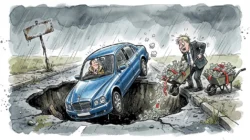
Now the grid was never designed that way. The grid was like a one-way road. That’s how it was built. And now what we’ve got is two-way traffic on a one-way road. Guess what that equates to? You know, the same sort of thing you’d expect if you’re driving a car. Sooner or later there’s going to be an impact somewhere. And there is. And the impacts come in the form decreased power quality.
It’s easy to understand what would happen if we used the same pipe to deliver clean drinking water and remove our dirty water. The system wouldn’t work particularly well, to put it politely.
Electricity networks were designed in much the same way — to flow in one direction. But several parts of the energy transition have turned that one-way system into a two-way street, creating the instability we now call dirty power.
And dirty power isn’t simply the result of your neighbour’s rooftop solar panels reverse-flushing electricity back into the grid.
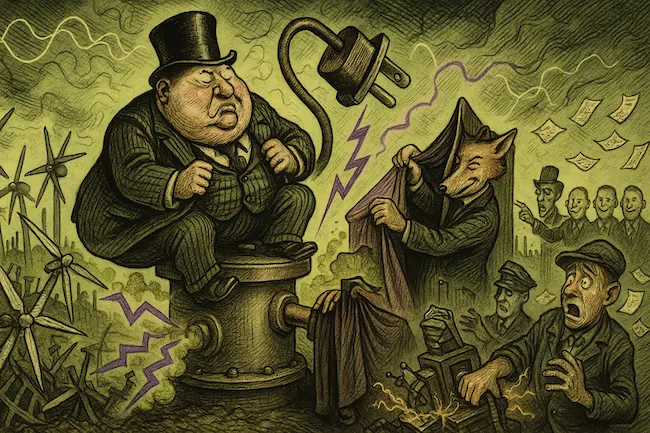
The Soho cholera outbreak occurred because contaminated water found its way into the drinking supply. In much the same way, renewables’ direct current (DC) power is becoming the cholera of modern electricity networks.
Collateral damage in the war of the currents
The exceptional video below explains some of the ways large-scale renewable energy generation can create dirty power on the grid. It also details the extraordinary — and extraordinarily expensive — lengths we must go to in order to fix it.
I urge you to watch it:
Connecting Solar to the Grid is Harder than You Think
The video makes several points worth summarising…
1. Solar panels generate direct current (DC) power. The long-distance power lines that move renewable electricity from wind projects around the country often use DC too.
This DC must be converted into AC on the grid for us to use it. But each conversion of DC to AC power is imperfect and the imperfection introduces dirty power.
2. Thermal power plants like gas and coal use turbines that spin to generate electricity. This means they have inertia. If you stop their energy supply (the gas or coal), the turbines continue to spin and generate electricity for a while.
Crucially, the drop-off in electricity produced is steady, slow, and predictable. Thisgives the power grid time to react and fix the problem before frequency and voltage get too low and cause dirty power damage.
But solar and wind don’t work this way. They do not have inertia. A cloud can knock out a large amount of solar output, almost instantly. The wind can suddenly stop blowing. And so renewables introduce a constant uncontrolled fluctuation in power around different parts of the grid that can happen very fast. This speed is what increases the chance of dirty power.
You might think these fluctuations should cancel each other out, because they are random. This is especially true if the grid is large and interconnected enough to capture the mean reversion of randomness. But the fluctuations happen in different parts of the grid. This instability between the different parts creates dirty power too.
3. It is not possible to use renewables to respond to fluctuations by asking them to produce a little more energy, because we don’t control their output. This combination of intermittency and lack of control means it’s only a matter of time before renewables’ fluctuations cause trouble.
4. As I failed to learn the hard way, a bagpiper must match the beat of the rest of the band to avoid polluting the overall sound. In the same way, renewables need to match the frequency of the AC power they are seeking to become part of. They do this by first sensing it and then conforming to it.
But if the grid becomes unstable, say due to renewables’ fluctuating output, you have a bad feedback loop. Renewables can reinforce the incorrect frequency by matching it instead of correcting it, leading to a spike in dirty power.
As the amount of renewables grows relative to electricity generated using turbines, the ability of the grid to enforce the correct frequency falls and the likelihood of renewables reinforcing the incorrect frequency rises.
This is, of course, only a brief introduction to the topic. What we really want to know as investors is this…
How big is the problem?
Fortunately, there is a simple way to tell whether dirty power is becoming a major issue. Power outages and frequency events are becoming more common in places that are rapidly transitioning to renewable energy.
In their 2020 academic paper, An Analysis of Frequency Events in Great Britain, two researchers from the University of Sheffield found that frequency events — which occur when grid frequency deviates too far above or below its prescribed level — have doubled in recent years.
More importantly, they specifically identified renewables as one of the causes:
With increasing penetration of wind and solar generation on electricity grids around the world, concerns are being raised about the effect this has on system stability. One measure of system stability is the volatility of the grid frequency. In this paper, an analysis is performed using one second resolution frequency data from Great Britain. We demonstrate that the number of frequency events has increased dramatically in the last couple of years, which coincides with the rapid increase in renewable penetration (wind and solar).
Scientific American sums up the data in the US:
Between 2013 and 2021, the average duration of a power outage in the U.S. grew from approximately 3.5 hours to more than seven hours, according to EIA data. The frequency of outages increased from 1.2 to 1.42 events per customer per year.
Also notable is the number of near misses, which still amount to the presence of dirty power. This website keeps a running commentary on them in Europe.
It turns out that the disruptions which cause dirty power are remarkably common. Interconnectors fail, lightning strikes knock out equipment, and clouds obscure solar farms. These events don’t just interrupt power supplies—they pollute them.
A renewables-based grid is especially vulnerable to such disruptions because it relies on the wider grid functioning properly. When that system falters, dirty power is one of the consequences.
At some point, the problem of Electric Cholera will trigger a sudden panic. As the problems grow worse, the public’s reaction will make it politically acceptable to point out the hidden problem of dirty power as the electorate turns on renewables.
First industrialists will expose the crisis they face. Germany’s car companies, America’s AI tech leaders, Australia’s them park operators and Italy’s precision manufacturing companies will reveal the dirty power pandemic undermining their business models. They will demand the government fixes it, or industries will shut down.
Governments will have three options.
- Deliver stable power using renewables at an even more impossible infrastructure expense than we have exposed in the past.
- Turn away from renewable energy to provide cheap and stable fossil fuel or nuclear power.
- Cover the vast cost of converting dirty power into clean at the users’ endpoint by subsidising the equipment needed to do so, such as batteries.
Probably it will be a mixture of the three.
In short, it may be time to start panicking.
Until next time,

Nick Hubble
Editor, The Fleet Street Letter
PS One thing I’ve learnt over the years is that politics has a habit of changing far more quickly than investors expect. Entire industries can go from politically impossible to politically inevitable almost overnight when national interests are at stake.
Jim Rickards believes we’re watching that happen right now in America. In fact, his “American Birthright” thesis is unfolding much faster than even he originally anticipated.
That’s why he recorded a video revealing the coordinates of what he believes could become one of America’s most lucrative resource projects — and the company positioned to benefit.