
 In today’s Issue:
- Central banks still don’t understand what caused inflation in 2022
- Misdiagnosis leads to mistreatment
- From the Great Moderation to the Great Blundering
Back in 2020 and 2021, I spent a lot of time warning readers that inflation was coming.
Not for the reasons everyone else gave.
Most analysts were obsessed with money printing, supply chains or government stimulus. Those mattered. But I thought they were missing something far more important.
Yesterday, for the first time, I read a piece of analysis that confirmed my suspicion.
Not only did it explain why inflation exploded in 2022. It explained why almost everyone misunderstood what was really happening.
You’ll remember the consequences.
Inflation surged into double digits in the UK. Central bankers responded by slamming on the brakes. Markets panicked.
What followed was one of the worst years in modern investing.
Stocks fell. Bonds fell too.
That’s not supposed to happen.
In 2022, a traditional 60/40 portfolio of US shares and bonds suffered its worst calendar year on record after adjusting for inflation—worse even than during the Great Depression.
The worrying part is this.
I’m not convinced economists or central bankers have learned the right lesson.
If you’ve misdiagnosed the disease, you’re unlikely to prescribe the right cure. And if that’s true, policymakers risk making exactly the same mistake again.
For investors, that’s more than an academic debate.
If you understand what really drove inflation—and what policymakers still haven’t grasped—you’ll have a much better idea where the next opportunities, and the next risks, are likely to appear.
Ridiculous in foresight
Lance Roberts explained on RealInvestmentAdvice.com what I was busy telling people five years ago:
“The other piece almost nobody talks about it velocity. MV = PQ has four variables, not three. And V, the rate at which money circulates through the economy, is wildly unstable. Ignore it, and you get inflation forecasts that look ridiculous in hindsight.”
Most analysts worry about the M in that equation – the amount of money. But our forecast in 2021 was based on a spike in V – the velocity of money.
Roberts continues with this description of what happened next:
“[…] velocity, instead of falling, recovered. You had money growing fast, money circulating again, and productive capacity disrupted, all at once. Inflation hit 9.1% by June 2022.”
The point is that it was the velocity of money spiking which gave us the inflation of 2022. It is like the wind that makes a forest fire dangerous by making the flames move fast and fuelling the oxygen.
Britain’s Investment Letter Since 1938
In 1938, The Fleet Street Letter warned its readers that war was coming to Europe — and even identified September as the critical month.
Since then, its readers have been warned ahead of Black Monday, the dotcom crash and the 2008 financial crisis.
Today, Britain’s longest-running investment advisory is still looking for the “news behind the news” — and the investment opportunities others could be missing.
Click here to discover what The Fleet Street Letter sees coming next.
Capital at risk.
What Does Britain’s Oldest Investment Letter See Coming Next?
It warned readers ahead of Black Monday.
The dotcom crash.
And the 2008 financial crisis.
Now, nearly 90 years after it was founded, The Fleet Street Letter is still searching for the “news behind the news” — and the investment opportunities that could emerge from the next major turning point.
Click here to discover what its editors are seeing now.
Capital at risk.
What is the velocity of money?
It’s a difficult concept to grasp in theory, but surprisingly simple in practice.
If money changes hands twice as quickly, it’s almost as if you’ve doubled the amount of money in the economy.
The effect on prices is much the same.
That’s why the velocity of money matters just as much as the amount of it.
During the lockdowns, people couldn’t go out and spend. The velocity of money collapsed. At the same time, central banks created enormous amounts of new money.
The two largely offset each other.
That’s why inflation stayed relatively subdued during the lockdowns despite the extraordinary expansion in the money supply.
Then the lockdowns ended.
People started spending again. The velocity of money snapped back towards normal. But central banks didn’t shrink the money supply quickly enough to compensate.
That’s when inflation took off.
The lesson is straightforward.
The money supply matters.
So does the speed at which money moves through the economy.
It’s just that the second factor is usually stable enough for economists to ignore—until something extraordinary, like a global lockdown, changes it overnight.
Which brings me to today.
Are we in lockdown now?
Do you expect the velocity of money to surge the way it did in 2021?
Or can you think of another reason it might suddenly accelerate?
Because without that sort of shift, a return to double-digit inflation becomes much harder to achieve.
It would require central banks to create vast amounts of new money.
That doesn’t mean prices can’t continue rising…
Inflation isn’t the only thing that moves prices
An energy crisis, for example, can send prices soaring.
Businesses face higher costs. They pass those costs on to consumers.
But that’s not the same thing as inflation.
Inflation is the devaluation of money.
Higher prices caused by shortages, supply disruptions or surging demand are something different altogether. The fact that our official inflation statistics bundle these things together doesn’t make them the same phenomenon.
Back in 2022, central bankers insisted the inflation spike was “transitory”. They blamed supply-chain disruptions and the energy crisis, assuming prices would settle once those problems faded.
They were wrong.
Not because supply chains and energy didn’t matter.
But because they completely missed what was happening to the velocity of money.
Even now, looking back with the benefit of hindsight, they still haven’t recognised the real driver.
Which brings us to today.
This time they’re making the opposite mistake.
They see another burst of price pressures and assume it’s the start of a sustained inflation problem. So they’re threatening tighter policy in response.
But if today’s price increases are largely the result of temporary supply shocks rather than a lasting monetary problem, higher interest rates won’t solve very much.
Quite the opposite.
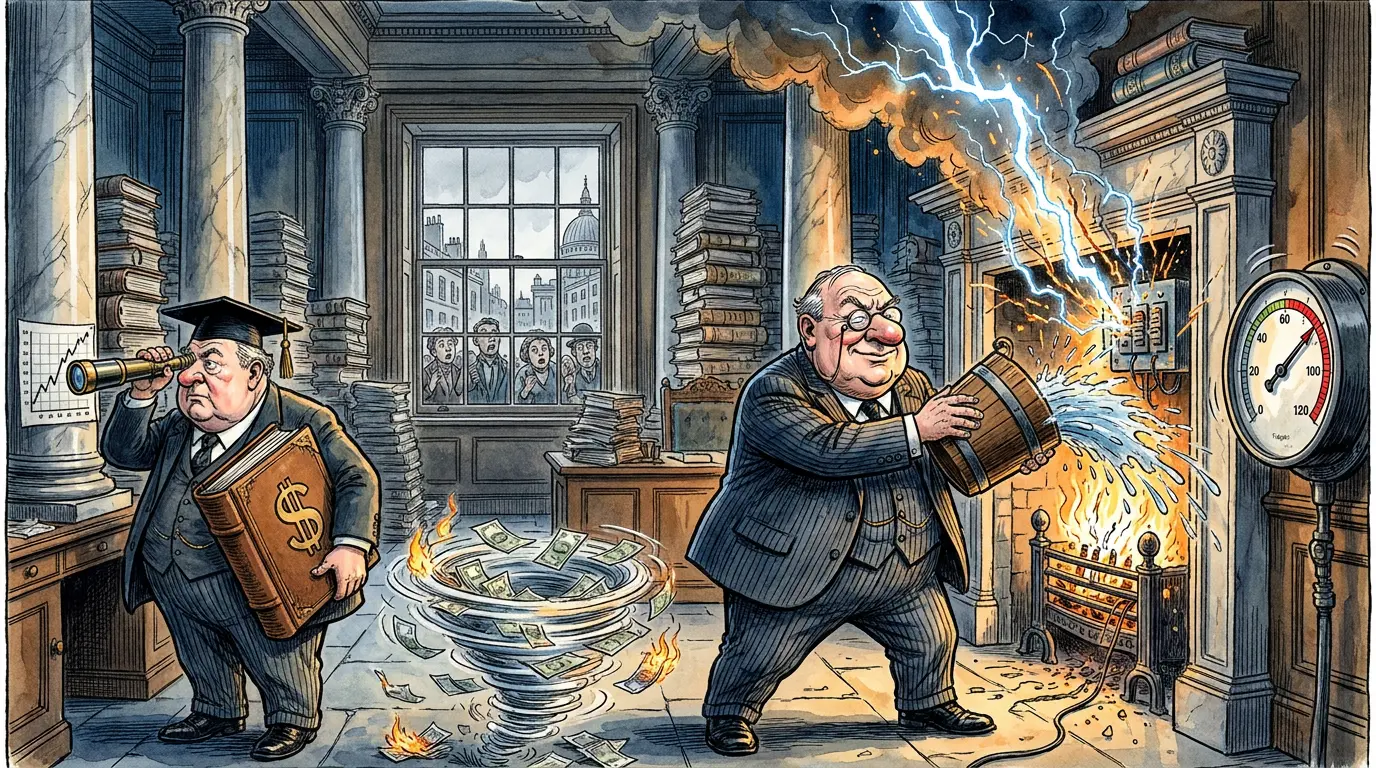
It’s a bit like trying to put out an electrical fire with a bucket of water.
You’re using the wrong tool for the wrong problem—and making the damage even worse.
But it will also create extraordinary buying opportunities, like these.
Inflation is not under control – it never is
After the 2008 financial crisis, central banks desperately tried to create inflation.
And discovered they couldn’t.
They slashed interest rates to zero. They printed money through quantitative easing. Yet consumer prices stubbornly refused to rise anywhere near their 2% targets.
The inflation doomsters of the QE era turned out to be wrong.
Not because money printing doesn’t matter.
Because they ignored the velocity of money.
After 2008, households and businesses weren’t eager to borrow and spend. They were paying down debt, rebuilding savings and behaving more cautiously. As a result, the velocity of money kept falling, offsetting much of the increase in the money supply.
Japan spent decades proving the same point.
The Bank of Japan cut interest rates to zero, launched repeated rounds of QE and even bought shares in the stock market. Yet inflation remained elusive because the Japanese public became ever more frugal, keeping the velocity of money on a downward trend.
That’s the crucial point.
The variable that matters most isn’t fully under the control of central bankers.
They can create money.
They can’t force people to spend it.
And unless something causes the velocity of money to surge again—as the lockdowns and reopening did in 2020 and 2021—it’s difficult to see where another sustained inflation shock comes from.
The Great Blundering
Between the mid-80s and 2007, financial markets and economies experienced 20 years of comparative stability. Inflation wasn’t a worry. Asset prices soared. GDP grew. Recessions were shallow. Unemployment was low. Real yields on bonds were high. The tech wreck and Asian Financial Crisis were the only major crises.
That period is known as the Great Moderation. The central banker who guided us through it, Alan Greenspan, recently passed away.
But since 2008, we’ve had 20 years of constant crises. The sub-prime meltdown, the European Sovereign Debt Crisis, the COVID crash, the inflation of 2022 and plenty more.
What will this era be called in hindsight?
Let me know: investorsdaily@southbankresearch.com.
Or, if you’re like me, and prefer to ponder the future, you may want to know what the next era looks like.
That’s our topic for next week’s live streaming event.
Our Investment Director Sam Volkering and I will discuss the turning points we face, how they will “change the rules of investing,” and how to invest £10,000 now.
Until next time,

Nick Hubble
Editor, The Fleet Street Letter