 In today’s Issue:
- Are you a bubbled gudgeon?
- 306 years of stock market satire later, nothing has changed
- The real bubble is masked, as it was in 1720
It isn’t often you discover an 18th-century song about you. Let alone one so accurate.
But around 1720, Thomas D’Urfey changed the words to the popular song Over the Hills and Far Away and called it Hubble Bubbles.
It doesn’t just bear my name. Believe it or not, it is about what I do all day too: tell people about stock market bubbles.
Can this be a coincidence?
Yes, it can.
But today, I’d like to walk you through D’Urfey’s rather cheeky analysis of the stock market.
See if you can spot any similarities to today’s financial markets. They might help you decide whether we’re in a stock market bubble now too.
Of course, there are lots of historical references to explain. But they’re well worth your time to appreciate just how clever the analysis was… and still is.
Britain’s Investment Letter Since 1938
In 1938, The Fleet Street Letter warned its readers that war was coming to Europe — and even identified September as the critical month.
Since then, its readers have been warned ahead of Black Monday, the dotcom crash and the 2008 financial crisis.
Today, Britain’s longest-running investment advisory is still looking for the “news behind the news” — and the investment opportunities others could be missing.
Click here to discover what The Fleet Street Letter sees coming next.
Capital at risk.
What Does Britain’s Oldest Investment Letter See Coming Next?
It warned readers ahead of Black Monday.
The dotcom crash.
And the 2008 financial crisis.
Now, nearly 90 years after it was founded, The Fleet Street Letter is still searching for the “news behind the news” — and the investment opportunities that could emerge from the next major turning point.
Click here to discover what its editors are seeing now.
Capital at risk.
306 years of stock market bubbles
Back in 1720, the South Sea Company stock market bubble was in full swing. The informal brokers known as stock-jobbers had been chucked out of the stock market for their bad behaviour.
So they had turned the nearby coffeehouses into unofficial markets. Two of the most notorious were Jonathan’s and Garraway’s, known for their truly horrific sludge.
That’s all you need to know to appreciate the opening verse of Hubble Bubbles by Thomas D’Urfey, written in 1720. Remember, it’s sung to the tune of Over the Hills and Far Away…
Ye circum and uncircumcis’d,
Come hear my song and be advis’d,
Sell all your lands, sell all your flocks,
And put your money in the stocks,
Hubble bubble, bubble hubble now’s in play,
Come buy our hubble bubbles whilst you may,
For there’s hubble bubble, bubble hubble night and day,
At Jonathan’s and Garraway.
The word “bubble,” back then, didn’t refer to stock market bubbles as it does today. A bubble was a rip-off, scam, or fraud in a broader sense. And the victims were said to have been “bubbled” out of their money. Terminology we should bring back today.
The second verse is about just how international the South Sea Bubble had become by 1720.
Ye Scotchmen who love Laws so well,
Ye Irish who have bulls to sell,
Ye Hollanders come here and buy,
For there’s guelt got by this alley,
Hubble bubble, bubble hubble low and high,
Come all away to Change Alley,
Come ye hubble bubbles o’er the hills & far away,
To Jonathans and Garraway.
I suspect the first line is a reference to Scotsman John Law. He was the financial engineer behind the South Sea Bubble’s French equivalent: the Mississippi Bubble.
“Irish who have bulls to sell” is a reference to humorous, self-contradictory statements known as Irish bull.
Politicians and tech magnates are full of Irish bull these days too. “Boiling oceans” and “renewable energy” are good examples. Such statements excite equal amounts of fervour amongst believers and ridicule amongst sceptics.
“Guelt” is money, meaning gold, not paper money. And “Change Alley” is Exchange Alley, in reference to the stock exchange.
The next verse is self-explanatory.
Now purchase in if you be wise,
For stocks will either fall or rise,
And how can stocks be at a stay,
Since time and riches fly away,
Hubble bubbles, bubble hubble come away,
Let every hubble bubble have his day,
For there’s spick & span new hubble bubbles for your pay,
At Jonathan’s and Garraway.
The next few verses are about some of the companies listed on the stock market at the time. Truly hare-brained schemes.
The first is about a fishing company. “Main” is a reference to the Spanish Main, meaning Spain’s territories in the Americas at the time.
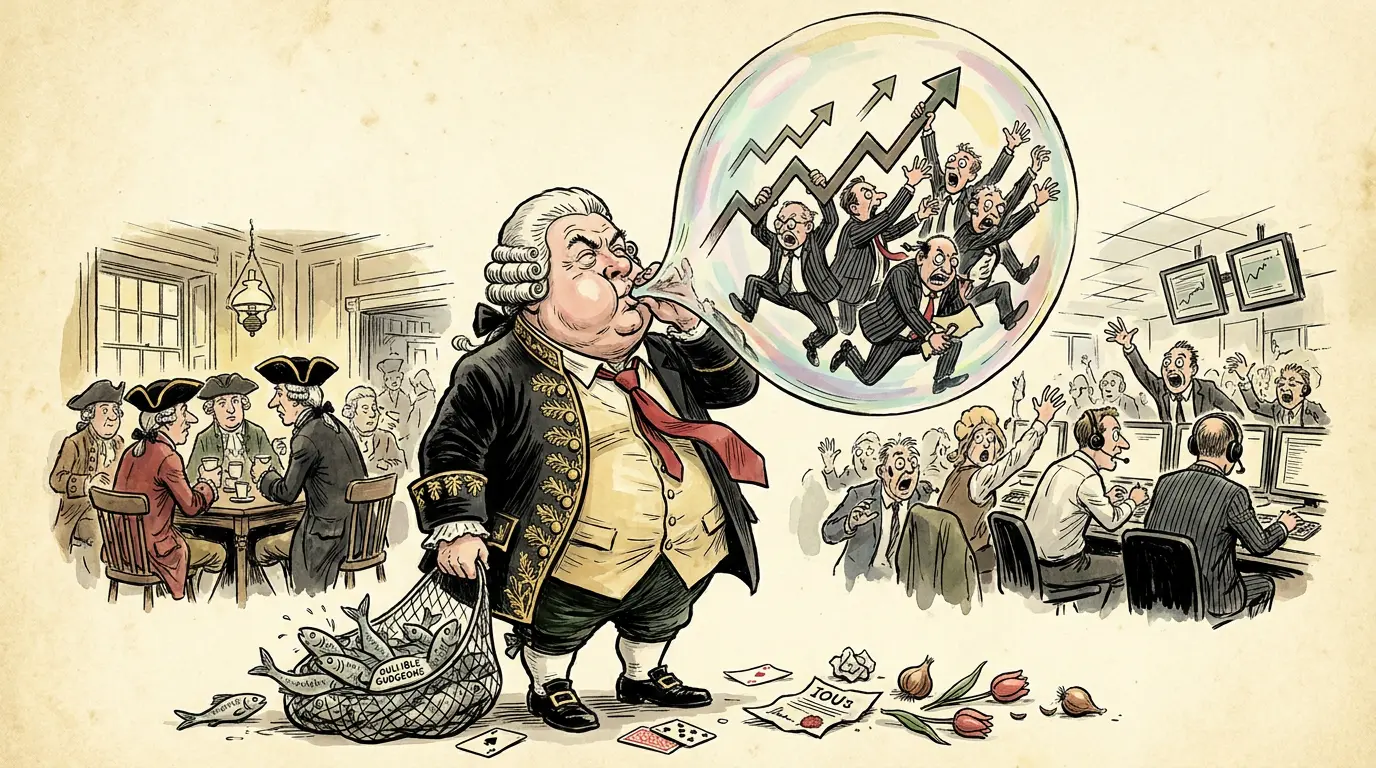
Projectors were those selling the stocks to fund their projects or ventures. And a gudgeon is both a small fish and a gullible person.
Come all who would by fishing gain,
Venture like gamesters on the main,
What e’er you loose projectors get,
For you’re the gudgeons in the net,
Hubble bubbles, bubble hubble come away,
Let every hubble bubble have his day,
For there’s spick & span new hubble bubbles for your pay,
At Jonathan’s and Garraway.
D’Urfey most likely had ventures like the Company of the Royal Fishery of England in mind with this verse. Sadly, the work of satirists dominates the historical record here, so it’s hard to tell fact from fun.
The importance of this verse is that it gets at the heart of the conflict of interest in stock markets. Company’ management can deploy their shareholders’ cash as it sees fit.
In the mining industry, the joke is that shareholders pay for the company’s workers to go hiking and fishing in the mountains. But the point is that shareholders’ losses are someone else’s gain. And the stock market is an efficient way to legalise scams.
The next verse is about marine insurance, which boomed at the time. And it’s still a major part of the City of London economy.
Come all who would large gain secure,
Our ships upon the sea insure,
And those the surest gain must find,
Who trust the faithless sea and wind,
Hubble bubbles, bubble hubble come away,
Let every hubble bubble have his day,
For there’s spick & span new hubble bubbles for your pay,
At Jonathan’s and Garraway.
Insurance companies are supposed to be steady and boring, with the occasional hiccup along the way. If insurance stocks go parabolic, it’s a good sign of a stock market bubble because the rise is likely being driven by the overvaluation of those shares.
Of course, mining stocks are the ageless classic when it comes to stock projectors pumping up their portfolios. The next verse is designed to poke fun at how our betters were caught up in the South Sea Bubble too.
Ye privy councellors draw nigh,
Come ease yourselves of your money,
Here cent for cent is money told,
For all gold finders must find gold,
Hubble bubbles, bubble hubble come away,
Let every hubble bubble have his day,
For there’s spick & span new hubble bubbles for your pay,
At Jonathan’s and Garraway.
Other forms of insurance also caught on in 1720…to the point of absurdity.
Come all ye nymphs of gay desire,
Insure your house, and selves from fire,
A house insur’d brings better rent,
Come then insure your tenement,
Hubble bubbles, bubble hubble come away,
Let every hubble bubble have his day,
For there’s spick & span new hubble bubbles for your pay,
At Jonathan’s and Garraway.
The next verse is about one of the more bizarre phases of the South Sea Bubble. The wealthy began bringing Italian opera artists to London to perform and financed their operatic ventures, yes, on the stock market!
Italian Songsters come away,
Our gentry will the piper pay,
Come hasten here for before ’tis long,
Opera stock will be sold for a song,
Hubble bubbles, bubble hubble come away,
Let every hubble bubble have his day,
For there’s spick & span new hubble bubbles for your pay,
At Jonathan’s and Garraway.
The final verse could be reprinted today. Keep in mind that a bubble is also someone who got bubbled out of their money.
A bubble is blown up with air,
In which fine prospects do appear,
The bubble breaks the prospect’s lost,
Yet must some bubble pay the cost,
Hubble bubble, bubble hubble all is smoak,
Bubble hubble, hubble bubble all is broke,
Farewell your woods, your houses, lands,
Your pastures and your flocks,
For now you have nought but yourselves in the stocks.
That last mention of the stocks is a pun on the punishment device which restrains your head and arms in public.
It’s all good fun. Until you think about what’s happening in Korea today.
Korean stocks inflated into a bubble that now seems to pop on an almost daily basis. Sadly, vast swathes of the Korean population borrowed to invest in the boom. Since the bust, many have faced margin calls, meaning they owe dangerous amounts of money relative to the value of their devalued shareholdings and have to pay up.
The losses aren’t just financially dangerous. They ruin lives. That is the legacy of financial bubbles.
Only one mystery remains in all this. Why did Thomas D’Urfey use the word “Hubble”?
Some say it’s a reference to an uproar and confusion known as a “hubbub.”
But you and I know it was a savvy reference to my writing to come, 300 years later…
Can you see any bubbles today?
I’m sorry I’m not half as eloquent as Thomas D’Urfey. He had many fellow bubble sceptics too. Some were equally brilliant. It seems there was an entire industry in stock market bubble satire. Songs, artwork, prints, poetry, and more.
There isn’t much of that today. Curmudgeonly bubble sceptics stick to banging away at their keyboards, occasionally going on TV to be hounded by a panel of believers.
Sadly, the genius of the projectors matches that of their counterparts from 1720 quite well.
They promise profits from a venture, but focus more on the financial engineering than the business itself.
Soon, the speculation takes a momentum of its own. Few shareholders could tell you what the underlying business they own actually does.
Eventually, those who launched the enterprise walk away with money somehow. The slowest to sell are left holding the bag.
But I’d like to leave you with one last thought. An important one that is almost always missed.
Both the South Sea Bubble and the Mississippi Bubble were actually attempts to consolidate the government’s national debt. The speculative frenzy was part of this scheme, knowingly aided and abetted by the governments of the time.
Today, our governments are back in debt. Wild stock market frenzies are back. And financial engineering puts government bonds at the heart of the financial system, creating artificial demand for them.
If all you see is a stock market mania, you are being bubbled by the government.
What’s an investor to do in Huva world of bubbles?
There are several options.
You could join the latest frenzy in the hope that you buy and sell early enough.
You could invest outside the industries caught up in the latest bubble.
Or you could stick to sound, fundamental analysis of good companies that are steady performers.
Or you could do all three.
Until next time,

Nick Hubble
Editor, The Fleet Street Letter