 Charles Dow (as in Dow Jones & Company) is at his desk in New York with a pencil and the closing prices of 12 industrial companies.
He adds them up, divides by 12, and gets 40.94.
If you held American Sugar or US Leather, one number told you how the whole group of companies was doing.
That was May 1896. It was the birth of what we know today as a stock market index.
Most of those 12 companies were later merged into other businesses, but the habit of adding up a group of them and figuring out the broader movement never disappeared.
The S&P 500 index eventually followed in 1957. And as recently as 2024, more than $20 trillion was tracked by or benchmarked against it.
It’s the gold standard of index benchmarks.
It’s one of those things you don’t ever expect to change. And the S&P 500 isn’t changing. But what you can index certainly is…
Britain’s Investment Letter Since 1938
In 1938, The Fleet Street Letter warned its readers that war was coming to Europe — and even identified September as the critical month.
Since then, its readers have been warned ahead of Black Monday, the dotcom crash and the 2008 financial crisis.
Today, Britain’s longest-running investment advisory is still looking for the “news behind the news” — and the investment opportunities others could be missing.
Click here to discover what The Fleet Street Letter sees coming next.
Capital at risk.
What Does Britain’s Oldest Investment Letter See Coming Next?
It warned readers ahead of Black Monday.
The dotcom crash.
And the 2008 financial crisis.
Now, nearly 90 years after it was founded, The Fleet Street Letter is still searching for the “news behind the news” — and the investment opportunities that could emerge from the next major turning point.
Click here to discover what its editors are seeing now.
Capital at risk.
An index for everything
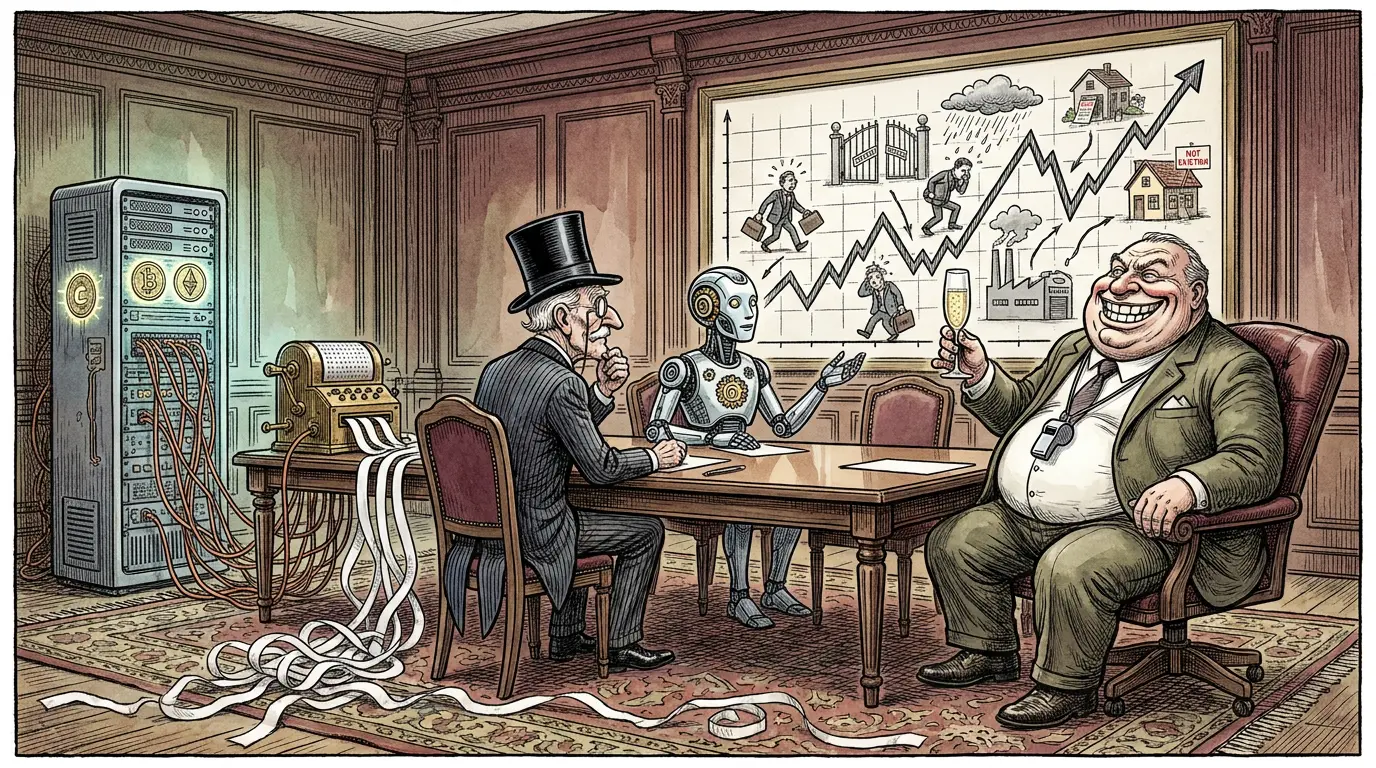
On Monday, S&P Global (which operates the S&P indices) signed a multi-year deal with Kalshi, the biggest US prediction market.
Yes, that Kalshi, where insider trading has been rampant.
That Kalshi, which you can’t even use in many countries around the world.
The deal centres on the fact that Kalshi lets you buy yes or no contracts on real outcomes, like who wins the House or whether the Fed holds rates.
The price reflects the crowd’s odds.
And it’s all built on crypto networks.
This deal will enable S&P to build indices from Kalshi’s prices.
Now what exactly would one of those indices track?
Kalshi’s list of markets covers everything from political power and supply chain risk to AI’s effect on jobs and the weather behind harvests.
Kalshi isn’t new to this either. It already has the Kalshi American Power Index, which mixes who holds Congress and the White House with what traders expect after the next vote.
Kalshi calls it the S&P 500 for politics.
|
The S&P form
S&P has some form when it comes to working with crypto-native organisations. So while this is a reasonably wild move, it’s not completely out of the blue for S&P.
It has already put the S&P 500 on-chain with Centrifuge, and a couple of weeks ago, it ran the first over-the-counter swap settled fully on-chain against a tokenised index.
Whether it’s a tokenised Treasury or a bet on the midterms, every new market needs a referee to publish the official number. S&P is kind of setting itself up as the one and only referee for them all.
While you can’t use Kalshi, and you can’t really influence what indices get built in the UK, you can buy the stock.
SPGI was trading at $453.84 on Wednesday, about 13% below its 52-week high of US$522.47.
Of course, it’s a stock, not a crypto, but it’s increasingly finding itself converging with the digital assets world.
And it’s also indicative of the direction of a lot of legacy TradFi (traditional finance) companies like this. The innovation in crypto is so fast and so disruptive that incumbents in TradFi can’t ignore it anymore.
Breaking things and building them back better has always kind of been the mantra in crypto.
And while Kalshi and its competitor in Polymarket, certainly have their issues, when you get the likes of S&P Global doing deals to run all kinds of new indices off the back of their prediction markets, well, you can see the direction that TradFi is heading.
Everything, and I really mean everything, will end up on-chain.
Until next time,
Sam Volkering
Investment Director, Southbank Investment Research
PS Speaking of the future of investing, I’ve got something rather special coming up next Tuesday, 3 November, at 4pm. I’ve persuaded a notoriously private former MIT AI scientist to sit down with me and reveal an investing system unlike anything I’ve come across before. He’s barely spoken publicly in over a decade, and he’ll be sharing his highest-conviction stock pick with us, too. It’s completely free to attend, and I think you’ll want to see this one for yourself. Reserve your free place here. (Note that by clicking the link you agree to automatically be signed up to The MIT Code and receive marketing information by email about Resonance AI. You can stop emails at any time using the link provided at the foot of each email.)