In today’s Issue:
- The Golden Rule we live by has been replaced
- A bear and a dragon in the hen house
- Jafar was right
There are three versions of “the Golden Rule.” Actually, there are at least four. But, fortunately, Humfrey Baker’s 1568 discovery that “if a/b = c/x then x = (b × c)/a” is not relevant to this edition of Investor’s Daily…
Today’s most commonly known version of the Golden Rule is, “Do unto others as you would have them do unto you.” Worry not. I’m not going to dig into the origins of that one either!
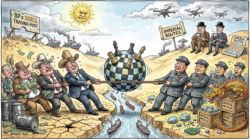
Suffice to say, the West’s attempt to apply this version of the Golden Rule to Russia and China has failed miserably over the past few decades. But nothing is so bad that it cannot be made worse.
Now we’re in even more trouble because Trump tried to apply a debased version of the Golden Rule: “do unto others before they can do unto you.”
The result may feel like chaos. But if you can spot the trend, you can see where all this is going. So, let’s take one step back to see where we came from.
A bear and a dragon in the hen house
The West invited its former enemies into institutions like the United Nations, G8, and the World Trade Organisation.
It offered “free” trade, cross-border investment, migration, open movement of capital, ownership of economic resources, access to our intellectual property, funding for gain of functional research, a blind eye to human-rights abuses, Hong Kong, and Chelsea football club. All in return for access to cheap Chinese labour, Russian energy, and peace in Taiwan and Eastern Europe.
The idea was to treat Russia and China as we wanted them to treat us – as economic partners in a free and open capitalist world. Then they’d reciprocate, right?
Western companies would capture their much vaunted “1% of the Chinese consumer market.” Western people would get rich from rising share prices. And our consumers would get cheap Russian gas.
But Russia and China had other ideas.
They exploited the freedoms and free markets of capitalism in various ways. Trade deficits and industrial policy hollowed out Western industry.
Russian oligarchs were able to launder their wealth clean through Western property markets. Chinese generals built up vast fortunes in shifty ways. China’s industry bought Russian and Venezuelan oil at a discount.
Western cultural and strategic assets were bought up. And a generation of our children are stuck trying to learn Mandarin at school.
Meanwhile, Hong Kong residents are fleeing to the UK, Eastern Europe is mired in war, Taiwan could be next, and Iran is being supplied with weapons.
But Russia and China’s most important (and relevant) play was to make us dependent on them for strategic resources and manufacturing.
You’ve probably heard about China’s domination of rare-earth metals, and the importance of Russian gas for Europe. But those are just examples in a long list.
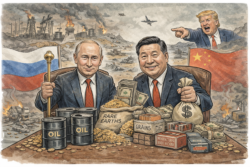
Russia and China are now in a real position of strength. They control sufficient chunks of global energy, food, manufacturing, and other supplies of the global economy to wreak geopolitical havoc with impressive amounts of immunity. The West cannot strike back without shooting itself in the remaining foot.
It’s also a reminder that not everyone has the same desires, values, priorities, and preferences. That makes the maxim “do unto others as you would have them do unto you” a little risky. If you have very different goals, you might get done altogether.
While Russia and China appeared to be participating in the liberal and capitalist world, and following our golden rule of “do unto others,” they were actually busy applying a very different Golden Rule… which we’ll get to in a moment.
But first, the factor nobody saw coming.
Trump.
Trump debases the Golden Rule
As we’ve already seen, Russia and China have made their intentions clear – through the invasion of Ukraine and their control over rare-earth metals. As we’ve already outlined, Trump’s response has been pre-emptive. His version of the Golden Rule: “Do unto others before they can do unto you.”
Trump’s tariffs were only part of this strategy. His attacks on Iran and Venezuela were directed at disrupting China’s cheap energy supply. He wants to be able to turn off the taps on China’s most important economic input. Just like the US did to Japan in 1941. We all know what happened next.
Trump believes he can reshape geopolitics by changing who is in charge and what their incentives are.
But there is another version of the Golden Rule…
One which Trump, Russia, and China are all following, while the UK and Europe lag behind.
This version of the Golden Rule was put forth by philosopher, alchemist, and wazir of Agrabah, Jafar, in Disney’s Aladdin: “You’ve heard of the golden rule, haven’t you? Whoever has the gold makes the rules.”
Well, Jafar was right
The Western world has discovered that our version of the Golden Rule hasn’t worked, and Jafar’s version of the Golden Rule was right all along.
Russia’s gas, China’s manufacturing capacity, Ukraine’s grains, and Belarus’ fertiliser are only some of the pressures building across global supply chains.
Canada’s lumber, Peru’s copper, even toilet paper during the pandemic, China’s rare-earth minerals, Qatari gas, Iranian oil, Indonesia’s cooking oil, Korean diesel, and countless other examples proved the point.
Possession may be nine-tenths of the law. But the ability to produce something gets you closer to nine-tenths of control.
That’s why the most important factor in geopolitics today is who produces what.
And the most important question in investing is how that’s about to change now that trade is a weapon.
One man made his career in business preparing for this moment. And now he’s helping investors profit from the way governments will respond. Find out what he’s predicting here.
Until next time,

Nick Hubble
Editor at Large, Investor’s Daily
PS If this shift is really about who controls resources… then the next move isn’t about Iran at all.
It’s about what comes next and who ends up holding the advantage.
There’s already a plan forming inside Washington that could reshape that balance and potentially drive huge returns for investors who position early.