Publisher’s Note:
If you’ve followed Bill’s writing for any length of time, you’ll know he has a habit of connecting dots most people don’t even notice yet.
Sometimes those dots look like small things.
A comment in the news.
A shift in policy.
A conflict appearing somewhere far from home.
But as Bill often reminds us, history rarely moves in straight lines.
It moves in patterns.
And the pattern he’s watching now is one we’ve seen before. Periods of relative calm giving way to something far more chaotic… financially, politically, and geopolitically.
That doesn’t mean panic is the right response. Quite the opposite.
The goal is preparation.
Bill’s job, as he sees it, is not to predict every headline. It’s to step back from the noise and identify the larger forces that could shape markets, currencies, and wealth in the years ahead.
Sometimes that view can feel uncomfortable. But understanding the risks is the first step toward protecting yourself from them.
 “How ye been keepin?” a neighbor greeted us.
“Not too bad. And you?”
“Not bad at all…it’s been raining almost every day since November. In the Bible it says it rained for 40 days and 40 nights. We beat that record handily.”
“I noticed that Mick had not added a single stone to that wall he was working on in October.”
“Nooo…but after so much rain…the flowers will be magnificent.”
That is how it works. It takes a rainy day to produce a beautiful one.
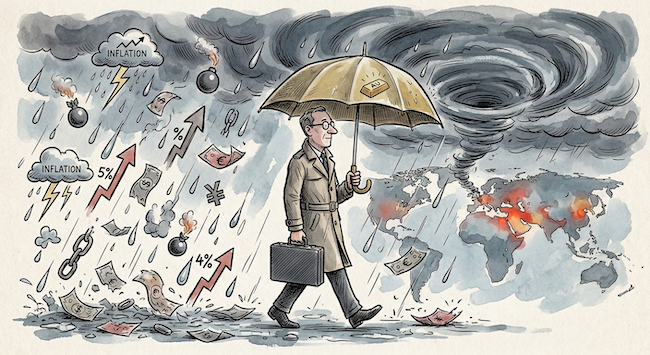
And the gist of our dot-connecting today: you may need an umbrella.
Poor Iran. It needs more than an umbrella. Bombs from America falling on its leaders. Missiles from Israel coming down on its people. And now, the earth beneath its feet seems to have turned against it. MorningOverview:
Powerful earthquake rocks Iran as US and Israeli strikes keep falling
God must not like them.
And then, we were just settling down to watch the war in Iran when…boom…another one shows up. The New York Times:
U.S. Opens Military Action in Ecuador Against ‘Terrorist Organizations’
U.S. Special Forces soldiers are advising and supporting Ecuadorian commandos on raids across the country against suspected drug shipment facilities and other drug-related sites.
We’ll have to take them one at a time.
Both wars, however, are the products of one man’s ambitions. Many readers think we spend too much time criticizing POTUS. But he is the man of the hour…the day…the year…and perhaps, the 21st century. Failing to understand Trump is a little like writing about the Decline and Fall of Rome without mentioning Caesar. Or surveying the 17th century and ignoring Cromwell…or the 19th without Napoleon…or the 20th without that fellow with the mustache.
All of them were the Big Men of their time. And whatever they thought they were doing…they played important historical roles that shaped the future. Commentators might have saluted Caesar after he crossed the Rubicon and expected him to reign over Rome for many years ahead. in 1812, they might have applauded Bonaparte’s victories at Marengo and Austerlitz…and predicted ever greater victories to come in Russia. They could have remarked at how the Nazis ‘made the trains run on time’….and looked forward to their getting the rest of Europe running correctly.
And now, Donald Trump thinks he is making deals that will add to America’s (and his own) glory. Alas, the history books may describe a very different outcome. Our job is to try to figure out what it is.
What readers might take as criticism of Trump is really our own unrepentant catastrophism on display. Our guess — based on the dots we’ve connected so far — is that the future is going to be marked by inflation, chaos, bankruptcy, war…and higher nominal interest rates. Life may be poorer and more brutal. It’s not Donald Trump’s fault. He’s just helping us get there.
Take the war on Iran, for example. Pete Hegseth said on Monday that the Pentagon didn’t need no stinkin’ “stupid rules of engagement…unlike so many of our traditional allies who wring their hands and clutch their pearls, hemming and hawing about the use of force.”
The rules of engagement are the ones that tell you you’re not supposed to murder prisoners, attack civilians, or initiate force, among other things. They are not foolproof…as Hegseth demonstrates. But largely in response to the disaster brought on by the man with the mustache, ‘rules’ were meant to nudge the world a little further in the ‘civilized’ direction. You stick with the rules, trusting your adversary to do the same.
It rained down hard in WWII. Even then, the Nazis generally respected the ‘rules of engagement’ on the Western Front. Atrocities were the exception, not the rule. As far as we know, they made no serious attempt to murder Churchill or Roosevelt. On the Eastern Front, meanwhile, murdering prisoners and civilians was much more common; both sides gave as good as they got.
Killing the Ayatollah, contrary to the rules of engagement, may have been a good way to make a deal. Or may not. But since our goal is to protect ourselves against the Big Loss, it set off alarms. Ina Hassan:
‘The assassination of Ayatollah Khamenei is the single greatest strategic blunder in modern history. By killing him, the US and Israel didn’t just eliminate a leader, they fulfilled a 1,460-year-old prophecy and created a martyr whose shadow will haunt the West for decades.’
Whether that is true, or not…we have no way of knowing. But since Iran posed very little threat to Americans prior to the war, we can only assume that it poses a greater one now.
Looking on the bright side, after six long years, WWII came to an end. Then, the flowers came out…soldiers put down their guns and took up their hammers and briefcases…the ‘rules of engagement’ were elaborated…and most people in the West enjoyed a period of (relative) peace and prosperity that lasted for the next 81 years.
And now…another sunny season may be on the way…but, in the meantime, it may be wise to keep an umbrella handy.
Regards,
Bill Bonner
Contributing Editor, Investor’s Daily
P.S. If the world really is entering the kind of turbulent period we described above, history tells us one asset tends to benefit more than most: gold.
But Richard Branson isn’t buying bullion or mining stocks. Instead, he’s backing a strange gold-related investment that’s quietly outperforming the entire sector.