
 In today’s Issue:
- Can anyone other than day traders make money from space?
- Why governments need a commercial space race now
- What if the Wuhan Institute of Virology had been in orbit?
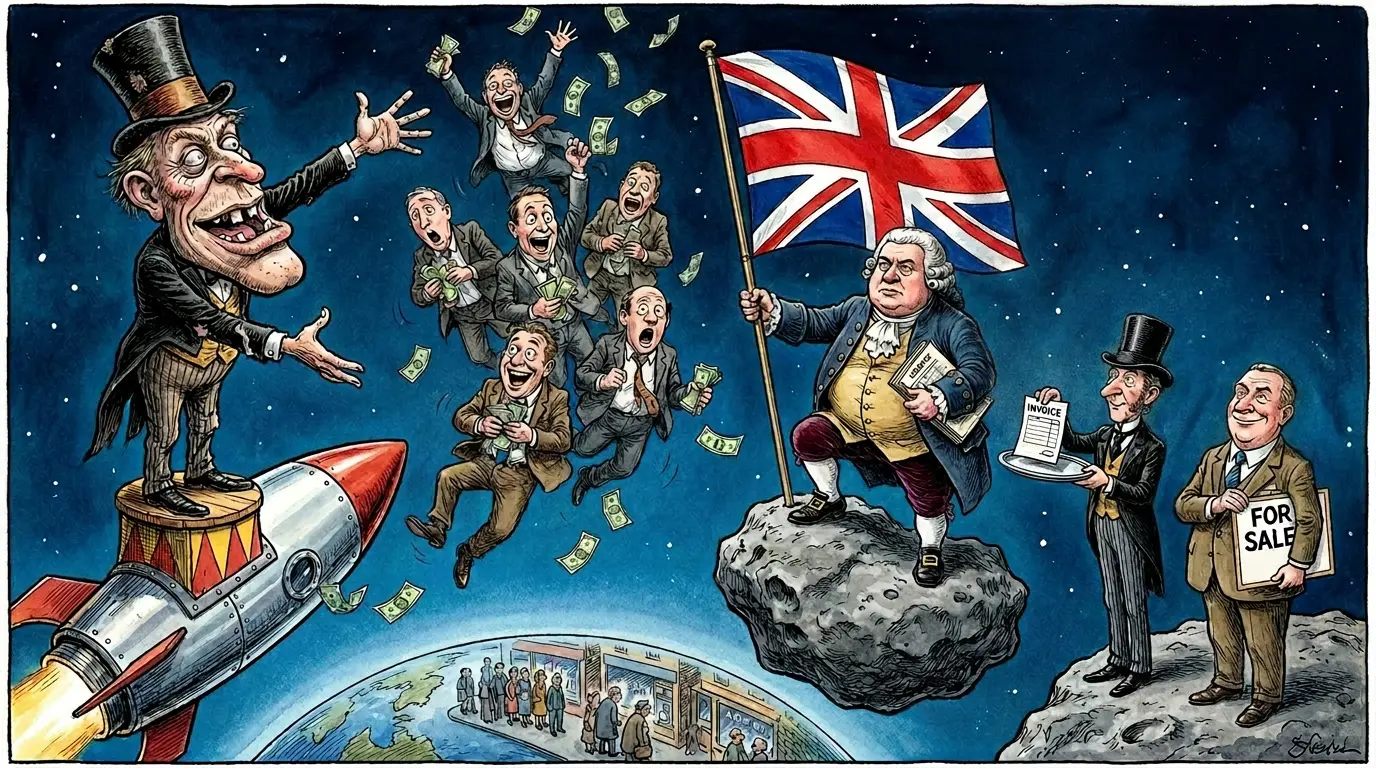
Elon Musk’s SpaceX IPO is getting all the attention. It’s a classic speculative frenzy. But has anyone thought through how the space economy will actually work in practice?
What will consumers be buying from space?
How will space goods come back down to earth?
What value is there in doing things in space?
How will governments regulate an international endeavour?
How will it all be monetised for investors?
All these unanswered questions are pushed into the background by the listing-day performance of a single stock.
As legendary value investor Benjamin Graham explained, “In the short run, the market is a voting machine, but in the long run, it is a weighing machine.”
So, while the financial media covers the daily stock market action, let’s try and tackle the weightier questions…
Space mining won’t be coming home
There are vast untapped resources in space. The metals on the asteroid 16 Psyche alone are valued in the thousands of quadrillions of dollars.
Like Western companies dreaming of cracking even 1% of the Chinese consumer market in the 1990s, space miners are fantasizing about bringing home just a fraction of the asteroid.
Except they aren’t. Not literally, anyway.
The biggest misunderstanding that people have about asteroid and moon mining is a simple one. The resources are worth more in space than on Earth. Because we desperately need them up there.
It costs a terrifying amount to get metal into orbit. Even Space X’s extraordinary innovations are merely a huge improvement in the price per kilogram.
Space mining will be about providing resources to the space economy in a cheaper way than getting that metal into orbit from Earth.
But what’ll it be used for?
Space manufacturing will be more efficient
Doing your industrial activities in space has serious advantages. The Earth is dirty. It is hot. There are people everywhere. Gravity makes things heavy. And pollution is frowned upon.
Space is empty, by comparison. It is cold too, which substantially reduces costs for things like data centres, energy production, and some industrial processes.
Space also unlocks industrial techniques that are too expensive to use on earth. Entirely new materials that only work in space could be invented to achieve results Isaac Newton could only dream of.
This means finished goods, or their parts, would be sent down to Earth. Not raw materials.
The new goods would be capable of entirely new things or advanced capabilities that can only be produced in an expensive vacuum on Earth will become affordable by mass production in space.
The consumer market on Earth will look completely different as entirely new products become available.
New lands to monetise and trade routes to tariff
During the 18th century, Britain and France were mired in government debt. They’d spent too much fighting each other.
Their solution was simple: sell trading rights to the new colonies to raise funds.
That’s how the Mississippi Company and the South Sea Company were born. As schemes to deal with the national debt.
You might ponder how the government acquired the right to sell a monopoly on trade in the first place. But let’s not get into an ideological debate.
Governments today face the same opportunity. A new frontier has opened up to commercial endeavours and that means entirely new tax streams are available for the taking.
Nobody owns space. But governments will claim the right to tax and control the trade routes.
Nobody owns space resources. But governments will claim ownership of them.
Nobody owns the moon. But real estate agents will claim commission for selling the place anyway. And governments will charge stamp duty.
All this will raise vast amounts of tax revenue.
Imagine the royalties on a quadrillion dollar asteroid…
The point is also that governments have a huge incentive to develop space – a fiscal one.
It’s a new type of space race. Instead of prestige, it’s about who collects how much tax revenue by hosting the fastest space development.
Send Fauci to Space
Companies spend vast amounts of money controlling their manufacturing environment on earth. Semiconductor companies use vacuums to keep manufacturing spaces clean. Biotech companies have special labs built in Ukraine and Wuhan. Nuclear power companies build containment domes and fish discos.
But in space, the environment is the containment. Pollution isn’t a problem. Pathogen leaks aren’t a worry.
Until environmentalists discover aliens, corporate conglomerates will be safe from these cost-prohibitive constraints. And even then, it’s hard to imagine Greta Thunberg joining a flotilla to go up there.
It’s not just about cost and efficiency. A lot of dangerous research that got shuffled off to dodgy jurisdictions in the past becomes ethical and commercially viable in space.
The sorts of technological developments we’ve ruled out over the risk of causing a pandemic could be developed at last.
A new weapons industry
The military industrial complex has long been a pioneer in space. But innovation mostly focused on how space could be used to gain an advantage on the ground.
In the future, space itself will become home to its own arms race.
We’ve seen this shift before. The nature of naval and air warfare shifted from playing a supporting role for land forces to hosting their own wars.
If you consider how important this was to the UK in World War I and II, you might understand what’s to come.
No amount of money will be spared by governments to try and gain an advantage. But space-on-space warfare is an entirely new field. And so entirely new companies will soar in value as they develop the technology needed. Just as drone stocks were spectacular outperformers in recent years.
New industries need more energy
Engineering, medical and financial innovations made colonising the Americas viable in the 17th and 18th centuries. If SpaceX succeeds in triggering a similar economic development in space, it will upend the global economy.
One thing we do know is that distance can only be conquered by vast amounts of affordable energy.
Coal and steam ships tamed the oceans enough to turn the Americas into a global economic powerhouse. Railroads and canals are other good examples.
But all these experienced booms and busts along the way. It was difficult for investors to survive the volatility.
Better to invest in the energy resources that fuelled the technologies making expansion viable. That’ll be .
Until next time,

Nick Hubble
Editor, The Fleet Street Letter
PS The interesting thing about SpaceX isn’t the IPO.
It’s what happens after.
The headlines are focused on the share price. But the bigger questions are far more important. What industries emerge around a functioning space economy? Who supplies them? Who profits from them? And where should investors position themselves before those answers become obvious?
That’s exactly the kind of question Sam and I will be discussing at our upcoming live Turning Point 2026 event.
If you had £10,000 to invest today, where would you put it? AI? Energy? Commodities? Something else entirely?
We’ll share where we see the biggest opportunities emerging, the sectors we’re watching most closely, and how we’d approach putting fresh capital to work right now.
It’s completely free, live on YouTube, and takes place on 9 July.