 In today’s Issue:
- Why Santa was late this year
- Kevin is making a list, he’s checking it twice…
- How to position for the post-Stanta rally
Dear Reader,
It wasn’t looking good for my prediction of a spectacular Santa rally. Stocks stumbled through the holidays for the third straight year instead.
As I watched Santa fall off the back of a jet ski into the Okinawan ocean, I began having serious doubts. But he was eventually rescued and replaced with someone new to keep the waiting crowd of kids happy and dry.
And then stocks suddenly took off to start the new year. Especially here in Japan.
Has Santa’s rally come at last?
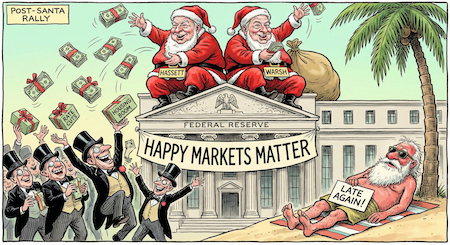
The catalyst for my prediction remains in place. It even features an identifiable Santa…
One who is as interchangeable as the Santa who almost drowned in front of us on Christmas day…
Indeed, looking too closely at who might become the next chair of the Federal Reserve would be missing the point. It needn’t really matter who is behind the false beard. Stock markets must be kept happy regardless. And monetary policy is the obvious tool to keep them afloat.
The next Fed chair will be chosen based on their ironclad guarantee to goose the stock market.
While central bankers around the world are still fretting about inflation and intend to tighten interest rates, Trump’s two Kevins are promising rate cuts.
Kevin Hassett is the Director of the National Economic Council of the United States. He’s the policy brains behind much of Trump’s plans. So he’s an obvious choice for the next Fed chair.
But he may be too obviously partisan. And so Kevin Warsh is in contention too – a former central banker and bank executive.
But it doesn’t matter which Kevin is chosen for the hot seat. The job will be the same. Dish out presents like nobody has to pay for them.
What about inflation?
Central bankers have been desperately trying to engineer a bout of inflation since 2009. That’s because inflation makes debt easier to repay. And the hangover of 2008 was too much debt.
What makes this interesting is how badly they failed. Despite countless warnings that quantitative easing and zero-percent interest rates would stoke inflation, it didn’t happen for over a decade.
Until 2021, of course. But that inflationary spurt was driven by the velocity of money, not its surging supply. The distinction is surprisingly easy to explain, for once.
Lockdowns prevented people from spending and froze supply chains. Removing lockdowns caused a spending surge that led to a temporary burst in prices.
The money supply is only half the equation. How fast that money circulates is the other half. And the pandemic featured a spike in the latter, not just the former.
So, let me ask you this: do you think the US government is going to reverse pandemic lockdowns anytime soon?
The answer is no. Because the US isn’t in lockdown in the first place…
So, I suspect we are back to the low-inflation environment of pre-2021. When central bankers couldn’t cause enough inflation, no matter what they did or how hard they tried. Even printing money wasn’t enough. Because the velocity of money kept falling.
They are more desperate than ever to try and push prices up. Because debt is even higher now.
But high debt levels imply a lack of further borrowing. Another anchor to inflation. The money supply can’t surge without more borrowing.
The point is that central banks have plenty of room to cut rates. Far more than they realise, because they misdiagnosed the cause of 2021’s inflationary spurt.
With the UK, eurozone and Australia expected to tighten monetary policy, the US stock market is the place to be. The Fed will cut rates, bucking the trend. And it will be proven right, if only for the wrong reasons.
As markets realise this in coming weeks, the post-Santa rally will kick off in earnest. The real mystery will be why the Santa rally didn’t begin when it was still Christmas.
How to position for a post-Santa rally
Stock markets are overvalued. Even the mainstream media admits it. And not just because Trump is in the White House. The maths is undeniable.
If the Federal Reserve pumps up stocks again, we are talking about the deliberate inflation of an asset price bubble. Just like the boom to 2008. One economist, like Paul Krugman openly called for seven years before it blew up in their faces.
But doom mongering about how bubbles eventually burst doesn’t help. There is too much money to be made in the meantime.
You only need to ensure you don’t drink your own Kool-Aid like green-energy stock buyers did in the run up to 2021. The time to sell will come. It’s just that the cusp of a new yes-man Fed chair isn’t it. The potential gains on the table over the next three months are immense.
The question is which sector will boom best.
Well, we are talking about substantial cuts to US interest rates while other central banks tighten. The most interest rate sensitive asset is housing. Because monetary policy controls the price of debt.
Right now, the US housing market is in the doldrums. It is undervalued and underperforming, having gone nowhere for two years now.
This means we have both a catalyst and an opportunity. It’s rare to have things line up so well.
And so I think homebuilders are the best way to play the coming of Kevin to the Fed.
Here’s a list of the major US listed home builders to consider:
- R. Horton, Inc. (DHI)
- Lennar Corporation (LEN)
- PulteGroup, Inc. (PHM)
- NVR, Inc. (NVR)
- Toll Brothers, Inc. (TOL)
- KB Home (KBH)
Santa will be late this year. But better late than never…
It’s not just the Fed that’s poised to goose markets
President Trump is doing what he can to revive US mining too.
There are countless vast projects that only need three things to become profitable. Lower energy prices, higher commodity prices and easier permitting.
Trump is busy engineering all three. And even punting some of the government’s own money on the result.
Care to join in?
Until next time,

Nick Hubble
Editor at Large, Investor’s Daily
P.S. Big market moves rarely arrive on schedule. They don’t ring a bell, explain themselves, or wait for consensus. They begin quietly, shaped by incentives, liquidity, and policy shifts most investors dismiss as “too obvious” or “too late.” That’s the setup taking shape now. In a short video briefing, the author explains how he’s thinking about positioning before the crowd catches on — and why this moment looks less like the end of a cycle and more like the start of one.