 In today’s Issue:
- Financial markets spread the consequences of war
- What to watch as the unintended consequences mount
- Stocks to buy when the panic fades
Back in January we pointed out that financial crises rarely hit hardest where they begin. The real question is who was relying on a crisis not to occur.
Usually, it’s an overleveraged bank or trader half a hemisphere away that gets caught out. From that point on, it’s domino day. Counterparty risk triggers a cascading series of failures until the government steps in with a bailout.
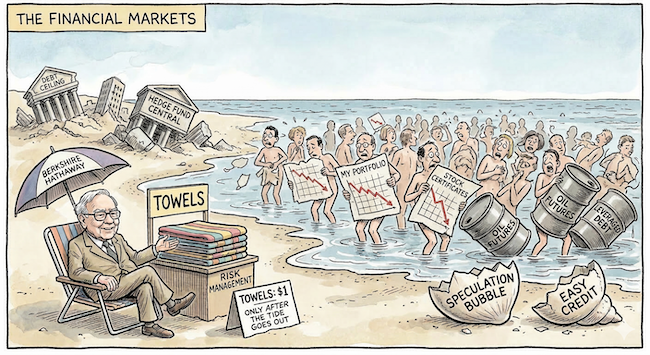
As Warren Buffett put it, “Only when the tide goes out do you discover who’s been swimming naked.” And the tide has gone out in the Strait of Hormuz.
Buffett’s company, Berkshire Hathaway, has a habit of sitting on the beach and waiting for the tide to go out. When the tide goes out, it sells clothes to the skinny dippers at exorbitant prices.
That’s how Buffett came to own vast holdings in many of America’s most famous corporate names during the 2008 crisis…
In September 2008, Berkshire Hathaway injected $5 billion into Goldman Sachs to help stabilise the bank.
In October 2008, Berkshire invested $3 billion in preferred stock in General Electric.
In February 2009, Berkshire “helped” Harley Davidson’s finance arm to the tune of $300 million at 15% interest.
In 2009, Berkshire invested to help fund Dow’s acquisition of Rohm & Haas with $3 billion backing.
In August 2011, investors were worried Bank of America was running short on capital due to mortgage-related losses. Berkshire provided a $5 billion infusion, earning a 6% dividend.
Today, I’m suggesting you use the same strategy. Prepare to invest in the companies that were caught out by the war in Iran.
On the lookout for skinny dippers
The first big victim is the Japanese stock market. It plunged as traders discovered Japan imports 90% of its oil from the Middle East, largely through the Strait of Hormuz.
I’m going to be polite here. Japan didn’t learn its lesson from World War II. It was caught swimming naked in the oil market.
The Korean stock exchange was caught up in the same selloff. The KOSPI index fell 7% and then 12% in two days!
But both governments are already pivoting.
Japan’s return to nuclear power is rapidly displacing its usage of natural gas, which has spiked in price. This will serve as a lesson to other countries too. Those willing to look, anyway. Which excludes ours.
The point is that Japanese and Korean stocks will soon be a buy as the energy crisis abates or forces policy action.
Also of interest are the long-haul airlines that use the Middle East as a hub. Indeed, the airline industry has been carving up the globe in bizarre flight patterns since the war in Ukraine kicked off. Avoiding particular countries’ airspace adds huge costs.
Once geopolitical conflicts die down, these companies will experience an extraordinary cost cutting tailwind. Their fuel will be cheaper, demand for travel will bounce back and their flight paths will be shorter. It’s also likely their emissions won’t be targeted by climate alarmist governments as oil and gas suddenly become more fashionable industries.
At one point, Japan Airlines stock was down 13% from its closing price on Friday while the country experienced record tourism…
Qantas fell about 18%. I’m expecting the Aussie dollar to soar in the coming years, which is great news for the airline.
Alongside stocks that are beaten down by the crisis, there are also opportunities in the political response to it…
Radical political change is afoot
The situation in Europe is politically fascinating for investors. European gas storage levels have been trending at unusually low levels since winter. That made sense because new sources of supply are now open. Europe’s capacity to import seaborne LNG during winter is high.
But now Qatar’s gas fields have declared force majeure on gas exports. They can’t produce the gas contracted for sale.
The UK’s gas price just surged by a record amount in two days. Now Europe faces months of refilling gas storage at very high prices if it can find the stuff.
For the second time in five years, Europe is at the mercy of a geopolitical energy crisis beyond its control. Once again it is reliant on the Americans.
If governments don’t wake up and permit domestic oil and gas production, voters will abandon them for parties that promise to.
European oil and gas stocks are primed to soar. More on that soon.
Until next time,

Nick Hubble
Editor at Large, Investor’s Daily
P.S. Moments like this are when fortunes quietly get made.
When markets panic, most investors run for safety. But the smartest capital starts looking for the opportunities created by the chaos.
That’s exactly the kind of moment James Altucher believes we’re entering right now.
In fact, he believes one of the biggest investment opportunities of the decade could soon arrive in the form of what may become the largest IPO valuation in history.
And he’s identified a little-known company that could give investors a way to benefit before that IPO happens.