Online nerds love to compare Elon Musk to Tony Stark.
The rockets, the AI ventures, the main character energy.
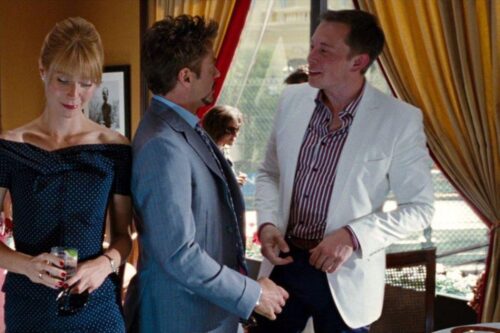
Even Musk leans into the Iron Man vibes… he had a cameo in Iron Man 2 back in 2010.
It’s a fun comparison and the media loves it.
But if we’re being honest about who actually fits the mould, the real-world Tony Stark isn’t Musk.
It’s Palmer Luckey.
Or more precisely, the version of Stark who built the next-gen weapons before he became a superhero and all altruistic.

And right now, Luckey’s company, Anduril Industries, is rapidly becoming the most important, most exciting, most hotly IPO-anticipated defence company in the world
From a garage to a $60 billion war machine
Luckey was born in Long Beach, California, building lasers and coil guns in his parents’ garage as a teenager. By 16, he was designing his own virtual reality headsets. By 20, he’d founded Oculus VR, a virtual reality headset company.
Just two years later he sold it to Facebook for$2.3 billion.
Then things went a bit sideways.
A political donation to a pro-Trump (yes, the current US president) group turned into a media firestorm, and Luckey was pushed out of Facebook – from his own Oculus division, mind you – in 2017.
I mean, when you really think about it, Mark Zuckerberg pushing Luckey out of Facebook may have single-handedly changed the direction and future of American warfare.
And at the time, no one realised.
Because within months of Luckey’s exit, he co-founded Anduril Industries with former Palantir executives, backed by Peter Thiel’s Founders Fund.
Anduril comes from Tolkien, the reforged sword of Aragorn. Translated from Elvish, it means “Flame of the West.”
If that sounds dramatic, well, it’s supposed to. That’s exactly what Anduril has been working on.
Since 2017, the company has grown from a small border security startup into a full-spectrum next-generation defence and weaponry technology company.
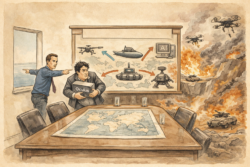
Its Lattice operating system is an AI-powered command and control platform that integrates sensors, drones, autonomous vehicles, and weapons systems into one unified battlefield picture.
The company now builds autonomous drones, loitering munitions, submersible drones, collaborative combat aircraft, and counter-drone systems. It took over the US Army’s IVAS augmented reality programme from Microsoft.
And it’s constructing Arsenal-1.
Arsenal-1 is destined to be a “hyperscale” manufacturing campus that would do for defense what Henry Ford did for the automobile.
Revenue doubled to roughly $2 billion in 2025 and is expected to nearly double again to $4.3 billion in 2026. A new funding round would value the company at $60 billion, nearly double its valuation from last summer.
I expect Anduril to hit the Nasdaq this year… or at the very least announce an IPO.
But as important as this backstory and context are…none of that is why I’m writing today.
Why I’m writing is because, last Friday, the US Army awarded Anduril a contract worth up to $20 billion over 10years. The deal now makes Anduril’s technology accessible to the entire US Department of War.
Already, there’s an $87 million deal to deploy Lattice as the command and control backbone for the Pentagon’s counter-drone operations under Joint Interagency Task Force 401.
And the US Navy has chosen Anduril to develop its unmanned submarine systems.
All of this came in just the last week.
The timing is not accidental.
Operation Epic Fury is consuming munitions, and drone-defence assets are now possibly the most important line of defence for countries everywhere.
The urgency for next-generation defence is real, and it’s Anduril that’s at the centre of it all.
Follow the metals, not just the machines
Clearly, for investors, the temptation is to fixate on Anduril itself. And I get it. If I could buy the stock of any private company tomorrow, Anduril would be top of my list.
For me, it’s arguably the best-value non-public company in the world right now. That’s saying something when you look at OpenAI and Anthropic (I really like them too, but their valuations are eye-watering). $60 billion for Anduril? Yes please!
But the bigger investment opportunity here sits underneath the end product.
Every autonomous drone Anduril builds requires rare earth permanent magnets for its motors.
Every sensor array uses neodymium and samarium for precision guidance.
The airframes rely on titanium for strength-to-weight ratios.
Gallium arsenide and gallium nitride underpin the radar systems.
Lithium powers the batteries.
Tantalum and tungsten sit inside capacitors and armour-piercing components.
Next-gen weaponry and autonomous systems are utterly and absolutely reliant on the supply of critical metals.
But we all know the problem here. China controls roughly 70% of global rare earth mining and over 85% of the processing capacity.
The Pentagon’s own audits have found it lacks the data to even project shortfalls for nearly half the materials it considers critical to national security.
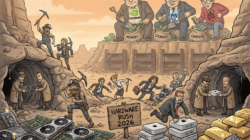
This is why the defence supply chain story is, in my view, a bigger and more important trade than any single defence company.
The Pentagon knows it.
Congress knows it.
Trump knows it.
That’s why there’s such an emphasis on “reshoring” these critical metals by accessing deposits in America, and also bringing in metals from overseas (places like Australia)… and refining and producing them in America.
It’s a long-term opportunity that demonstrates immense demand for everything America needs and wants to arm itself, rearm itself, and protect itself… and the allies that stand alongside it.
But this is no market for the faint-hearted. The market is volatile, the companies boom out of nowhere, and many bust overnight. Knowing who to trust, who to listen to, and where to invest is as important as knowing about this story to begin with.
We’ll be discussing this soon at The Big Dig, an event Jim Rickards and a man he only refers to as “The CEO” will be hosting on Monday, 23 March at 4 pm GMT. One click will get you on.
Anduril might be the name on these big war contracts. But when you pull apart the supply chain, the real asymmetric opportunities are in the metals and minerals that the US is desperate to lock down for national security.
And for that, I think we can thank Mark Zuckerberg for kicking Palmer Luckey out of Facebook in 2017.
Until next time,

Sam Volkering
Investment Director, Southbank Investment Research
PS Palmer Luckey may be building the future of warfare… but he can’t do it without rare earths, lithium, and critical metals. That’s where the real battle is being fought and where the biggest investment opportunities are emerging. We’ve scheduled an urgent, critical briefing for Monday, 23 March at 4 pm GMT to prepare investors for this shift. One click here will secure your spot here.