 My kids have iPads.
Yep. I’m one of those parents!
No, actually I’m not. The iPads are for education apps.No YouTube, no Netflix — just maths apps, colouring, spelling, that sort of thing.
Anyway, the point is my youngest is using an older iPad we’ve got. I think it’s so old it’s running iOS 11 or something ancient like that. The current iOS version is 26 for reference.
It’s really not that old, maybe seven or eight years. Certainly good enough to still work. Certainly still good enough that an expensive device shouldn’t be classified as a paperweight.
But that’s exactly what it’s become. I can’t install any new educational apps on it.
Why? Because they all use iOS15 and above, won’t work on iOS11.The tablet is still fine, but it can’t do much beyond a handful of utterly basic apps.
This is endlessly frustrating because it’s kind of at the point where I’m forced to get a newer iPad for him now just so he can progress with stuff he really wants to (which he does when he sneakily uses his two-years-older brother’s iPad).
This is frustrating. But it would be far worse if the same thing happened to something larger and more expensive, say perhaps…my car.
But that’s exactly what’s on the cards for any Tesla Model S or Model X owner.
Buckle up Tesla-heads. This one’s a doozy!
Why kill the S and X?
Tesla’s latest earnings call wasn’t just an update on margins, deliveries, or FSD mileage.
It was an admission of failure.
Of course Elon Musk has spun it as he would like, and I’ll get to that in a moment. The failure is simpler: Tesla’s most high-end products never found a sustainable market.
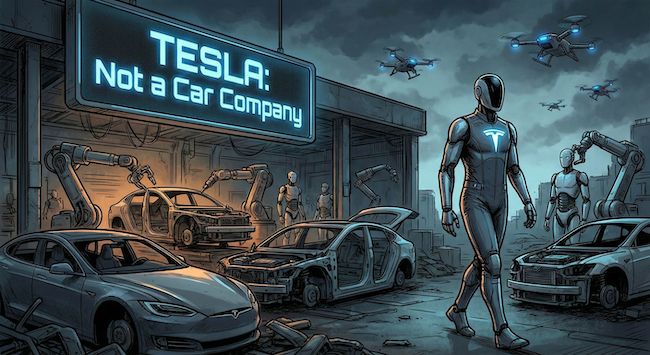
Tesla will cease production of the Model S and Model X next quarter, with the Fremont factory lines repurposed for the manufacture of Optimus humanoid robots. More on that in a moment too.
They say existing owners will be supported and current inventory will be sold through, but imagine the dive in resale values on the S and X now. Knowing full well these will be like a bricked iPad in a few years.
I can hear the class-action lawyers suiting up as we speak.
This is the problem when your cars are more a device than vehicle. And it’s also evidence there’s just not enough money to be made in that part of the market from Tesla, because they wouldn’t bin those models if they were still selling, still relevant, and still profitable.
It’s easy to hide the failure of model line ups when you say you’re going to build robots. But you also have to ask: where’s the Tesla Roadster that was promised? Where’s the Tesla Semi that was promised? And really, how are the sales of CyberTruck going now the hype of Kim Kardashian having one has faded away?
Not hard to think the CyberTruck 2.0 never sees the light of day.
But then again this is a big pivot to robotics and the mass production of the Optimus robots. Sure Tesla sold some cars, still does sell a few, but this announcement feels like Elon is simply bored with cars.
Now it’s about robots and AI. Until something else catches his attention perhaps?
I think this is actually more about the state of the auto industry than Tesla’s car making foibles.
China dominates car making now, and Japan, and Korea. But America, Europe, anywhere else, I wouldn’t even bother. And yes that includes the Volkswagen Group, Daimler, whatever the French are now doing and the Italians… although Ferrari (the road car group at least) is going just fine.
But this China domination is very much something that needs attention. Because yes, they dominate car making now, and will continue to do so, but they’re also kind of dominating the progress of humanoid robotics too.
The China factor
The most revealing moment of the earnings call came when Musk addressed competition.
Asked about the surge of humanoid robotics start-ups from China,
“The biggest competition for humanoid robots will be from China. China is incredibly good at scaling manufacturing.”
“To the best of our knowledge, we don’t see any significant competitors outside of China.”
He then broke down what he considered to be the three big things needed to solve humanoid robotics,
“Building an incredible hand that has the same degrees of freedom and dexterity as a human hand is an incredibly difficult engineering challenge. Then there’s the real-world AI, and scaling production. Those are the three hardest problems by far for humanoid robots.”
His view is that Tesla does all three the best, no one else in China does.
But I guess the proof will be in about 10 years time and whether the Optimus production lines are shut down and repurposed to build military drones or something else that Tesla fails at?
I should be clear: I like the direction Tesla’s going. And the idea that they were never really a car company and it was a pathway to AI and robotics for Elon kind of makes sense.
I mean, that’s not going to console any Model S or X owners and their hopes of a good price for trade in. But if you own Tesla stock, robotics may well be what history ultimately remembers them for.
So that’s a good thing, but let’s just not call Tesla a car company any more please.
Tesla is a robotics company.
Until next time,

Sam Volkering
Contributing Editor, Investor’s Daily
P.S. Tesla’s pivot is a good example of how these moments really unfold. The narrative changes first. The price follows later. James Altucher is hosting a briefing that digs into this exact kind of transition — where investors tend to underestimate how quickly an old story breaks and a new one takes over. If you want to see how he spots these shifts early, it’s worth watching before the crowd catches up.