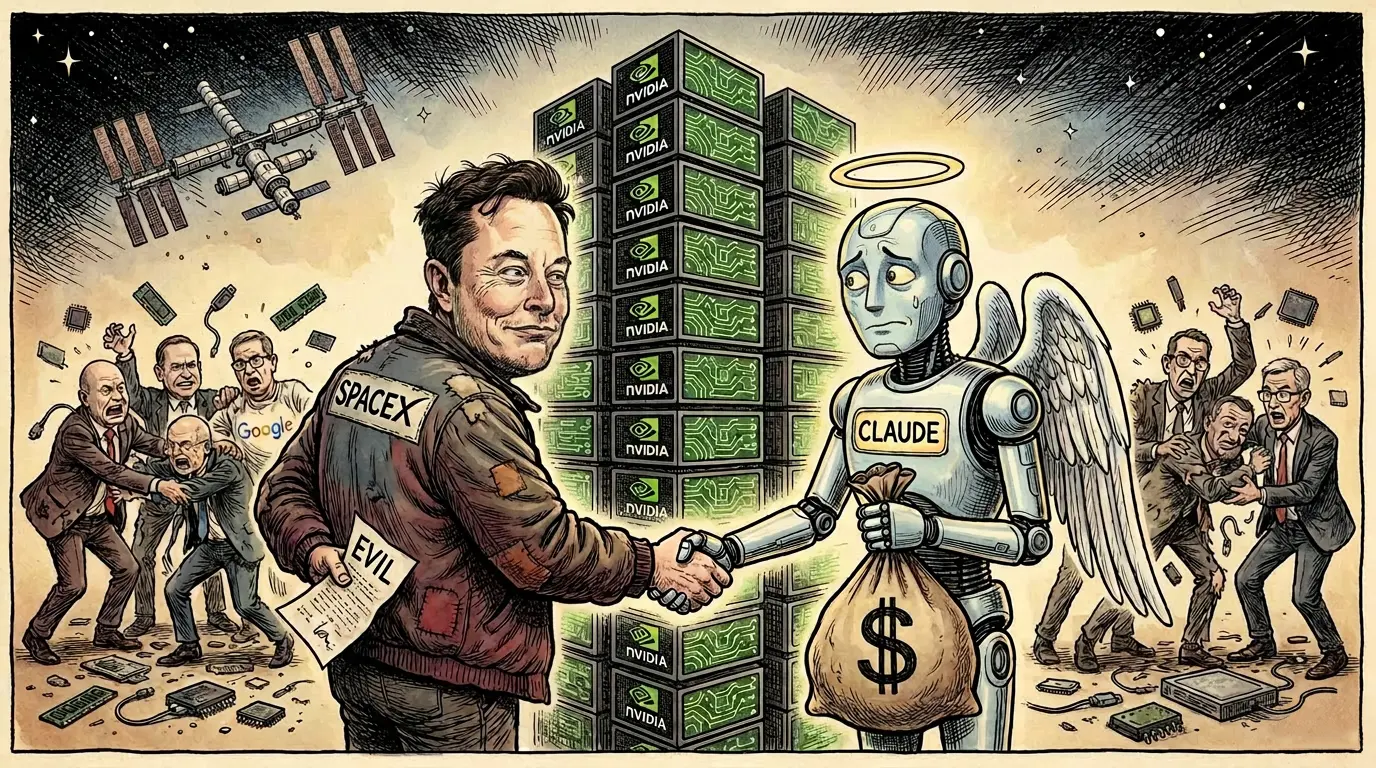
 Last February, Elon Musk called Anthropic “misanthropic and evil.” He said the company hated Western civilisation.
Then the “evil” company called and wanted to hand over fistfuls of cash…
The about-face here is genuinely funny. I’ll admit, I went back to the announcement a few times just to make sure it wasn’t posted on April 1.
SpaceX, which now contains xAI after the merger I wrote about back in February, has signed a deal to lease its entire Colossus 1 facility in Memphis to Anthropic .
That’s more than 220,000 Nvidia GPUs, a mix of H100s, H200s, and the brand-new GB200 accelerators, plus more than 300 megawatts of compute capacity, all now feeding Claude Pro and Claude Max subscribers.
And like any good shopping channel would say…
But wait, there’s more.
Musk also confirmed on X that xAI will be dissolved as a standalone entity. The AI products will simply become SpaceXAI , and that SpaceXAI and Anthropic have “expressed interest” in jointly developing multiple gigawatts of space-based AI compute capacity .
So now the two most anticipated IPOs of 2026, both pencilled in for later this year, are sharing AI infrastructure on Earth, and planning AI infrastructure in space.
May the AI bull run continue…
Britain’s Investment Letter Since 1938
In 1938, The Fleet Street Letter warned its readers that war was coming to Europe — and even identified September as the critical month.
Since then, its readers have been warned ahead of Black Monday, the dotcom crash and the 2008 financial crisis.
Today, Britain’s longest-running investment advisory is still looking for the “news behind the news” — and the investment opportunities others could be missing.
Click here to discover what The Fleet Street Letter sees coming next.
Capital at risk.
What Does Britain’s Oldest Investment Letter See Coming Next?
It warned readers ahead of Black Monday.
The dotcom crash.
And the 2008 financial crisis.
Now, nearly 90 years after it was founded, The Fleet Street Letter is still searching for the “news behind the news” — and the investment opportunities that could emerge from the next major turning point.
Click here to discover what its editors are seeing now.
Capital at risk.
The deal that nobody saw coming
I didn’t see this one coming.
But this says more about the constraints on compute than it does about either company.
Anthropic is reportedly in active talks to raise around $50 billion at a valuation near $900 billion, with an IPO targeted for October 2026. Annualised revenue has exploded from roughly $9 billion at the end of 2025 to more than $30 billion today. Some estimates put the current run rate closer to $40 billion.
Private markets already have the valuation floating around $1.2 trillion.
The company has reached the point where it simply cannot buy compute fast enough to keep up with demand for Claude, and its absurd growth trajectory.
SpaceX, on the other hand, merged with xAI back in February at a combined valuation of roughly $1.25 trillion, and is still targeting a public listing as early as June.
With Colossus 2 already online and handling Grok training, Colossus 1 had effectively become spare capacity sitting in Memphis. Renting it out transforms a dormant asset into a massive revenue stream just as the IPO roadshow ramps up, and likely helps fund the next Colossus build from there.
It’s a win-win for both sides.
Anthropic gets to double Claude Code rate limits, remove peak-hour throttling for Pro and Max users, and dramatically expand Opus API limits overnight.
SpaceX gets a multi-billion-dollar tenant, and a fresh investor narrative that says: “we’re a rocket company… and also AI landlords.”
The capex is the real story
Now put all of this into the context of the broader AI build-out.
Morgan Stanley revised its hyperscaler capex forecasts higher in late April. Combined spending from Amazon, Google, Meta, Microsoft, and Oracle is now expected to hit $805 billion in 2026, and $1.116 trillion in 2027, up from prior forecasts of $765 billion and $951 billion.
In just two years, annual capex is expected to more than double from the $449 billion spent in 2025.
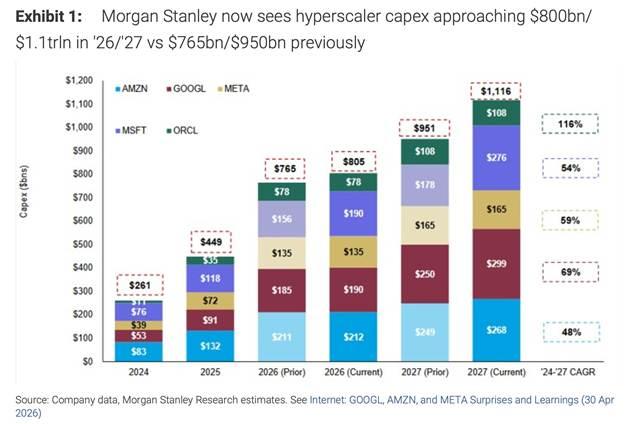
That’s more than a trillion dollars a year in data-centre spending from just five companies.
And Anthropic isn’t even included in those numbers.
Neither is SpaceXAI.
Neither is Cursor, which SpaceX is acquiring for $60 billion.
Neither is OpenAI.
Add those in, and 2027 starts looking like a year where the AI infrastructure build-out clears $1.5 trillion without much trouble.
And all that money has to go somewhere.
It doesn’t stop at Nvidia.
Every dollar of capex flows through an entire stack of suppliers.
Colossus 1 is packed with high-bandwidth memory sourced from SK Hynix, Samsung, and Micron, where each system carries tens of thousands of dollars’ worth of HBM alone.
Every rack needs advanced substrates from companies like Ibiden in Japan.
Photonics components for optical interconnects, which I’ve been writing about for more than a year now, route through names like Lumentum, Coherent, and nLIGHT.
Then you’ve got cooling systems, racking, power distribution, copper backplanes, and all the rest of the infrastructure layers that are effectively sold out years in advance.
Underneath all of that sits the critical metals layer: gallium, germanium, neodymium, and the rare earth elements that feed magnets, lasers, and power systems.
The SpaceX-Anthropic deal is exactly the kind of customer behaviour that tells you these shortages are very real.
When a company decides to rent compute capacity from another company that it called “evil” just weeks before… that’s the market screaming that supply constraints are getting serious.
And when they immediately start talking about orbital data centres together, that’s the market telling you nobody expects those shortages to end on Earth anytime soon.
For investors, this is just more confirmation that the AI build-out is not slowing down.
As long as you’re positioned correctly, there’s still plenty of money to be made.
Memory, photonics, advanced packaging, critical metals… pick one, or pick all of them. It doesn’t really matter.
The picks-and-shovels side of an industrial build-out we haven’t seen since the railroads is minting profits across the board.
I just hope you’ve got some skin in the game.
Until next time,

Sam Volkering
Investment Director, Southbank Investment Research
PS The SpaceX-Anthropic deal is about far more than two AI companies making nice with each other.
It’s proof that the scramble for compute, power, critical metals, and infrastructure is accelerating faster than almost anyone expected.
And that matters because the same forces driving this AI build-out are now colliding with something much bigger: a government-backed industrial and energy push coming directly out of Washington.
Trump’s latest use of the Defense Production Act is not random. It’s part of a much larger attempt to secure the energy, mineral, and manufacturing capacity needed for the next phase of American dominance.
That’s where the real supercycle opportunity may sit.
One veteran investor with deep ties across the intelligence, defence, and political world believes we’re entering the early stages of a once-in-a-generation boom in energy, metals, infrastructure, and industrial capacity. In fact, he’s reportedly committed more than $1 million of his own money positioning for it.
And in this briefing, he explains exactly where he believes the biggest opportunities could emerge next.