
 2.5 trillion.
That is more than half the annual economic output of the UK. Roughly equivalent to the entire GDP of Italy. Enough to buy every house in Greater London twice over, with enough left for five million Lamborghinis and probably a small island to park them on.
It sounds completely absurd.
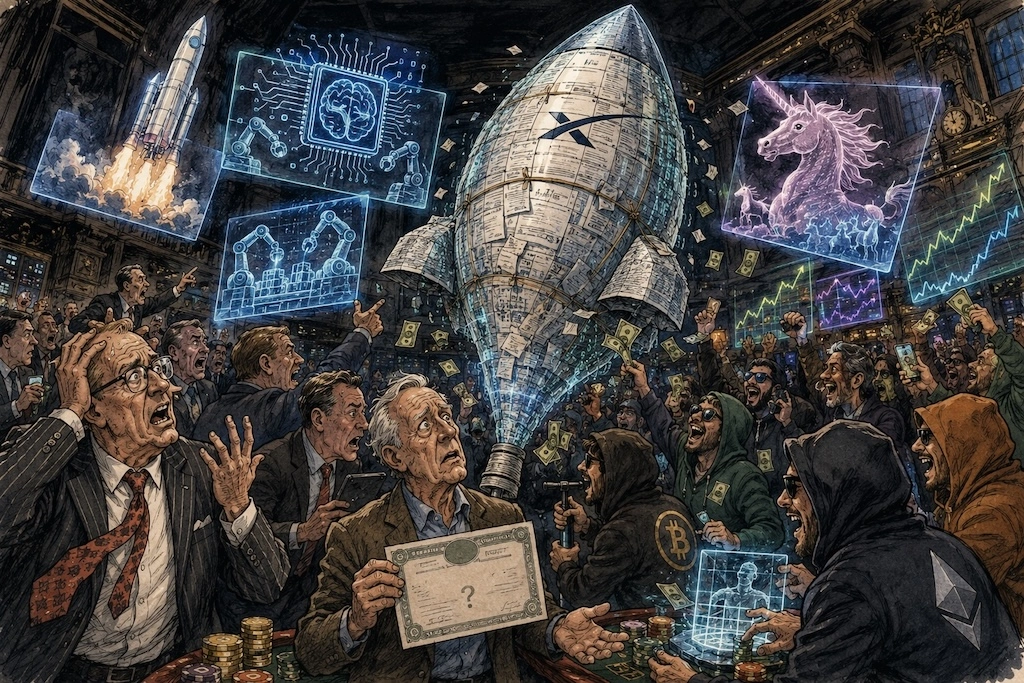
Yet that is exactly where a brand-new crypto market – the IPOP market – is currently pricing SpaceX just three weeks before its expected Nasdaq listing under the ticker SPCX.
Meanwhile, the traditional Wall Street banks running the roadshow, firms like Morgan Stanley and Goldman Sachs, are reportedly valuing the company closer to US$1.75 trillion.
The crypto market is effectively saying the bankers are at least 40% too conservative.
Which raises the obvious question…
What exactly is an IPOP market?
And why is it suddenly pricing what could become the biggest IPO in history at a valuation large enough to place SpaceX among the five most valuable companies on Earth from day one?
Three weeks ago, a platform called trade.xyz launched something genuinely new.
A pre-IPO perpetual futures market. IPOP for short.
Built on Hyperliquid (HYPE), the fully on-chain decentralised exchange, it allows anyone with a wallet and some USDC to take long or short positions on where a private company may eventually price once it goes public.
No shares actually change hands. No accreditation requirements. No investment bank deciding who receives allocations.
Just a cash-settled derivative tracking implied valuation, trading 24 hours a day to anyone on the planet with an internet connection.
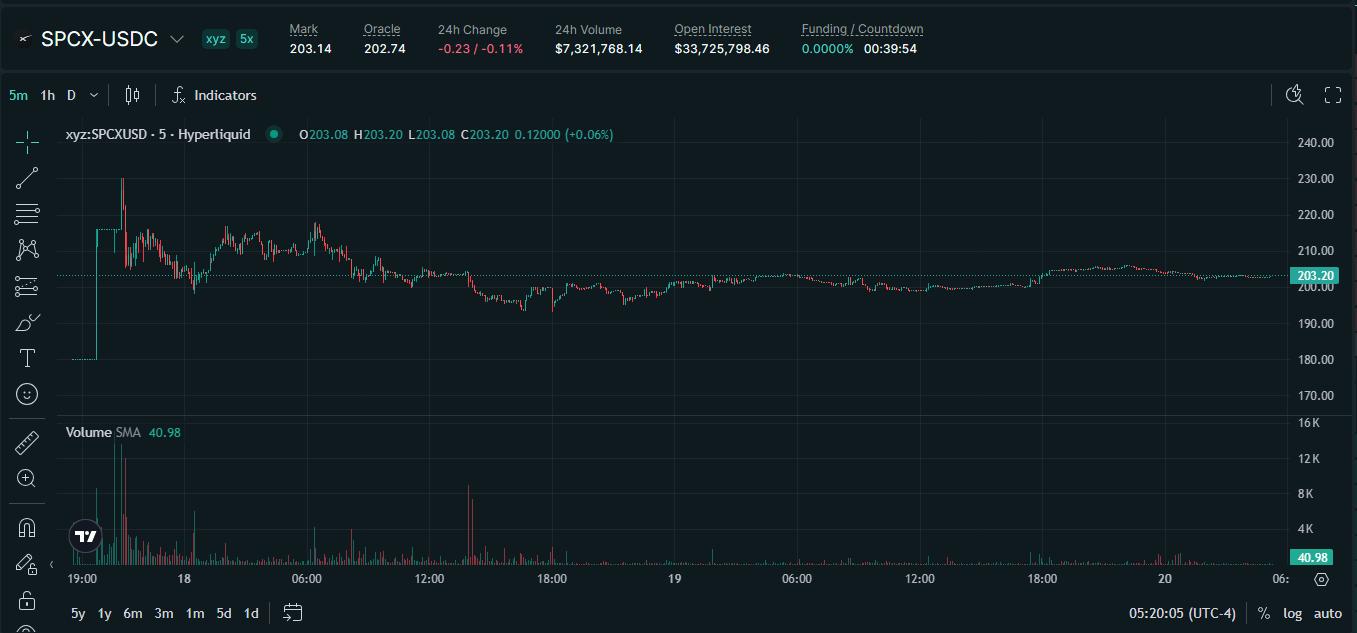
Here, see for yourself,
The first IPOP market centred on Cerebras Systems, now listed on the Nasdaq under the ticker CBRS.
In the days before listing, the Cerebras IPOP traded around $350.
Meanwhile, Morgan Stanley and the underwriting syndicate were guiding investors toward an IPO range closer to $115–125.
Plenty of commentators dismissed the IPOP pricing as ridiculous.
But the crypto market kept buying.
Then the underwriters lifted the range to $150–160. Then again, to $185. Reports suggested the deal ended up more than 20 times oversubscribed at the final pricing.
And still, the IPOP traded around $350.
Then, on May 14, Cerebras opened on the Nasdaq at $350 and briefly touched $385 within the first hour of trading. It has since cooled back toward roughly $315, but the important point remains:
The crypto market effectively nailed the pricing days before the bankers did.
Now, one successful prediction does not suddenly validate an entirely new market structure.
But it does raise a fascinating question for the future of capital markets:
Could a global pool of anonymous capital, trading 24 hours a day with no incentive other than to be right, ultimately perform price discovery better than the traditional IPO roadshow system that excludes almost everyone who will eventually own the stock?
There is another category of pre-IPO crypto product that has also emerged over the past year: tokenised shares.
The idea is relatively simple. An SPV holds private equity in a company like Anthropic or OpenAI, while a platform issues blockchain-based tokens on networks like Solana that supposedly provide economic exposure to those shares.
Good idea in theory.
In practice, it largely imploded last week.
Both Anthropic and OpenAI publicly stated that any transfer of shares into an SPV without explicit board approval is void.
Literally void.
Tokenised pre-IPO shares tied to both companies on a platform called PreStocks fell nearly 40% within days. Anthropic even published a named blocklist of platforms it claimed were operating without authorisation, including Forge Global, one of the largest regulated secondary marketplaces in the United States.
And this is where the IPOP structure suddenly starts looking rather clever.
Because the IPOP is simply a synthetic derivative tracking implied valuation, no actual shares ever move. No SPV is required. No transfer restrictions are triggered.
In a strange way, the IPOP may be the purest pre-IPO product yet precisely because it owns nothing.
Britain’s Investment Letter Since 1938
In 1938, The Fleet Street Letter warned its readers that war was coming to Europe — and even identified September as the critical month.
Since then, its readers have been warned ahead of Black Monday, the dotcom crash and the 2008 financial crisis.
Today, Britain’s longest-running investment advisory is still looking for the “news behind the news” — and the investment opportunities others could be missing.
Click here to discover what The Fleet Street Letter sees coming next.
Capital at risk.
What Does Britain’s Oldest Investment Letter See Coming Next?
It warned readers ahead of Black Monday.
The dotcom crash.
And the 2008 financial crisis.
Now, nearly 90 years after it was founded, The Fleet Street Letter is still searching for the “news behind the news” — and the investment opportunities that could emerge from the next major turning point.
Click here to discover what its editors are seeing now.
Capital at risk.
Should you actually use this thing?
On Monday, the SPCX IPOP launched ahead of SpaceX’s reported June 12 listing. It opened at a $150 reference price, implying roughly a $1.78 trillion valuation.
Within hours, it traded above $216 and now sits closer to $210, implying a valuation near $2.5 trillion.
Roughly 40% above where the bankers are currently pitching the IPO.
Maybe the crypto market is right again.
Maybe it is wildly overshooting.
We will probably know within a few weeks.
But the real utility here may not be speculation. It may simply be information.
The IPO calendar forming behind SpaceX is extraordinary. Anthropic, OpenAI, Stripe, Revolut, and Anduril Industries are all expected to arrive across late 2026 and early 2027.
And each will likely have an IPOP market trading ahead of the listing, giving investors a real-time public signal on where markets believe the stock should actually price.
That alone could become incredibly useful when deciding whether to chase day-one momentum or simply wait for the hype to cool before buying later.
For Anthropic specifically, given the company has now effectively blocked most backdoor exposure routes into its equity, the IPOP market may end up becoming the only liquid public signal on valuation before the stock finally starts trading.
To be clear, I am not recommending anyone trade IPOPs directly, especially not with leverage, which is also available.
That is probably a step too far even for me.
But as a research tool, as a kind of speculative crystal ball pointed at the largest IPO pipeline in modern history, this may genuinely be one of the more useful things crypto has built so far.
And it also tells you something else.
The market remains absolutely desperate for the next shiny thing to speculate on.
Until next time,

Sam Volkering
Investment Director, Southbank Investment Research
PS What makes the new IPOP market fascinating is not just the speculation. It is the fact that investors are so desperate for exposure to companies like SpaceX, Anthropic, and OpenAI that crypto traders have now built an entirely new market structure just to bet on where these companies might list.
That tells you something important.
The appetite for the next generation of AI, defence, and space infrastructure companies is absolutely insatiable right now.
And that is exactly why investors are scrambling to find “backdoor” ways into the ecosystem before these IPOs finally hit public markets.
One current opportunity tied directly to the incoming SpaceX listing could allow investors to position themselves ahead of what may become the largest IPO event in financial history.