 Apparently, part of the reason Anthropic’s Fable 5 model was recently banned in several international markets comes down to a simple problem: Dario Amodei, Anthropic’s founder and CEO, couldn’t “speak Trump’s language”.
Come on, guys. Everyone knows you don’t send the nerds in to do a salesman’s job.
Jokes aside, the Anthropic situation has exposed something much bigger.
Frontier AI models are no longer just a Magnificent Seven story. They’re becoming a sovereign-state issue.
For years, artificial intelligence was a borderless industry. OpenAI would release a model. Then Anthropic. Then Meta. Then xAI. Then DeepSeek would send the entire sector into a panic before the cycle started all over again.
The only question investors cared about was who had the smartest model this week.
That open field is now getting a giant security fence built around it.
Governments increasingly view frontier AI models the same way they view strategically important technologies: something to monitor, protect, and keep under national control.
In some respects, the parallels with nuclear technology are becoming difficult to ignore.
If this trend continues — and I think it will — the prize stops being who has the best model and starts becoming who controls the infrastructure behind it.
Regulators are already shifting their attention towards the compute layer: the chips, data centres, and cloud infrastructure that power advanced AI systems.
Why?
Because that’s the one part of the AI supply chain governments can actually count, monitor, and, if necessary, switch off.
Ideas such as Know Your Customer requirements for cloud providers have already been floated, including by Microsoft itself. Export controls are increasingly being written around access to high-end computing power rather than the models alone.
At the same time, countries from Australia to Saudi Arabia are reaching the same conclusion. They don’t want their AI future sitting entirely inside an American technology giant. They want AI infrastructure they own, control, and operate at home.
And that points directly towards the companies building regional data centres, supplying sovereign compute capacity, and providing governments with infrastructure they can keep an eye on.
In short, the next chapter of the AI story may not be about better models at all. It may be about sovereign AI.
Who has it.
Who controls it.
And who doesn’t.
Britain’s Investment Letter Since 1938
In 1938, The Fleet Street Letter warned its readers that war was coming to Europe — and even identified September as the critical month.
Since then, its readers have been warned ahead of Black Monday, the dotcom crash and the 2008 financial crisis.
Today, Britain’s longest-running investment advisory is still looking for the “news behind the news” — and the investment opportunities others could be missing.
Click here to discover what The Fleet Street Letter sees coming next.
Capital at risk.
What Does Britain’s Oldest Investment Letter See Coming Next?
It warned readers ahead of Black Monday.
The dotcom crash.
And the 2008 financial crisis.
Now, nearly 90 years after it was founded, The Fleet Street Letter is still searching for the “news behind the news” — and the investment opportunities that could emerge from the next major turning point.
Click here to discover what its editors are seeing now.
Capital at risk.
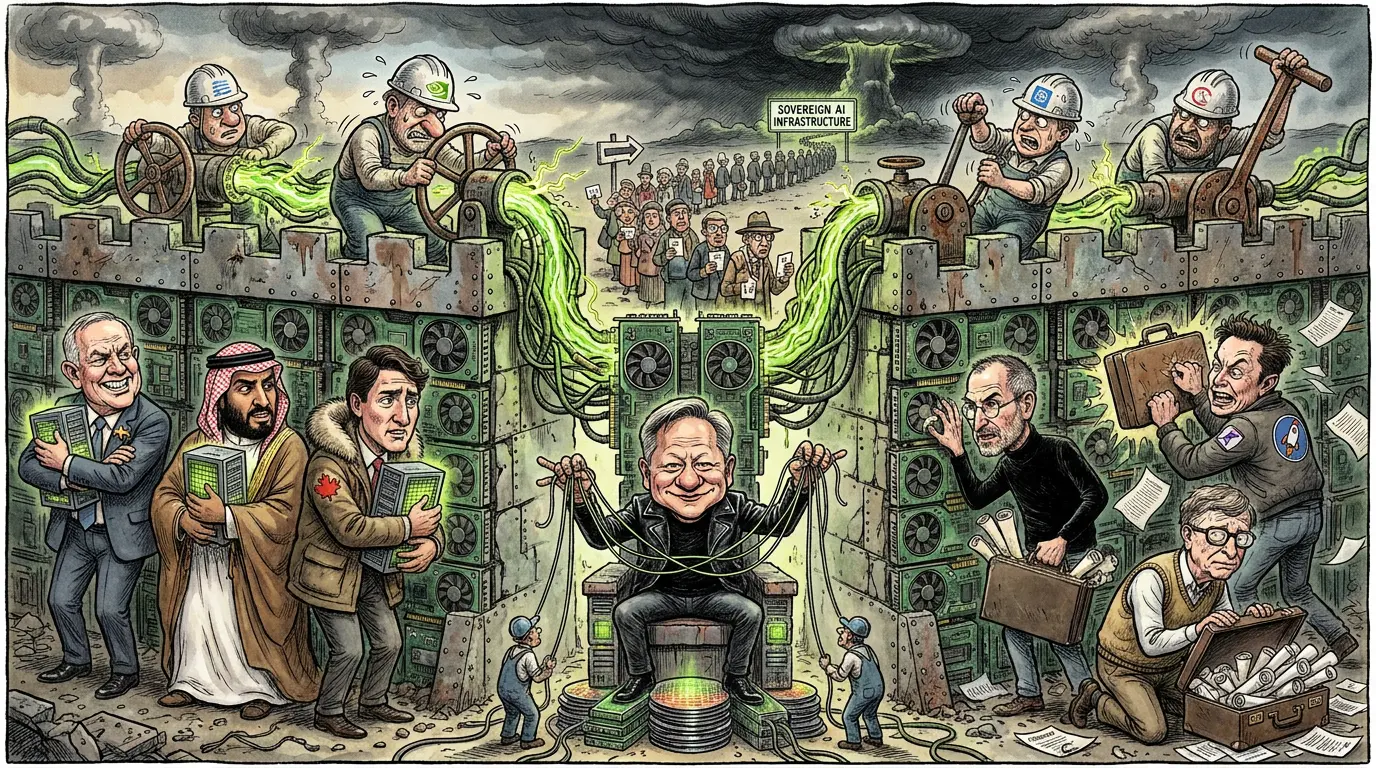
A gated race pays the gatekeeper first
In a walled AI world — and at least in the short term, that seems to be where we’re headed — the major cloud providers want to be the gatekeepers.
The host nations don’t.
A government in Australia or the Gulf would much rather back infrastructure it can regulate than hand the keys to Amazon, Google, or Microsoft.
That means local models running on local infrastructure, with governments retaining visibility and control over the systems powering their AI ambitions.
That gap is where the neoclouds come in.
These smaller, highly specialised AI infrastructure operators are increasingly finding themselves in the right place at the right time. It’s why some of them are signing contracts worth many times their own market capitalisation.
Now, it’s important to point out that the hardware remains firmly under American control.
And by hardware, I mean Nvidia.
But Nvidia has quietly evolved its role in the ecosystem.
Rather than simply selling chips, it has started backing infrastructure providers directly — sharing revenue, supporting financing arrangements, and helping underwrite expansion plans.
That’s important because the biggest risk in AI infrastructure has always been timing.
Operators need to spend enormous sums on chips, servers, and data centres long before the revenue arrives. Those upfront costs can destroy a business if demand shows up later than expected.
Building AI infrastructure without a major partner is often a fast track to oblivion.
But when Nvidia carries part of that burden, smaller operators can pursue much larger opportunities without betting the company on every order.
We saw this playbook with CoreWeave.
Now Nvidia appears to be rolling it out across the broader neocloud ecosystem as well.
And if sovereign AI becomes the next phase of the AI race, that’s a trend investors should be paying very close attention to.
Let’s name names
Start with Sharon AI (Nasdaq: SHAZ). It is an Australian operator that listed on the Nasdaq in February 2026 and now carries a market capitalisation of just over US$1 billion.
It stays capex-light by installing its hardware inside existing NEXTDC (ASX: NXT) and Equinix (Nasdaq: EQIX) data centres rather than pouring its own concrete.
In June, it signed a six-year deal with Nvidia covering 72 megawatts of capacity and up to 40,000 Grace Blackwell GB300 chips on home soil. That’s on top of a US$1.25 billion contract with ESDS and a US$950 million agreement with an unnamed Asia-Pacific group. Canva is already a named customer.
WhiteFiber (Nasdaq: WYFI) is the North American cousin. It was spun out of Bit Digital last August and now has a market capitalisation just north of US$1 billion.
Its edge is simple: take over existing buildings and retrofit them for roughly 40% less than the cost of building from scratch.
The company recently signed a 10-year agreement with Nscale worth around US$865 million, alongside a fresh contract in Paris as it expands internationally.
HIVE Digital (Nasdaq: HIVE), with a market capitalisation of roughly US$1.1 billion, brings the Canadian flag into the mix.
Through its BUZZ division, an approved Nvidia cloud partner, the company is building what it calls sovereign AI compute infrastructure, including a planned 320-megawatt site near Toronto.
Management believes contracted income could reach US$660 million annually by 2028.
Bitdeer Technologies Group (Nasdaq: BTDR), valued at roughly US$4.8 billion, adds a Singapore angle.
What sets Bitdeer apart is that it designs its own chips and operates its own data centres. Its AI cloud business is still relatively small, but it is growing quickly.
These are some of the smaller players acting as the gatekeepers to compute.
Most of them are packed with Nvidia chips.
But Nvidia chips are useless without giant connected data centres humming away in the background, generating the compute needed to power AI systems around the world.
Of course, there is a larger end of the neocloud spectrum as well.
Applied Digital (Nasdaq: APLD) sits around US$13 billion. TeraWulf (Nasdaq: WULF) is approaching US$14 billion. CoreWeave (Nasdaq: CRWV), and Nebius Group (Nasdaq: NBIS) have become giants…
But there is only so much compute those larger operators can deliver at the scale and speed demanded by hyperscalers and sovereign AI projects.
Eventually, that demand filters down into the mid-tier and smaller operators.
Now, this is not as simple as saying more demand for AI equals massive returns for every tiny neocloud.
But there is an exponential increase in demand for compute and a finite amount of supply.
Those who control access to that compute hold an increasingly valuable position in the AI economy.
And I think there is enormous value across the smaller operators that could become the backbone of AI infrastructure over the next decade.
Particularly the companies that can dominate a region while serving both sovereign AI ambitions and hyperscaler demand.
Until next time,

Sam Volkering
Investment Director, Southbank Investment Research
PS All of this raises an interesting question, and it’s one you’re going to hear us talk a lot more about over the coming weeks…
If you had £10,000 in cash sitting on the sidelines right now, where would you put it?
Not where would you put it five years ago.
Not where would you put it if interest rates were zero.
Where would you put it today, with AI, energy, geopolitics, inflation, and a wave of new investment themes all colliding at once?
The good news is that Nick Hubble and I are tackling exactly that question in a FREE live event on the Southbank YouTube channel.
We’ll be discussing the sectors we like most, where we think the biggest opportunities are emerging, and how we’d approach investing £10,000 if we were starting from scratch today.
The event is completely free, live, and happening on 9 July.
Make sure you’re subscribed to the Southbank YouTube channel and have notifications switched on so you don’t miss it.