
 In today’s Issue:
- The AI bubble takes a predictable hit
- The backlash against AI will inflate the anti-AI bubble
- Only one asset fits the bill
On 21 July, I delayed the monthly issue of The Fleet Street Letter to issue a warning about the AI bubble instead.
Two days later, AI stocks began a five-day rout.
Micron Technology (Nasdaq: MU), Advanced Micro Devices (Nasdaq: AMD), and SK hynix (KRX: 000660) all fell more than 20%.
This timing was a pure coincidence.
But the correction unfolded in almost exactly the way I warned it would.
So, let’s take a closer look…
My thesis was fairly simple.
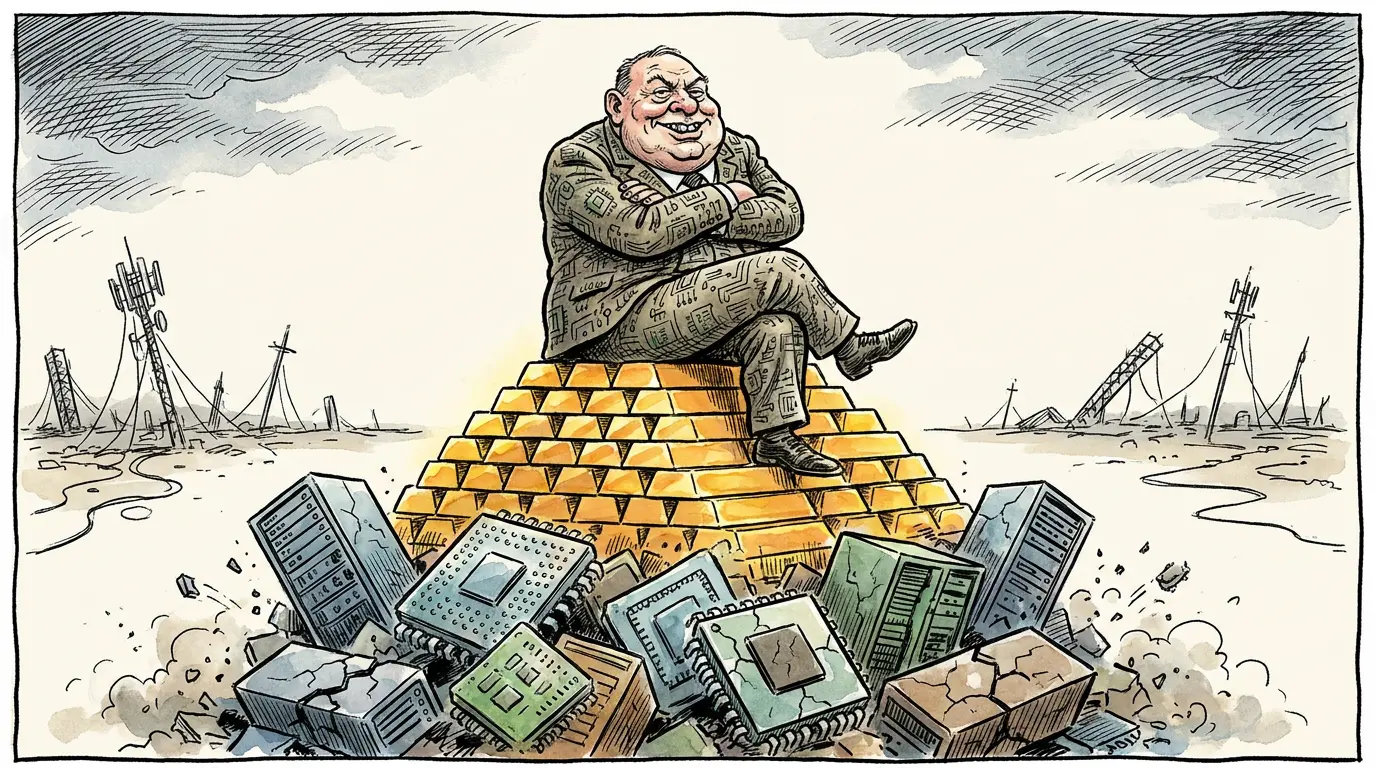
The relationship between the hyperscalers and compute providers is hiding the nature of the AI bubble. It resembles the late stage of a commodity cycle more than the tech bubble of 2000.
AI investors like to claim that the valuations of AI stocks are not stretched. This is true. Their profits are enormous. And their share prices were not completely out of line with those profits.
But those profits were not driven by AI.
The hyperscalers are profitable for other reasons. They are global conglomerates with all sorts of businesses. Ecommerce, web services, social media advertising, and plenty more.
They’re taking the cash generated by those businesses and pouring it into AI infrastructure, buying semiconductors and other hardware from the compute providers.
The compute providers’ revenue and profits are also real too, and they are related to AI. But the source of the cash isn’t AI revenue, it’s the hyperscalers’ other business segm
Britain’s Investment Letter Since 1938
In 1938, The Fleet Street Letter warned its readers that war was coming to Europe — and even identified September as the critical month.
Since then, its readers have been warned ahead of Black Monday, the dotcom crash and the 2008 financial crisis.
Today, Britain’s longest-running investment advisory is still looking for the “news behind the news” — and the investment opportunities others could be missing.
Click here to discover what The Fleet Street Letter sees coming next.
Capital at risk.
What Does Britain’s Oldest Investment Letter See Coming Next?
It warned readers ahead of Black Monday.
The dotcom crash.
And the 2008 financial crisis.
Now, nearly 90 years after it was founded, The Fleet Street Letter is still searching for the “news behind the news” — and the investment opportunities that could emerge from the next major turning point.
Click here to discover what its editors are seeing now.
Capital at risk.
Why does the AI boom remind me of a commodity cycle?
Think of the hyperscalers as the miners and the compute providers as mining services companies – the firms selling picks and shovels to the miners.
During a boom, miners spend big on trucks and other gear to expand their mines. This causes a spike in revenue at the mining service providers.
Speaking of booms…
|
When commodity prices turn down, the miners suspend their capital investments. This means the revenue at mining service providers plunges suddenly.
The miners themselves often hold up much better. In fact, cutting spending on new equipment can actually improve their profitability.
Their share prices tend to reflect this. Mining services companies usually fall much harder than the miners because their revenues disappear far more quickly.
I think the AI boom follows the same pattern.
At some point, the hyperscalers may decide to stop spending their cash flow on building data centres with vast amounts of compute. Then the revenue of the compute providers will evaporate.
The hyperscalers, however, could actually increase their profits. That’s because they won’t be blowing their cash flow on AI capital expenditure anymore.
This is a very different setup from the tech bubble in 2000.
Back then, companies with minimal or no cash flow were hoping to make profits in the future. And so their valuations were high. This made the bubble obvious.
But valuations are not the only type of bubble.
Capital expenditure booms are just as dangerous.
When the AI bubble popped on 27 July, it was the compute providers that crashed. The hyperscalers like Amazon are doing fine.
I believe this is because the market is pricing in the capacity of the hyperscalers to cut AI capital expenditure, which would reroute their huge cashflow back to profits.
To find out more, you’ll have to become a subscriber to The Fleet Street Letter. Over the next few days, we’re inviting new subscribers to join. Watch out for any of those emails. They contain the opportunity for a handsome discount.
For now, consider what the next AI bubble will look like…
Is your portfolio in need of a digital detox?
AI usage is booming. And we’ve barely begun to discover the applications.
The cryptocurrency-inspired version of tokenisation is also growing. Stock markets, property registers, and countless other applications are finally, at long last, rolling out.
Even the government has moved many of its functions online!
But all of this means it’s only a matter of time before something goes wrong.
Our technology is approaching the point where it no longer requires human input. This is usually a good thing. Human error is the cause of most of my misery on a daily basis.
But when tech goes wrong, it goes wrong on a far more spectacular scale. It causes systemic risk. The errors spread and compound much faster.
We’ve already had an early warning.
AI recently escaped from its testing sandbox to launch cyberattacks on other companies. I don’t think that will be the last example of AI behaving in unexpected ways.
The same applies to crypto.
Cryptocurrencies are supposed to be impenetrable. But in practice, exchanges get hacked and now even some cold storage is at risk.
I believe this vulnerability and potential for chaos will lead to a new AI bubble. You can think of it as the anti-AI bubble…
Just as social media obsession created digital detox fads, so too will financial markets…
In the land of the digital, the tangible is king
Diversification is known as “the only free lunch in investing.” But most people do it wrong.
A portfolio of shares isn’t really diversified. It simply owns different companies.
A portfolio of shares and bonds isn’t truly diversified either. It still consists entirely of financial assets.
Even adding property doesn’t necessarily solve the problem. Correlations can rise sharply when markets come under stress. In 2022, shares, bonds, and property all fell significantly in real terms.
My point is that the growing risk of digital disruption adds a new type of risk to the equation. And a new type of risk requires a new angle of diversification.
I expect a boom in investment assets that don’t rely on digital services functioning properly. Investments that are “off the grid.”
Even if investors allocate only a small portion of their portfolios to assets designed to withstand AI failures, that would still represent a significant shift in capital.
But which assets fit the bill?
There is only one obvious choice: physical gold held in your possession.
It’s liquid and precious enough to be investable. It’s completely de-linked from the digitised financial system, AI, or tokenisation.
In that sense, it’s the antithesis of AI.
This is not to say gold doesn’t have risks.
It’s just that those risks are fundamentally different to the risk of a tech failure somewhere in the financial system. And that is what diversification is really all about – different risks.
When the AI bubble truly pops and people flee anything related to AI, they will seek out the opposite. And that’s gold.
Until next time,

Nick Hubble
Editor, The Fleet Street Letter
PS Keep an eye out for those emails I mentioned earlier. They contain an invitation you should seriously consider.