 In today’s Issue:
- We’ve narrowly dodged technological Nirvana before
- How AI makes electricity cheaper
- Bet on governments fending off prosperity
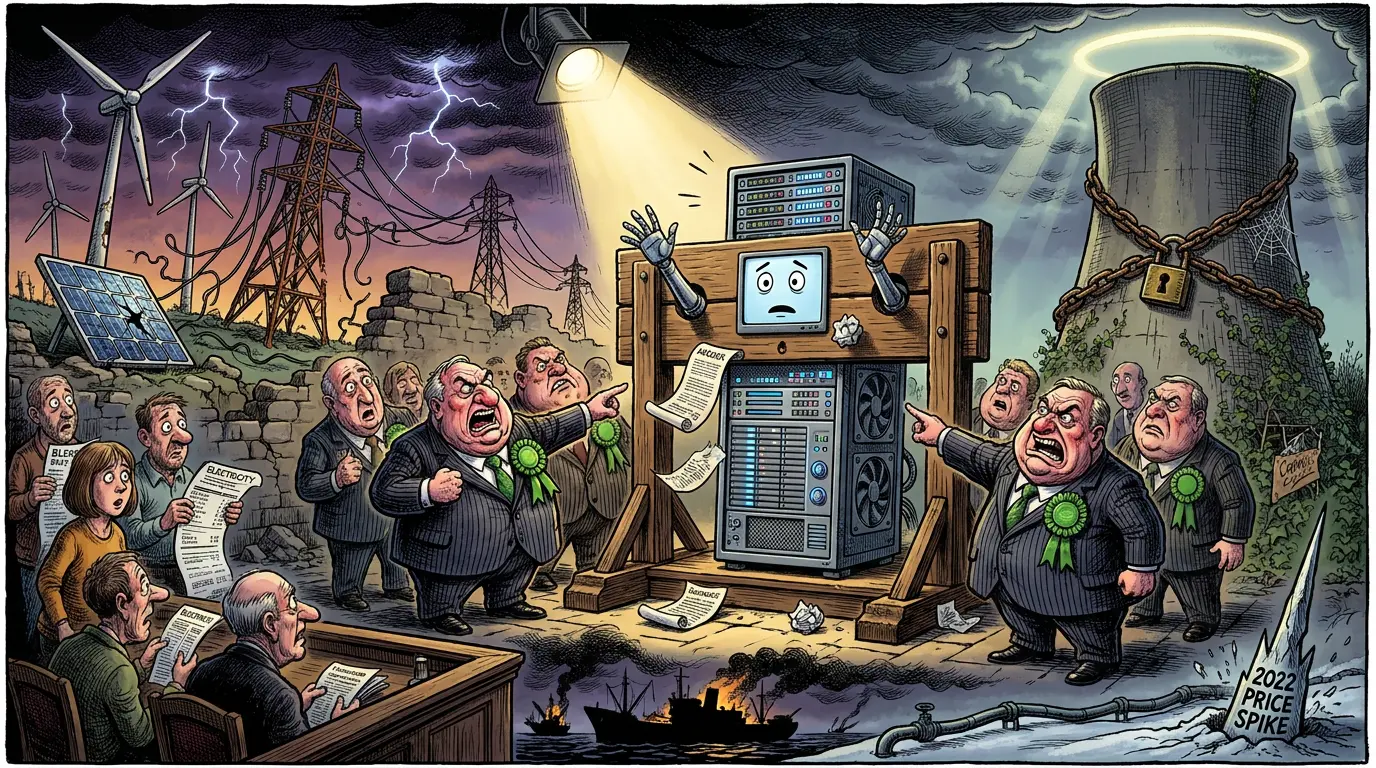
What would the world be like if environmental activists hadn’t short circuited the nuclear age?
Would we have built an electricity grid that covers the face of the earth like a skin disease?
Would the 2021 green energy bubble have cost investors so dearly?
Would companies have wasted billions of shareholder funds on green virtue signalling?
Would the West have achieved energy security given the ease of storing enough nuclear fuel to last decades?
Would our political system have split on the issue of carbon emissions?
Would we be using bunker fuel to power our ships? Or would nuclear powered cargo ships cross our oceans emissions free, like in 1959?
Would Russia have invaded Ukraine, safe in the knowledge that Europe would not only fail to respond, but fund the Russian war effort by buying Russian oil and gas?
Would we have had an energy crisis in 2022?
Would our power bills be impervious to the Strait of Hormuz closing?
Would those bills have been steady and stable given that the variable costs of nuclear are small and hardly fluctuate under long-term supply agreements?
Would we have had a double-digit inflation spike if electricity prices were impervious to oil and gas prices?
Would our grids be stable enough to counter Russian disruption, just as France’s nuclear heavy grid stopped Spain’s blackout from spreading to another country?
Would nuclear powered desalination have solved our water problems, like in the Middle East?
Would we be burning coal?
Would we need hydropower storage, salt caverns, gas storage, oil storage, batteries, voltage optimisers, rooftop solar, home batteries, smart meters, and countless other expensive “innovations”?
What percentage of our car fleet would be electric?
How advanced would hydrogen fuel be if hydrogen production used stable electricity supply instead of intermittent?
Would our countryside be at war with Westminster over wind turbines?
It is truly astonishing to think how many of our problems would’ve been solved by a nuclear dominated grid.
The French must be seething that they hooked up their grid to the rest of Europe.
And the Japanese must be terribly embarrassed that they turned their back on the safest form of electricity in the world… even if only for a while. They’ve just announced plans to rebuild a good chunk of their nuclear power fleet.
The point is that these birds-eye-view strategic decisions end up having truly extraordinary impacts on our day-to-day lives. They can preserve us from all sorts of problems. Or trigger everyday chaos.
Today, I want to warn you that we are on the cusp of making the same mistake again. A fundamental misunderstanding that could reshape the planet is playing out at the political level.
And you’re probably on the wrong side of history…
Britain’s Investment Letter Since 1938
In 1938, The Fleet Street Letter warned its readers that war was coming to Europe — and even identified September as the critical month.
Since then, its readers have been warned ahead of Black Monday, the dotcom crash and the 2008 financial crisis.
Today, Britain’s longest-running investment advisory is still looking for the “news behind the news” — and the investment opportunities others could be missing.
Click here to discover what The Fleet Street Letter sees coming next.
Capital at risk.
What Does Britain’s Oldest Investment Letter See Coming Next?
It warned readers ahead of Black Monday.
The dotcom crash.
And the 2008 financial crisis.
Now, nearly 90 years after it was founded, The Fleet Street Letter is still searching for the “news behind the news” — and the investment opportunities that could emerge from the next major turning point.
Click here to discover what its editors are seeing now.
Capital at risk.
How AI reduces electricity costs
Electricity is not like other goods. It’s counterintuitive for a long list of reasons…
- The importance of the grid and network relative to the creation of electricity is extreme.
- The need to meet peak demand is crucial, leaving much of the rest of the day comparatively unimportant.
- A failure at one point can cause a chain of failures right across the grid.
- Electricity pricing uses a very odd system because the underlying good is so unique.
- Supply and demand on the grid must be balanced to the microsecond to avoid a general failure.
- And electricity’s importance to our daily living is so extreme that we have backup systems just in case.
Combine all these odd features and you can see how electricity is very easy to misunderstand.
But some of the same economic laws do apply.
Economies of scale dictate that high energy demand can reduce prices per unit of energy.
This might seem counterintuitive. Isn’t the cost curve supposed to be upward sloping? Isn’t producing more supposed to become more expensive?
The contradiction is solved by the issues of time and scale.
Cost per unit of many things initially falls as the amount of production increases. Mechanisation is a good example of this. Only eventually, as resources are used up, do costs rise.
The complication is that more demand for something allows other parts of the production process to use economies of scale to expand too.
Coal mines needed a huge source of demand to become cost efficient using mechanisation. Ironically, the steam engine was designed to pump water out of coal mines…
Here’s what’s interesting. It seems the electricity grid benefits from the same relationship between demand and cost.
The evidence is already in
A new Institute for Energy Research study claims that “the latest data from the Energy Information Administration (EIA) on electricity prices and sales contradict the narrative that data centers are driving up electricity prices.”
First it points out that electricity prices aren’t high or rising in areas with high data centre concentrations:
There is no statistically significant correlation between the number of data centers in a state and its current electricity prices. In fact, prices in the top ten data center states are virtually identical to the average across other states. Furthermore, there is no statistically significant relationship between data center concentration and faster increases in electricity rates.
This surprise has nothing to do with AI. It is due to the nature of electricity:
Does rising electricity demand lead to higher prices? No. The relationship runs sharply in the opposite direction, which is one of the strongest findings in the entire dataset.
Across all 50 states, states where electricity sales grew faster from 2015 to 2025 paid less, not more, for electricity. States where sales declined paid dramatically more.
The logic is simple:
The intuition behind this result is straightforward. Electricity grids entail high fixed costs, transmission infrastructure, and generation capacity, as well as long-term contracts that must be recovered regardless of how much power flows through them. When sales grow, those fixed costs are spread across more kilowatt-hours, holding per-unit rates down.
The electricity grid is like a road that only really gets used during rush hour. Adding data centre demand to the grid actually optimises the use of that road. And so the cost is carried by more shoulders.
AI data centres would only cause trouble where the electricity grid is already struggling. In which case the grid would have to be expanded.
But AI data centres avoid such areas in the first place. Or pay disproportionately to add to the grid in the ways needed.
Of course, this explanation doesn’t really matter. Most people won’t understand it. And politicians will make the most of this.
Why AI is the perfect scapegoat
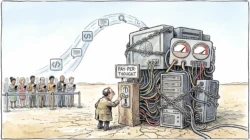
As the consequences of our Net Zero policies begin to play out, AI’s voracious energy demand will be blamed for its failure. This kills two birds with one stone. Job losses and rising power bills can both be blamed on AI.
This is classic left-wing politics. It also highlights the reason that capitalism works and central planning does not.
Consumer sovereignty is the guiding light of capitalism. It is what organises society. It decides what is produced and what isn’t.
To central planners, the immediate solution to a lack of production is not to produce more of what people want. It is to constrain demand. To blame excess demand for shortages.
Thus, we won’t build an electricity grid to fuel AI because people want to use it. We’ll constrain AI to meet our capacity to produce power.
The irony is immense. AI is what could save us from escalating power bills. Its voracious demand is what could make electricity affordable again.
In the end, we could end up with expensive electricity and underpowered AI.
Our suggestion? Continue to bet on politicians getting this terribly wrong.
Until next time,

Nick Hubble
Editor, The Fleet Street Letter
PS I’ve made some big predictions over the years. Some sounded completely implausible at the time. But that’s usually when the best opportunities appear.
On 9 July, I’m going to explain why I believe we’re standing at the beginning of the biggest market shift of my career — and the three stocks I think are best placed to benefit.