 The four biggest hyperscalers are about to post their weakest free cash flow in more than a decade.
But I think that’s just the calm before the storm.
On 13 April, I wrote to you about Amazon being a company stuffed full of other companies.
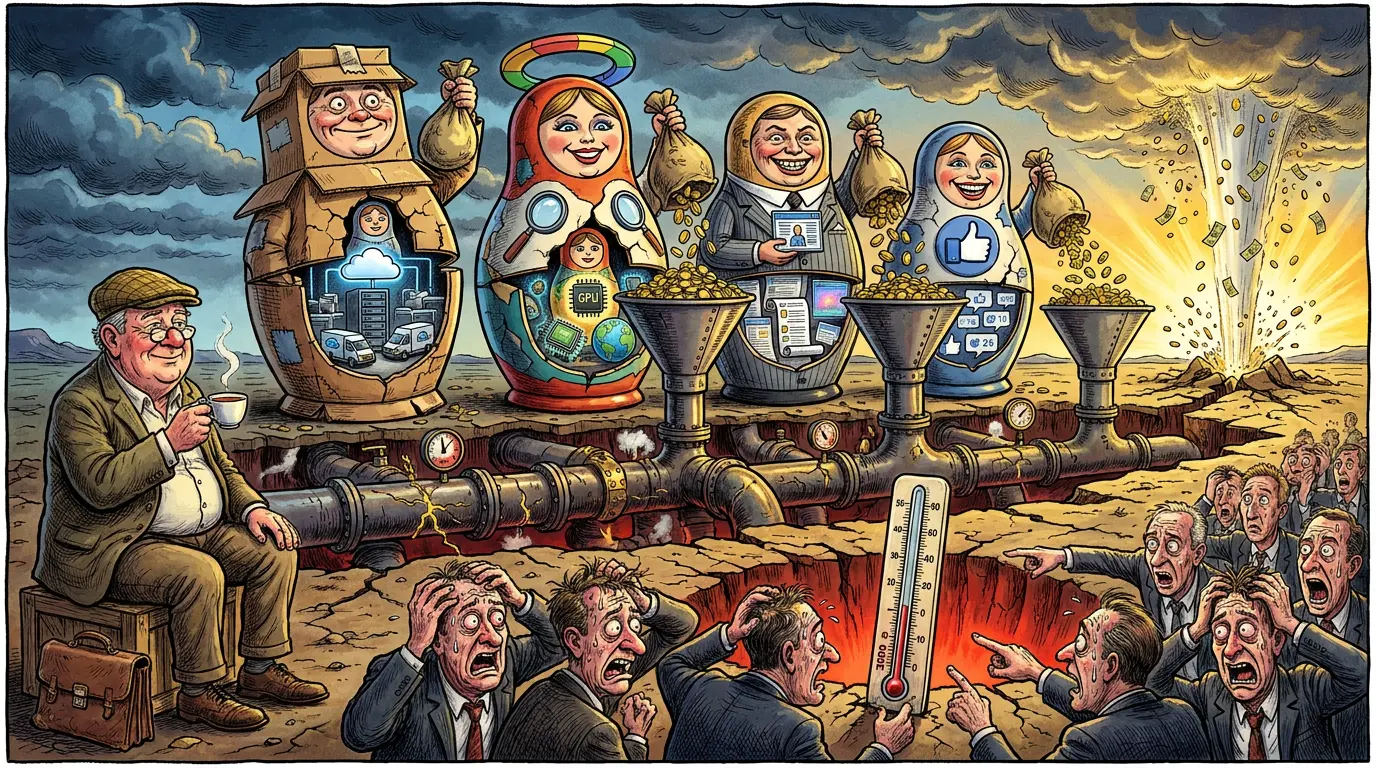
An ecommerce business wrapped around a cloud business, wrapped around a logistics empire, wrapped around one of the world’s biggest AI chip businesses. A proverbial matryoshka doll of big tech—you know, those Russian wooden dolls where you keep opening one only to find another inside.
Pop the lid on the other giants and it’s the same story.
Alphabet (Nasdaq: GOOGL) is Search, YouTube, Cloud, Waymo, and a whole collection of mind-blowing moonshots.
Microsoft (Nasdaq: MSFT) is Azure, Office, Windows, LinkedIn, and Xbox.
Meta Platforms (Nasdaq: META) runs the biggest advertising machine ever built while quietly laying down AI infrastructure on the side.
When I wrote that Amazon piece, it centred on something CEO Andy Jassy said in his shareholder letter:
“We’re not investing approximately US$200 billion in capex in 2026 on a hunch.”
I know, because we’ve seen it before, that when big tech spends this kind of money on infrastructure, it’s rarely by accident.
The reason isn’t always obvious to the market.
But it’s obvious to me.
Yes, sometimes these big bets miss the mark. Just look at Meta’s first pivot into the metaverse.
But when the spending goes into infrastructure that changes how the world works, the payoff rarely comes overnight.
It comes later.
And when it does…
Kablamo.
Liftoff.
I bring all this up because I came across a chart this week that puts what’s coming into perspective.
We already know free cash flow across the hyperscalers is taking a hit as they pour hundreds of billions of dollars into the AI intelligence buildout.
The interesting question isn’t what’s happening today.
It’s what happens when all that spending finally starts paying for itself.
Courtesy of the Financial Times, it looks like this.
 Source: Financial Times (S&P Capital IQ historical figures; Bloomberg consensus estimates)
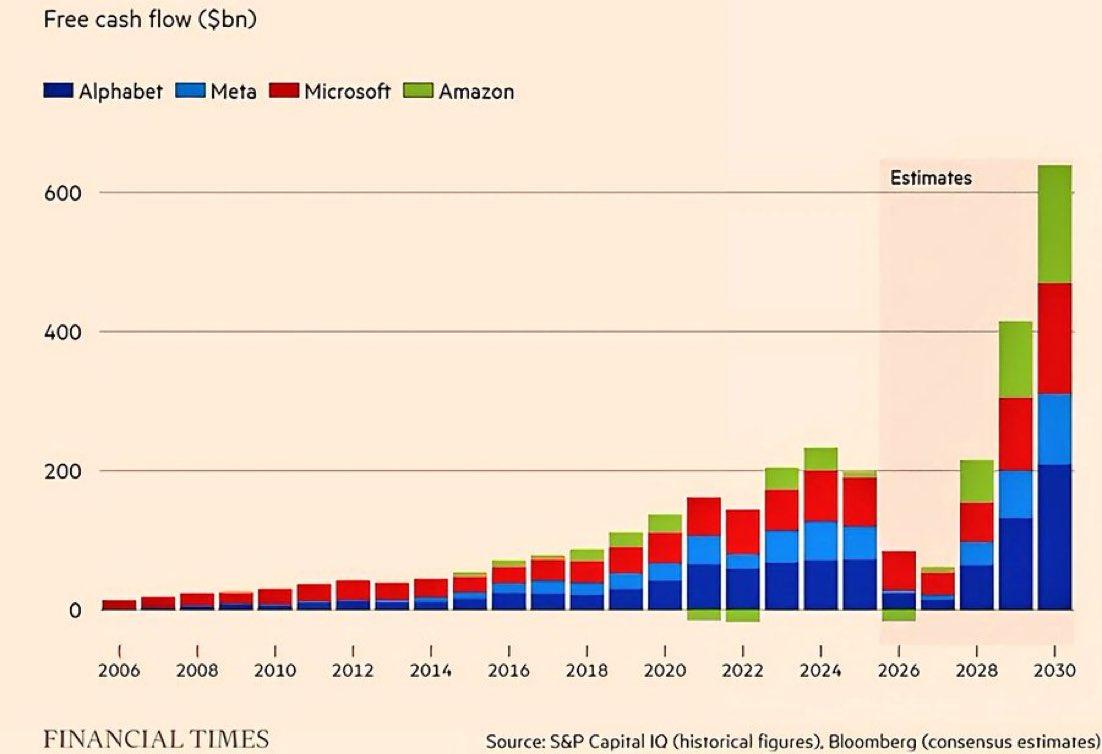
It tracks the combined free cash flow (FCF) of Alphabet (Nasdaq: GOOGL), Meta Platforms (Nasdaq: META), Microsoft (Nasdaq: MSFT), and Amazon.com (Nasdaq: AMZN).
For nearly two decades, the group’s free cash flow climbed steadily, reaching somewhere north of US$200 billion by 2024.
Then the AI revolution kicked into overdrive. Free cash flow fell off a cliff. The bars shrink.
Amazon even dips below zero. But now we can start looking at what analysts expect over the next few years.
From 2028, free cash flow doesn’t just recover and grind higher.
It explodes. And not by a little. It blows the roof off. It bends the minds of the mainstream. It very nearly goes vertical, surging towards US$640 billion by 2030.
Britain’s Investment Letter Since 1938
In 1938, The Fleet Street Letter warned its readers that war was coming to Europe — and even identified September as the critical month.
Since then, its readers have been warned ahead of Black Monday, the dotcom crash and the 2008 financial crisis.
Today, Britain’s longest-running investment advisory is still looking for the “news behind the news” — and the investment opportunities others could be missing.
Click here to discover what The Fleet Street Letter sees coming next.
Capital at risk.
What Does Britain’s Oldest Investment Letter See Coming Next?
It warned readers ahead of Black Monday.
The dotcom crash.
And the 2008 financial crisis.
Now, nearly 90 years after it was founded, The Fleet Street Letter is still searching for the “news behind the news” — and the investment opportunities that could emerge from the next major turning point.
Click here to discover what its editors are seeing now.
Capital at risk.
The build years nobody enjoys
Right now these four are spending like there’s no tomorrow.
Combined capital expenditure for 2026 is tracking around $700 billion, up from roughly $410 billion last year. Amazon as per Andy Jassy is on track for $200 billion. Data centres, GPUs, power contracts, networking, cooling, land.
All of that money leaves the building immediately.
So free cash flow, the cash left over once the bills and the building are paid for, gets hammered.
The chart shows these four are heading for their weakest full-year free cash flow since 2014, back when they were roughly a seventh of their current size.
Amazon is even projected to burn cash this year.
And frankly, in 2026, the market hasn’t rewarded any of them.
Year to date, Amazon.com (Nasdaq: AMZN) is up just 4%—and that’s after yesterday’s rally.
Meta Platforms (Nasdaq: META) is down 14%.
Microsoft (Nasdaq: MSFT) is down 23%.
Alphabet (Nasdaq: GOOGL) has fared a little better, up 11%, but given the excitement around AI, that’s a fairly demure return.
The market is looking at the here and now.
As investors, we should be looking at tomorrow.
And every fibre of my being says tomorrow is going to be glorious.
Where the cash comes back
A data centre is not a bonfire. You pour the concrete, rack the chips, sign the power contract, and then it earns money for years. The spending is front-loaded, the returns come later. Capex doesn’t disappear, but once these assets begin generating cash, the investment equation changes dramatically.
That’s why the chart doesn’t simply recover. It launches. Consensus expects the combined free cash flow of these four companies to top US$600 billion by 2030—multiples of where it sits today.
This is where the matryoshka nature of these businesses really pays off. Every layer plugs into the infrastructure they’re building today. AWS rents it out. Google monetises it through Search and Cloud. Microsoft pushes it through Azure and Copilot. Meta uses it to make its advertising machine even more valuable. One enormous upfront bill, multiple ways to earn it back.
And the numbers are already pointing that way. Google Cloud grew 63% in a recent quarter. Microsoft’s AI business has crossed a US$37 billion annual run rate. AWS is now running at roughly US$150 billion annualised. That’s real revenue, and it’s growing fast.
If these companies land anywhere near those 2030 estimates, US$10 trillion valuations stop sounding bonkers and start sounding inevitable.
And everything supplying them gets pulled higher too: the chip designers, the memory makers, the foundries, the power suppliers, and the cooling companies.
Now, let’s also be clear. These are projections.
Those 2028 to 2030 numbers may never materialise. Monetising AI at this scale is no easy task. These companies are exceptionally good at what they do, but they aren’t perfect.
Right now, the four are spending something like US$450 billion a year on AI infrastructure while generating perhaps US$25 billion in direct AI revenue. If demand stalls, or the hardware becomes obsolete faster than expected, those rosy 2030 projections quickly disappear and you’re looking at write-downs for the record books.
Even Alphabet CEO Sundar Pichai admits there are “elements of irrationality” in the spending.
So we could be wrong.
But I don’t think we are.
I think the market is far too focused on today and not nearly focused enough on tomorrow.
We saw something similar a couple of years ago when the market punished big tech for mass layoffs. It took the best part of 18 months before investors recognised what those cuts had done for profits and margins.
This is that…
On steroids.
I’m looking at an infrastructure buildout unlike anything we’ve seen before, followed by a payoff that could be just as extraordinary.
In my view, you’ve got a window now, while everyone is fixated on the trough. Or you can wait until the cash starts visibly flooding back, the share prices have already moved, and you’re left asking the question nobody enjoys:
What if I’d been earlier?
Until next time,

Sam Volkering
Investment Director, Southbank Investment Research
PS The hyperscalers themselves are the obvious way to play this. But I reckon the more interesting money sits one rung down, with the unglamorous suppliers that get repriced every time one of these giants signs another cheque. Nick Hubble and I will be digging into exactly that during our live YouTube broadcast on 9 July, where we’ll answer a simple question: If you had fresh money to put to work today, where would you put it? Be sure to sign up here.