 In today’s Issue:
- Some very familiar crises
- Unusually dangerous divisions
- Will democracy settle our differences?
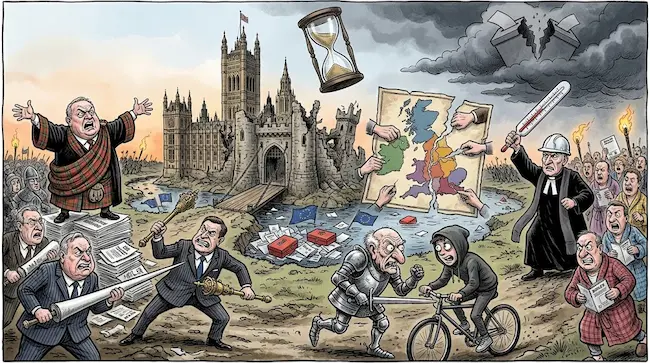
It’s nice to see the UK getting back to its political roots.
We’ve got an unelected Catholic pretender king from the North laying claim to the South…
A political assassination on the moor…
We thrashed the French on American soil for no real gain…
Our political debates are about which distant territories we should give up next…
And we even saw a half-baked crusade against the infidel that failed to get off the ground.
If anyone sees Prince Harry taking Prince George and Princess Charlotte to visit a particular staircase at the Tower of London, you’ll know things are really kicking off.
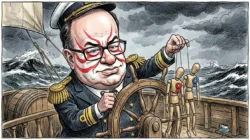
All that’s missing to complete my sense of nostalgia is a proper navy.
No doubt Wes Streeting will fix that. Although it may take press gangs.
It has even become fashionable to talk of civil war. Are things really that bad?
Forget AI, America’s No.1 forecaster says a bigger boom is coming:
“I’ve invested $1 million of my own money to prepare for this…”
He predicted the Financial Crash, both Trump victories and 2025’s record rare metals surge that saw stocks soar as much as 645%
Now discover the move he is making as America seeks to unlock a home grown fortune potentially worth trillions on Friday, May 15th
Find out what that move is right here >>
Capital at risk
Our divisions are dangerous indeed
It seems impossible to seriously consider any sort of civil war. And it is impossible that one would break out.
But what if we broaden the definition a bit?
What if politics is descending into something not quite as bad – but still rather bad?
What if our civil war is more of an attempt by one part of the country to rule at the expense of another?
Well, then the question becomes: Where are the battle lines?
We could, for example, have intergenerational warfare.
People who use that term don’t imagine pensioners descending on schools swinging lawn bowls in their stockings. Rather, it’s about one generation exerting its political influence over another in ways perceived as unfair or domineering.
Tax reform could heavily favour one generation over another. Taxing private schools to help fund pensions, for example.
It’s not necessarily the vision for the future that matters. It’s the shift.
If one generation became wealthy under a set of generous tax policies, changing those policies today denies the next generation the same opportunity to build wealth in the same way.
Equally, taxing older generations for their disproportionate gains would be seen by many as an unexpected breach of their property rights.
Both are divisive enough to be unjust. They pit one set of voters against another. Questions of what policy is “right” or “works best” quickly fall by the wayside.
Other possibilities…
Perhaps we’ll be divided by geography instead.
The Prime Minister’s popularity is sharply divided along geographical lines – lines that will look familiar to students of civil war history.
Andy Burnham favours devolution. Which is an interesting idea given the size of fiscal transfers from some parts of the country to others.
Can regions of the UK govern themselves without funding themselves?
And what if devolution simply leads to even more unequal outcomes?
Politicians from the nationalist parties of Scotland, Northern Ireland, and Wales sit in a parliament that governs the UK as a whole. How do you think they view the purpose of UK-wide politics?
Perhaps our backgrounds will form the battle lines instead.
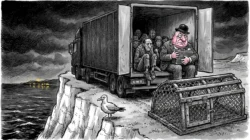
Migrant communities are already concentrated and politically influential enough to sway elections. That creates political divisions the UK is not particularly accustomed to. Someone else has drawn lines through our democracy for us – lines that often have little to do with policy or ideology.
Or perhaps we’ll divide ourselves over foreign conflicts.
People openly protest against one another over foreign governments and distant wars. Haven’t they got anything closer to home to riot about?
Morality is proving divisive too.
We still can’t agree on what a woman is, for example. Yet everyone remains absolutely certain that their definition is the correct one.
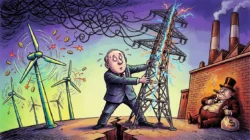
Environmentalism has pushed politics to the point where governments can conceivably control how people heat and cool their homes. Imagine placing that power in the hands of some of our former prime ministers. It’s enough to provoke riots and counter-riots.
The nationalists are steadily winning the battle against the globalists lately. But that rarely comes without unpleasant consequences of its own. And what happens when the nationalists start disagreeing with one another?
|
Not the usual political debate anymore
Recent events suggest our political conflicts have reached a different pitch. Politics used to divide families and end friendships. Now it threatens the cohesion of the political system itself.
The principles of democracy, property rights, loser’s consent, and pragmatism are taking a back seat to limitless causes pursued for their own sake – welfare, environmentalism, and globalism without limits.
These differences are far more divisive than the political disagreements of recent decades. And they cannot be settled by elections, blackouts, or GDP growth.
Brexit changed who governed our country. But in the end, there is very little difference between the British and European political classes.
The gap between New Labour and the Conservatives was small too.
The ideological battles of the past were settled by what worked. Capitalism defeated communism in practice, and politics adjusted accordingly.
Today’s political battles run much deeper.
They are beginning to resemble the sorts of arguments we settled centuries ago.
And so the rules of politics are being bent back towards older standards.
Medieval standards.
Until next time,

Nick Hubble
Editor, The Fleet Street Letter
PS Politics has a habit of changing remarkably quickly when strategic resources are involved. Yesterday’s environmental virtues become today’s national interest. That’s particularly true when trillions of pounds are at stake.
Sam Volkering, our Southbank Research Investment Director, recently revealed what a House of Commons report values at £45 trillion sitting off Britain’s coastline… and why he believes it could become one of the biggest investment opportunities available to UK investors in decades.
He’s also named the company he believes stands to benefit most.
I’d encourage you to watch the full briefing while it’s still available.