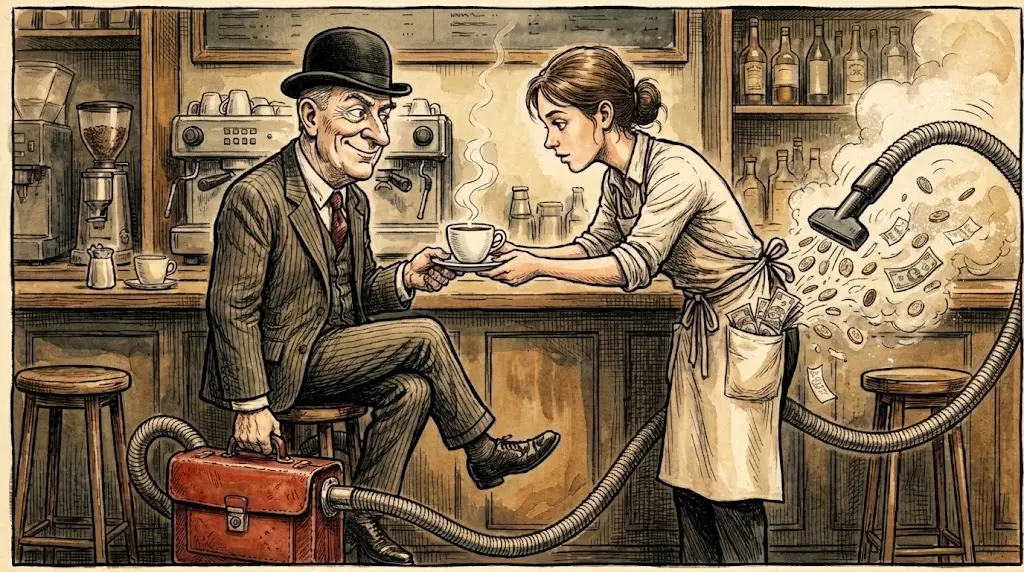
 Let’s say you run a café in Brighton.
Your barista is on the minimum wage, working 37.5 hours a week. Then you hear that today, the Chancellor is going to raise the minimum wage.
John Healey is expected to lift the National Living Wage from £12.71 an hour to £13.20, a rise of 3.9%, according to The Times.
That’s only 49p an hour, and for your barista, it’s fair enough. You’re not completely opposed to it, but you’re also acutely aware that everything is costing you more to run the business these days.
Over a year, 49p an hour amounts to £955.50 in extra pay.
You pay 15% employer National Insurance on top of that, so the rise costs you £1,098.83 for one full-time worker.
Again, you don’t mind that, but you’ve got three baristas on rotating shifts, plus three kitchen staff and a couple of servers. Assuming they’re all on minimum wage, you’ll have to find an extra £9,000, give or take (including pension auto-enrolment).
Besides… how much of that ends up in their pockets?
Looking at the one barista, they keep about £688.
Income tax takes £191.10, and their own National Insurance takes £76.44. Add your £143.33, and the Treasury collects £410.87, or 37p of every pound you spend on the rise.
Hang on a minute…
This is the minimum wage, and the Treasury still takes 37p in every pound of the rise?
Yes, because it taxes the job three times.
Your barista pays 20% income tax and 8% National Insurance on the extra, and you pay 15% on top before they see a penny.
And because the tax-free allowance never moves, more of their pay gets taxed every year.
In April 2021, a full-time worker on the £8.91 living wage paid £960.90 in income tax, 5.5% of their pay. Next April, on £13.20, it’ll be £2,634, or 10.2%.
In cash terms, that’s a 174% rise in tax on the lowest earners in just five years.
And it’s only going to get worse.
Britain’s Investment Letter Since 1938
In 1938, The Fleet Street Letter warned its readers that war was coming to Europe — and even identified September as the critical month.
Since then, its readers have been warned ahead of Black Monday, the dotcom crash and the 2008 financial crisis.
Today, Britain’s longest-running investment advisory is still looking for the “news behind the news” — and the investment opportunities others could be missing.
Click here to discover what The Fleet Street Letter sees coming next.
Capital at risk.
What Does Britain’s Oldest Investment Letter See Coming Next?
It warned readers ahead of Black Monday.
The dotcom crash.
And the 2008 financial crisis.
Now, nearly 90 years after it was founded, The Fleet Street Letter is still searching for the “news behind the news” — and the investment opportunities that could emerge from the next major turning point.
Click here to discover what its editors are seeing now.
Capital at risk.
Everyone gets dragged up for the squeeze
The government will gloss over it once again… and both sides of the political divide are guilty of this abhorrent policy.
But the tax-free personal allowance has sat at £12,570 since 2021, and it’s frozen there until April 2031.
Wages rise, yet the tax bands don’t.
And year after year, more and more people slide into a higher bracket without feeling any richer… because they’re not.
There is ZERO incentive to earn more when you’re penalised for doing so.
Even when you earn the same, the government is intent on squeezing the life out of you until you’re paying top whack.
The UK calls it fiscal drag.
I know it as bracket creep.
The truth is, it’s a stealth tax, intentionally designed to get as many people as possible, even the lowest earners, paying the most tax humanly possible.
Every single person in government knows it, too. And if they don’t then they’re flat-out brain-dead and don’t deserve to hold office.
Worse still, they’re all complicit. The thieving mugs.
HMRC expects 7.7 million higher rate taxpayers this tax year, up from 4.43 million in 2021/22. That’s 74% more people in the highest tax bracket in just five years.
And what has all this extra tax revenue achieved?
Not much.
Borrowing is running £8.1 billion above forecast, and the Institute for Fiscal Studies says Healey’s buffer has shrunk to £11 billion from £24 billion.
You can’t tax your way out of a decade with no growth.
The bloat was the problem
So where did the money go?
Well, let’s go look at the civil service, shall we?
In June 2016, the civil service had 384,230 full-time staff, its smallest since the Second World War. By March this year, it had 523,635.
It’s the biggest it’s been since 2005.
Britain isn’t alone, by the way.
Australia is in a similar position.
Even the Dutch have seen immense bloat, but at least they’re looking to do something about it.
Its central government workforce hit a record 160,000 at the end of 2025, up 41% on 2018.
So the Dutch government has said it will cut 25,000 civil service jobs by 2035 and save €3.5 billion a year, with AI doing much of the lifting.
We’re seeing AI as a way for not just the government, but private-sector companies to cut bloat.
Barclays is cutting around 5,000 jobs, and this week, Microsoft is reportedly looking to let go of 60,000 employees across its global workforce as it reshapes how it uses AI in the workplace.
It looks grim if you’re on the wrong end of one of those emails saying, “Thanks and goodbye.” But the problem isn’t AI. It’s the bloat that piled up while growth went missing.
AI is the tool that finally shows how much bloat there is.
AI is also one way growth can return to the table, potentially easing the tax burden on the population.
It’s not a difficult problem to solve.
Cut the fat, the rot, and the waste.
Improve productivity and growth using the most advanced technology in history.
Lower tax pressures across all income brackets, and incentivise greater productivity and economic contribution.
It doesn’t right the ship in a quarter, but over two, three, or five years, it certainly could.
This also needs a commitment to embracing new technology, specifically AI. And it feels like there’s still a reluctance to do that in the UK.
I think that can be corrected.
But it starts one person at a time.
It starts with you.
Learn what these tools can do for you, your work, and your money, or you risk ending up on the scrap heap with the rest of the bloat.
I picked my lane and my AI of choice several years ago, and I’ve dedicated the years since to refining, learning, and developing my approach.
I’m an early mover and adopter, but even now, you’d be ahead of a huge proportion of the population.
This is also why I decided to go to the “Godfather of AI investing” and get him in front of a camera for the first time in over a decade.
He studied at MIT, where he was part of its artificial intelligence lab, then went on to earn an MBA at Harvard. He also holds two US patents in automated stock analysis.
For more than 20 years, he’s turned the published methods of Warren Buffett, Peter Lynch, and Benjamin Graham into computer models designed to identify investment opportunities.
What did I ask him?
How those models think, what the AI brains behind them do now, and how he’s using them while everyone else argues about tax bands.
We sat down for a deep-dive interview, and it goes out on Tuesday, 3 November.
Get your viewing pass here to make sure you’ve got a front-row seat. Just note that by clicking the link you agree to automatically be signed up to receive marketing information by email about Resonance AI. You can stop emails at any time using the link provided at the foot of each email.
Until next time,
Sam Volkering
Investment Director, Southbank Investment Research
PS Are you personally feeling the tax pinch? Share your thoughts about this situation. Share your stories about how it’s affecting your life. Email us at investorsdaily@southbankresearch.com. I look forwarding to hearing from you.