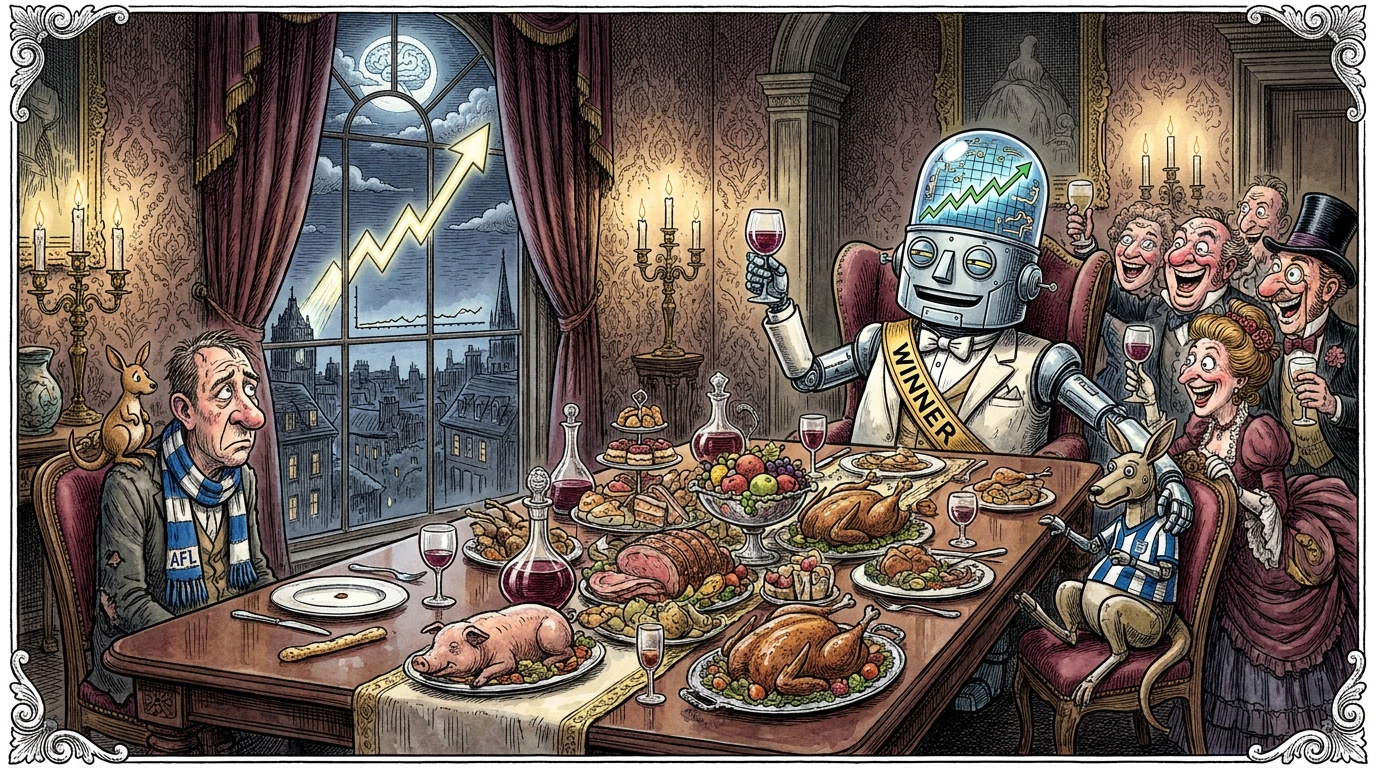
 I just won my football tipping competition.
It’s me and a group of friends. Every year, we run our own small football tipping competition, and the winner gets an all-expenses paid dinner courtesy of the rest of us.
There is one condition: the dinner has to be with all of us.
It’s a pretty good prize, really, considering how much wine we usually get through when we get together.
Anyway…
Historically, I’ve sucked at footy tipping. I’ve come last more times than I dare to count.
My problem is I’m blindly loyal to my Aussie football side, the North Melbourne Kangaroos, and frankly, for the better part of a decade now, they’ve also sucked. They lose a lot more than they win, so I’m always going in each week with one hand tied behind my back.
But this year… oh boy! This year it was all different.
See, I came last again. But I also came first!
Well, not technically me, but a creation of mine. A creation I like to call “KangasBot”.
Here it is in all its (simple) glory.
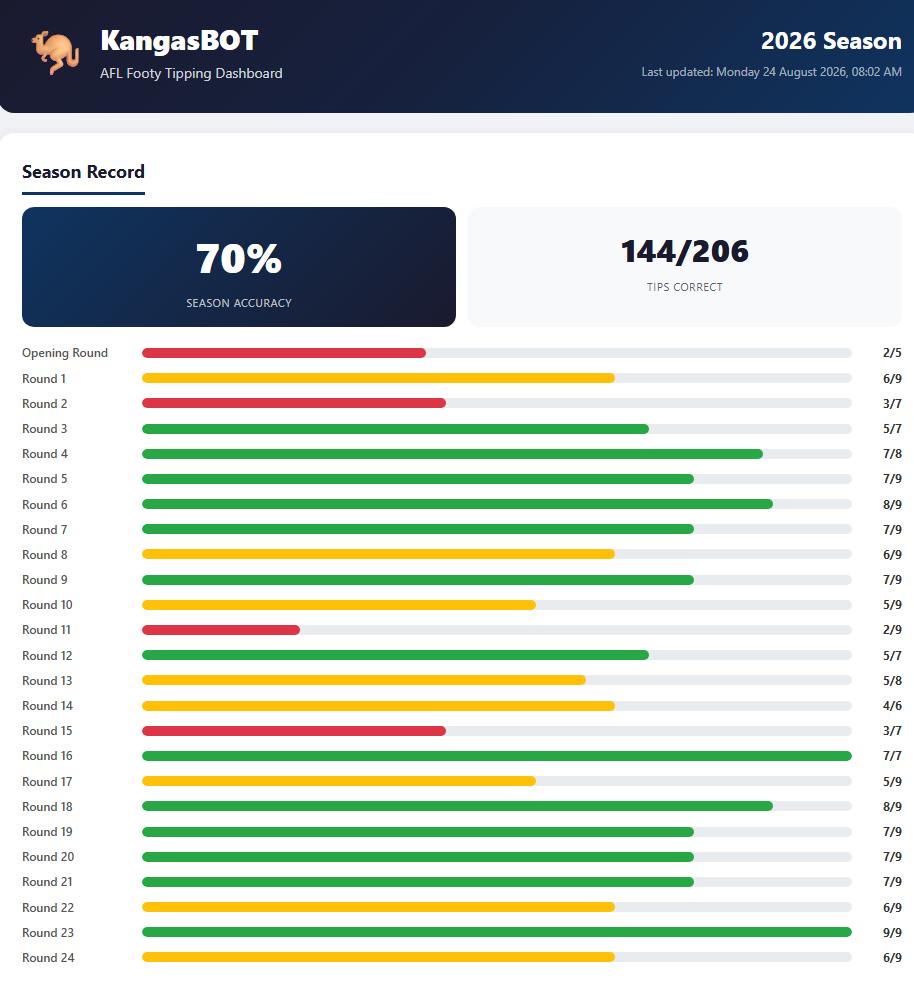
What you’re looking at there is 70% accuracy over the course of the year. It even managed perfect scores in two rounds!
This was enough to win our tipping competition (just).
What was clear from the results was that KangasBot struggled at first. It took a little time to adapt to the data, then it had a string of great results, then fell away mid-season, and then peaked again at the end.
Which of these is a recognised tendency that can cause investors to hold onto a losing investment for too long?
|
It evolves, it gets better
Now I’m writing to you about all this today because I built this. I built it with Claude Code, from scratch. I got it to pull in data from multiple sources, I got it to review weather forecasts, check out team injury lists, team selections, and form data.
It was a good chunk of data for it to analyse. But it also wasn’t the best data. I know I could be even more specific next year. I could find better-quality data sources, make the analysis more granular and specific, and go beyond simply reviewing team form.
I could look at individual player form, align that with team selections, and analyse performance against particular opponents, in particular conditions, at different points in the season. against opposition in certain conditions at certain times of the year.
In short, there’s no bounds to what I can build next, and how it can evolve.
If it can win in year one, I can only imagine what it will do next year, and the year after.
And next season, I’m going to back it in with some cash too and follow the tips. If it gets two or three or four perfect rounds next year… well there might just be a little profit to be made as well.
I built this because I was curious.
That curiosity came from something else I was already building.
At the start of the footy season in March, I was already a couple of years deep in my research, planning, and building of my Hyperion stock analysis AI tool.
As I was really starting to understand what Hyperion could do, I thought to myself: Why not build a predictive AI engine for my football tipping comp too?
Why not really put human versus machine to the test?
Now I’m realising just how striking the parallels between the two are.
When we backtested Hyperion, 80% of the stocks that appeared in its Top Five list went on to rise by at least double digits from their entry point within 12 months.
In other words, the AI I’d built would consistently put winners on the list.
But it needed the human element to determine which of those to choose, and when to get out.
Because double-digits was only the baseline.
In many months, there were multiple winners. Some went on to double. Some tripled. And every now and then, Hyperion found one of those elusive 1,000% winners.
So it was clearly good at what it was designed to do.
On top of that, when we looked at a simulated basket of 10 stocks and rotated them monthly based on Hyperion’s rankings, it outperformed the S&P 500 by more than 48-to-1.
That’s why I’ve decided to put Hyperion to the real test.
I’m now transparently tracking its performance using live market data.
And that’s been running since 23 July.
This isn’t backtesting anymore. This is the real test.
And so far, after just one month of live testing, Hyperion is already outperforming the S&P 500 by 13.3%.

Will that hold?
Will it continue to outperform?
I don’t know. All I can do is back the AI system I’ve built.
I hope it will, of course. And I hope in 11 more months I can write to you that it’s smashed the S&P 500.
But for now, at least, it’s doing its job. Just like KangasBot did its job. Because AI can do a job that humans simply can’t.
It’s like having an army of quants constantly building models and analysing vast amounts of data at a speed and scale only a machine can manage.
And it’s increasingly clear to me that we may be sitting on the precipice of something truly extraordinary – where the combination of machine intelligence and human judgement can achieve things neither could achieve alone.
There’s another parallel between KangasBot and Hyperion that I think is just as important.
Machines don’t become emotionally invested.
Britain’s Investment Letter Since 1938
In 1938, The Fleet Street Letter warned its readers that war was coming to Europe — and even identified September as the critical month.
Since then, its readers have been warned ahead of Black Monday, the dotcom crash and the 2008 financial crisis.
Today, Britain’s longest-running investment advisory is still looking for the “news behind the news” — and the investment opportunities others could be missing.
Click here to discover what The Fleet Street Letter sees coming next.
Capital at risk.
What Does Britain’s Oldest Investment Letter See Coming Next?
It warned readers ahead of Black Monday.
The dotcom crash.
And the 2008 financial crisis.
Now, nearly 90 years after it was founded, The Fleet Street Letter is still searching for the “news behind the news” — and the investment opportunities that could emerge from the next major turning point.
Click here to discover what its editors are seeing now.
Capital at risk.
The sweet spot between AI and humans
I blindly tip the Kangaroos because I’m loyal to them. Granted, I know this will impact my tipping scores, but that’s OK. I’d rather tip them and lose than tip against them and watch them win.
So I accept that risk.
The market is a different beast.
Investors can become blindly loyal to a stock without even realising it. And when they do, they typically aren’t aware of how much risk they’ve introduced into their portfolios.
Using AI tools, like Hyperion, helps to remove some of that human element of investing. You can look at its scores, how it rates a stock, how it uses millions of data points every day to determine what is primed to move higher now.
Then you overlay human experience, research, and insight to decide what to do with that information.
By removing human emotion and bias from the outset, you can then bring the human element back where it matters most.
I mean, that’s the idea at least.
Of course, it won’t always work because the market never delivers winners 100% of the time. We all know that.
But I do believe that using AI in all kinds of ways can radically improve outcomes for people.
That might be how you manage your household bills and budget, how you invest your money, or even which team you pick in this week’s tipping comp.
I believe the convergence of AI and humanity is more powerful than either humanity or machines on their own.
The sweet spot is somewhere in the middle. AI does its thing and does it at a level humans can’t, and then we do ours, bringing the experience, judgement, and insight machines cannot.
That sweet spot is why I spent the time building Hyperion from scratch.
And it’s why next year I expect KangasBot to dominate our footy tipping once again.
Regards,

Sam Volkering
Investment Director, Southbank Investment Research
PS If you want to see my Hyperion AI experiment you can take a look at here. Like I said, it’s now running on live market data, ranking the stocks it believes are primed to move higher, and we’re transparently tracking how it performs against the S&P 500.