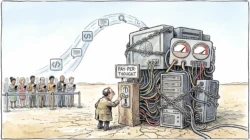
In August 2016, Jensen Huang walked into a small office in San Francisco carrying a computer about the size of a suitcase.
It weighed 70 pounds, held 35,000 parts, and took his engineers five years to build.
Before handing it over, he signed the case: “To the future of computing and humanity.”
The office belonged to OpenAI, then a non-profit research lab that almost nobody in the market had heard of.
The computer was the DGX-1, the first supercomputer built purely for AI. And the delivery was, in the context of what we know now, one of the most important moments in history.
It was more or less at this moment that Nvidia (Nasdaq: NVDA) decided it was going all-in on AI, a decade before AI was even really a thing.
For years afterwards, Nvidia was just a “gaming company”.
But inside, it was clear Huang had other ideas.
Then, last Wednesday night, Huang appeared on CNBC’s Mad Money, interviewed by Jim Cramer and talking about Nvidia’s latest earnings.
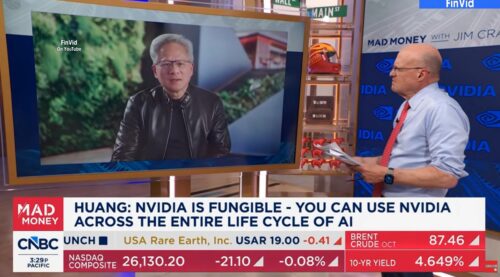
And all of it came down to one key growth catalyst.
Cramer asked… how on earth do you continue to grow revenues at 70% from here?
It’s a fair thing to ask a company worth around US$5 trillion.
That’s more than the yearly economic output of every country on Earth bar the US and China. Companies that size are supposed to grow like utilities.
Nobody told Jensen.
Compute is revenue
Hours earlier, Nvidia had reported revenue of US$96.2 billion for the quarter to 26 July, up 106% on a year ago.
US$89 billion of it came from data centres alone. You see data centres on the profit and loss statement, but you can read it as AI.
The stock actually fell when the numbers first hit. Gross margins are heading from 75% down to a floor of 71% to 72% by the fourth quarter, and the market didn’t love that.
But then again, I still believe that Nvidia trades initially on algorithms. Then, once humans realise the insanity of the profits it makes and the growth it has, the market overrides itself.
Nvidia now expects revenue to grow about 70% in fiscal 2028, against Wall Street forecasts of roughly 44%.
The stock soared and was up 7.4% in pre-market trade the next morning.
So, how the heck do they do it? Speaking to Cramer, Jensen answered that question:
“Demand is super strong and, incredibly, it’s accelerating… AI is now useful. It’s doing productive work and the tokens that are being generated by these AI labs are now profitable.”
Tokens are the little units of output an AI produces every time it answers you.
And Jensen’s point is simple. People now pay real money for them, the models keep getting hungrier, and the only thing holding every customer back is compute.
Half of Nvidia’s business is the hyperscalers. The other half is neoclouds, sovereign clouds, and “ordinary companies”.
But all of it is growing at once, just as the new Vera Rubin platform begins the fastest production ramp in Nvidia’s history.
Jensen has described it several times now, but he says, “compute is revenue.”
In just ten years, Nvidia has gone from that innocuous delivery to Elon, when he was still at OpenAI, to a US$5.5 trillion company. I mean, Nvidia was still a big company in 2016, but the growth trajectory… it’s all down to AI.
Added to this, Jensen and Nvidia are once again planting the flag and saying where they think things head next, and where they want to take Nvidia.
And that new bet is inference, the “thinking” side of AI where models actually do the work, and the physical AI coming after it in robots and machines.
Nvidia has put nearly US$50 billion into the frontier labs building out inference. Jensen reckons they’ll be some of the most consequential tech companies in history.
One company doesn’t make a revolution
Now for the part that matters most to you and me, because we can’t buy demand, we can only buy the companies supplying it.
Nvidia’s supply commitments more than doubled in a single quarter, from $119 billion to $279 billion, mostly to lock up memory.
Memory scarcity is being driven by the AI buildout itself.
And I may be the proverbial broken record here, but if you’re following compute, then you also need to follow the memory.
Hyperscaler capital expenditure from the likes of Microsoft, Google, Meta, and Amazon is set to jump from US$800 billion this year to about US$1.3 trillion next. And Jensen says US$400 billion of venture capital flowed into AI start-ups in just six months.
All of it is hunting for more compute, more memory, and more storage.
The morning after the results, Micron rose 4.5%, Marvell 5.8%, and neoclouds CoreWeave and Nebius jumped around 6% and 7% before the open.
Memory, power, networking, packaging, and storage… the whole supply chain is suddenly lifting off the back of the realisation that Nvidia is riding high on the AI buildout and that maybe, just maybe, this thing has years left to run.
The way I see things, the world’s most important (and largest) company is growing like a start-up and telling us that it’s got a truckload of growth to come.
So you’ve got an insanely profitable and growing company (ignore the fact it’s worth US$5.5 trillion) that is stacking up demand and leading the entire world into the next evolution of AI.
Trillions more to come.
But as much as those trillions end up on Nvidia’s bottom line, trillions also flow into the other companies that make AI what it is.
It is the best time I can ever remember to be investing in the market.
Until next time,

Sam Volkering
Investment Director, Southbank Investment Research