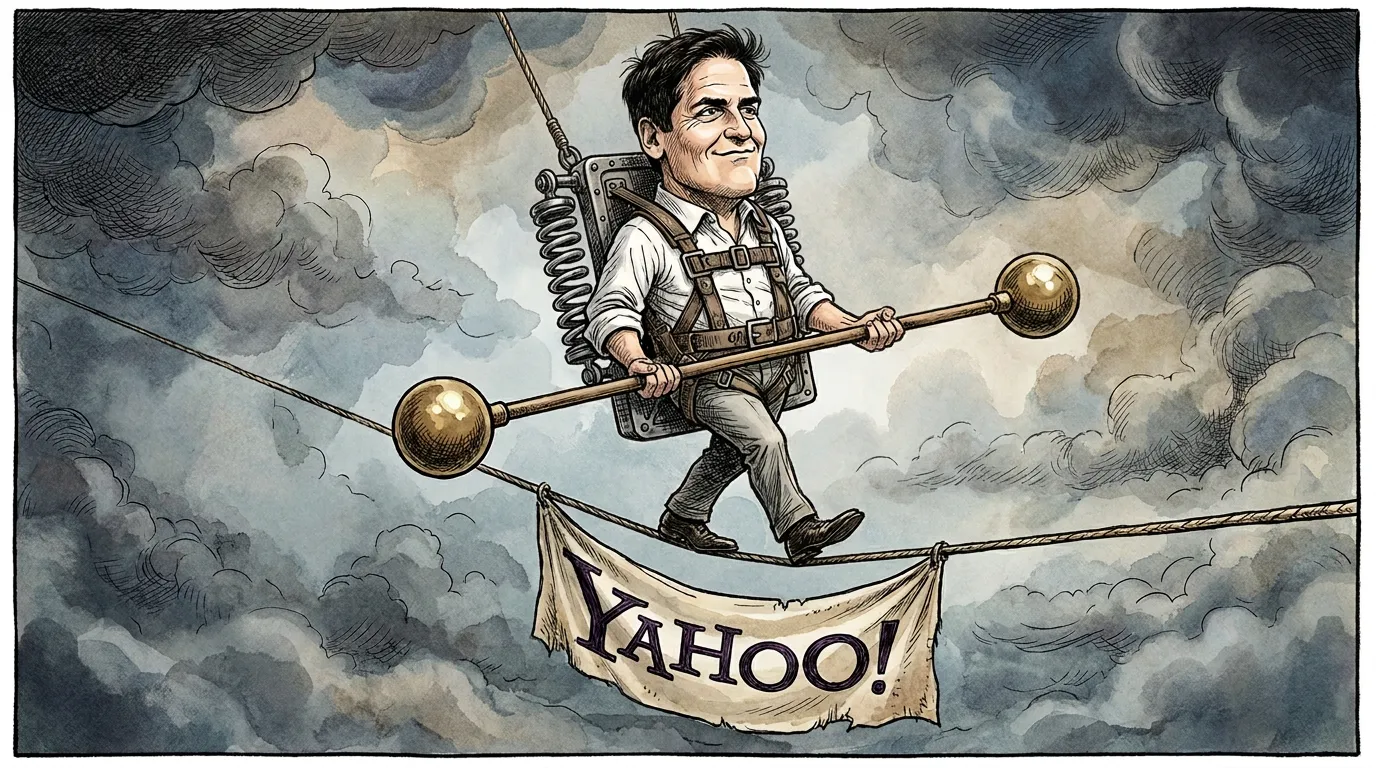
 On 1 April 1999, Mark Cuban got the news most entrepreneurs can only dream about.
Yahoo! had agreed to buy Broadcast.com for $5.7 billion… in the form of Yahoo! stock.
Cuban had helped build the company from a small internet radio business into one of the stars of the dot-com boom. Now Yahoo! wanted it.
But the way payment was made presented Cuban with a problem. Admittedly one most of us would be quite happy to inherit, but a problem none the less.
Sure, he’s become extraordinarily rich.
But much of that wealth was tied to one company.
Yahoo!
Now…
This was in 1999. Internet stocks were soaring. Yahoo was one of the companies at the centre of the excitement.
The obvious thing for Mark to do was nothing. Hold the shares. Enjoy the ride.
But Mark was worried. What if…
Did he really want one collapsing share price to undo what he’d just spent years building?
Of course not.
But rather than dumping his newly acquired Yahoo! shares, he changed the economics of owning them.
He built a hedge around his Yahoo position.
One part protected him if the share price collapsed. Another meant surrendering some of the gains he could have made if Yahoo continued soaring.
Crucially, one part helped finance the other.
The structure is known in the financial world as a collar.
Now, before we go any further, Cuban’s strategy is not the same strategy Sean Allison will be sharing with viewers on Wednesday, 16 September at 6 pm BST.
Long time readers may remember Sean from his strategy webinar last September. He’s the heart of Reliable Trading Circle, having spent more than 20 years working in and around the financial markets. With a background in finance and accounting, he specialises in thinking about not just what to invest in, but how an investment can be structured around risk, reward, and cash flow.
Circumstances, objective, and structure are all different.
But the thinking behind Mark’s decision is extremely useful for what we’ve been discussing the last few days… and Sean’s strategy.
Mark didn’t ask: “Do I think Yahoo is going up or down?”
He asked a better question: “What outcome am I actually prepared to live with?”
Forget AI, America’s No.1 forecaster says a bigger boom is coming:
“I’ve invested $1 million of my own money to prepare for this…”
He predicted the Financial Crash, both Trump victories and 2025’s record rare metals surge that saw stocks soar as much as 645%
Now discover the move he is making as America seeks to unlock a home grown fortune potentially worth trillions on Friday, May 15th
Find out what that move is right here >>
Capital at risk
You don’t have to accept the default
This is one of the assumptions we rarely question as ordinary investors.
You buy a share for £50. If it goes to £100, fantastic. If it goes to £25, painful. If it goes to zero, you’ve lost the lot.
That’s the deal.
But investing doesn’t have to be such a shot in the dark.
Mark’s story demonstrates we don’t need to just sit back and let the market happen to us. We can play a significant role in the process.
Mark effectively decided that protecting the fortune he’d already made mattered more to him than retaining every last dollar of potential upside.
So he exchanged one thing he valued less – some potential future gains – for something he valued enormously…
Protection from a catastrophic loss.
He didn’t know what Yahoo would do next. He didn’t need to.
Fitting the pieces together
Think back over the Billionaire Files we’ve explored over the last few days.
Warren Buffett showed us that accepting risk isn’t necessarily something you pay for. Under the right circumstances, somebody may pay you to accept it.
Stanley Druckenmiller showed us that being right and being wrong don’t have to carry equal consequences.
And now Mark Cuban gives us another piece. An investment doesn’t necessarily have to retain the payoff structure you started with. You can make choices about the risks you’re willing to accept.
You can trade away outcomes you care less about in exchange for outcomes you value more.
And sometimes one part of that structure can help pay for another.
On Wednesday, 16 September at 6 pm BST, Sean will show you how to implement such principles and strategies into your own investing. Join him.
Regards,

Elizabeth Cox
Associate Publisher, Southbank Research
PS On Wednesday, Sean will take you through his Ultimate Risk Reversal approach – including how he identifies a company he’d genuinely like to own, chooses the price he’d be prepared to pay for it, and then structures the investment around that decision.
If you haven’t registered yet, you can do so here. Attendance is free.
As always, investing involves risk. Sean’s approach can result in an obligation to purchase shares at an agreed price even if their market value subsequently falls substantially below it. It therefore isn’t appropriate for every investor or every company. Never invest more than you can afford to lose.