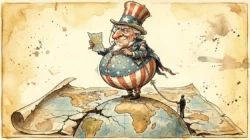
Publisher’s Note: For UK investors, the purpose of this essay is not to assess Donald Trump’s character or ideology. It is to clarify how power is being exercised — and why that matters for markets.
Trump’s approach to foreign policy is transactional rather than doctrinal. He is not attempting to export democracy or reshape institutions. He is asserting control over assets, trade routes, energy flows, and strategic leverage. That distinction is crucial for investors.
When politics becomes deal-driven, the consequences show up first in energy prices, defence spending, commodity supply chains, and currency volatility — all areas where UK markets and portfolios have direct exposure.
Understanding what Trump is not helps investors anticipate what comes next:
less predictability, more leverage politics, and wider dispersion between winners and losers.
That environment tends to reward positioning over prediction — particularly in real assets, energy, defence, and volatility-sensitive strategies.
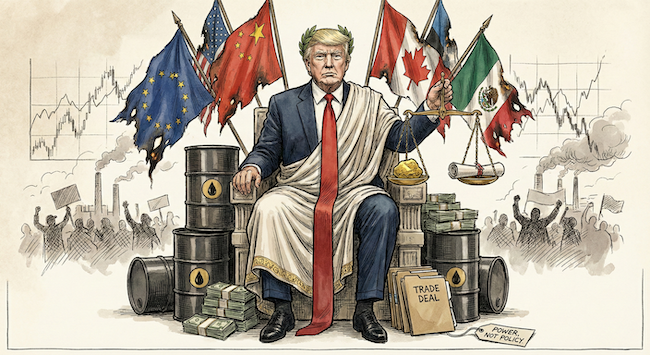 It’s been very hard to know what Mr. Trump really is and what he is up to. So sui generis is he, from an American political perspective, that analysts have had trouble finding a label that suits him or a box that will hold him.
Our contribution to the who-is-Trump genre is not so much to figure out what he is, but to eliminate some of the things he is not. That is the rock we will roll up the hill today.
When Donald Trump first appeared on the political scene, few people took him seriously. Even his own sister — a federal judge — reportedly said he was ‘a clown,’ with ‘no principles.’
Comedian Seth Myers commented that he thought the campaign was a ‘joke.’ Many people thought so, perhaps including Trump himself. Always promoting his own brand, he craved the spotlight. Running for president allowed him to mouth off…and the media reported it as ‘news.’
Since then, it has become more and more clear that while his sister may have been right about the ‘no principles,’ the ‘clown’ label doesn’t do him justice. He is much less funny and much more serious than people realized.
As we see in the Venezuela example, one thing that Donald Trump is not is a Johnny Appleseed for democracy…or any other form of government. The Wall Street Journal:
US Tries a New Playbook: Regime Management, Not Regime Change
After costly failures in Iraq and Afghanistan, the Trump administration is betting that managing Venezuela’s autocracy is cheaper than dismantling it
Trump is not planting the seeds of republicanism, nor communism, nor Americanism, nor capitalism. Democracy? Theocracy? He doesn’t seem to care.
But there’s nothing new about this. Most empires don’t care either. They don’t insist that the conquered country worship their gods or imitate their political system. That’s the difference between an empire and a common nation. Louis the 14th described the French nation as ‘un roi, une loi et une foi’ (one king, one law, and one faith). Hitler had his version too: ‘Ein Volk, ein Reich, ein Fuhrer’ (one people, one government, and one leader).
An empire, however, is a different thing. Like the US, it is made up of many different nations, each with its own religions, languages, and governments. In its heyday, for example, England ruled 56 different sovereign states — from India to South Africa to Canada. But in an empire, unlike the US, subject peoples are not expected to become citizens or salute the same flag. The emperor just wants them to obey…and pay tribute.
Trump doesn’t mind that the people running things on the ground in Venezuela are the same corrupt people who ran it under Chavez and Maduro. He only demands that they take orders from him, rather than from Maduro, and that they send their oil to him rather than to the Chinese.
And he has no intention of restoring democracy in Venezuela, either. Even in America itself, he has little regard for democracy. And his affection for ‘vox populi’ — the voice of the people — only lasts as long as they are singing his praises.
But one of the biggest mistakes in the ‘who-is-Trump’ canon came from those who thought he was a ‘conservative.’ He may have been confused about it himself. While he was a registered Democrat for many years — and contributed to Democratic candidates — when he ran for president in 2015 he claimed to be a conservative:
“I am a conservative person. I am by nature a conservative person. I never looked at putting a label on myself, I wasn’t in politics. But if you look at my general attitudes in life I would certainly have the more conservative label put on me.”
But there was never anything ‘conservative’ about Donald Trump. From his billionaire lifestyle, to running his own airline, to grabbing women by the crotch and partying with Epstein, nothing about his life was ‘conservative.’
As for his politics, he was all over the place. But in the campaign of 2016, he promised a balanced budget, promoted a ‘live and let live’ attitude towards Russia, dissed NATO and other ‘foreign entanglements,’ despised wokism, DEI, and Rosie O’Donnell, and said he would end the ‘endless wars.’ He even said he would pay off the national debt…though no one took it seriously. All of these things endeared him to ‘conservatives.’
A conservative is someone who wishes to hold onto institutions, customs and ideas — like an old pair of boots — until they no longer give good service. At the heart of it is a respect for laws and traditions.
Laws of nature, laws of men, Boyle’s law, the US Constitution, supply and demand…he loves them all.
Mr. Trump doesn’t believe in laws at all. He believes in deals…and his power to get what he wants by deal-making. He said that America’s trade deficits, for example, were the result of ‘bad deals’ made by his predecessors.
Perhaps even more fundamental, a conservative is someone who distrusts government power; he believes government should always be subordinate to the writ of Moses and the Grand Convention of 1787.
This is the opposite of Trump’s pensée. For him, laws can be used to advance his own power, wealth and glory. Or, if they get in the way, they can be ignored.
Nevertheless, a substantial part of the voting public, in 2016 and after, came away thinking Trump was, at least in some measure, a ‘conservative.’ But today — after the most unbalanced budgets in history…and attacks on Nigeria, Somalia (more than 100 times!), Iran, Venezuela, and Syria, in 2025 alone — much of his ‘conservative’ make-up has washed off.
What does that leave? Conservatives don’t know either. But they have one other helpful insight. Over-arching the whole structure of laws and traditions, they believe, is Murphy’s Law. It tells us that for all our efforts, there will always be some jackass who comes along and messes everything up.
Stay tuned for more of what Trump isn’t.
Regards,
Bill Bonner
Contributing Editor, Investor’s Daily
P.S. Over the past year, James Altucher has been quietly developing a new approach focused on a narrow group of small, high-volatility stocks capable of making unusually large, rapid moves. These opportunities typically sit outside mainstream coverage—too small for large funds, unfamiliar to most advisers, and often missed by traditional screening tools.
Later this month, James will formally present how he identifies these setups, the risk controls he applies, and why he believes this corner of the market could be approaching a rare window of opportunity. Attendance is limited, and access is being offered on a first-come basis. Investors who want to hear the full framework should consider securing their seat before registration closes.