
 Nvidia doesn’t have a demand problem.
It has a physics problem.
Lately, investors have started asking a fair question:
Is AI infrastructure spending getting out of hand?
Data centers cost billions. Power demand is surging. Hyperscalers are spending at eye-watering levels.
At some point, that pace probably slows.
But that “some point” doesn’t appear to be now.
When Nvidia reported last November, data center revenue was still climbing sharply. Meanwhile, the world’s largest tech companies are committing tens of billions more toward AI build-outs.
CEO Jensen Huang has been clear: this isn’t a normal semiconductor cycle.
It’s an industrial build-out.
And the bottleneck isn’t chips anymore.
It’s plumbing.
The real constraint
For nearly two decades, Nvidia’s breakthroughs have come in waves:
- CUDA in 2007, turning graphics chips into parallel computing engines
- The A100 in 2020, which reshaped AI training
- The newer Blackwell systems, pushing performance even further
But every leap forward required one thing:
Moving enormous amounts of data between chips — instantly, efficiently, and without overheating the system.
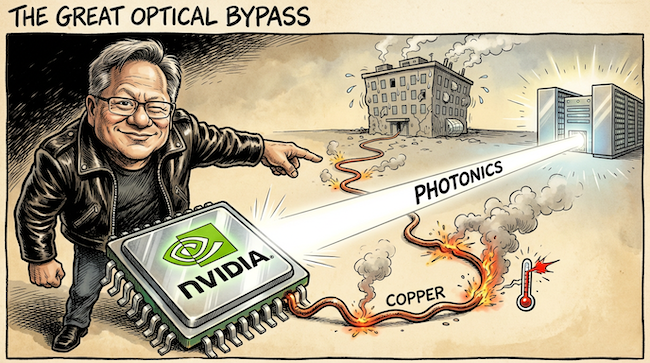
Right now, most of that communication still runs through copper.
Copper works. It’s reliable. It’s proven.
But at AI scale, it’s increasingly inefficient.
Copper generates heat. Heat consumes energy. Energy limits scale.
The uncomfortable reality is that AI data centers are becoming electricity-hungry industrial complexes.
The International Energy Agency estimates global data center electricity consumption could double by 2030.
In parts of the U.K., developers are already being told new facilities may have to wait years for power connections.
The chips are ready. The grid, and the internal wiring, are not.
Enter photonics
There’s another way to move data: light.
Optical interconnects use photonics instead of electrical signals. That means dramatically faster speeds and significantly lower energy loss.
Industry research suggests that replacing copper connections with next-generation optical systems can increase data speeds by 10x or more in certain configurations.
Imagine replacing a congested three-lane motorway with a 30-lane expressway.
The processors themselves don’t change.
But the system suddenly breathes easier.
Chips “talk” faster. Energy loss falls. Heat drops. Throughput rises.
And the economics of AI factories shift.
That’s why a quieter corner of the semiconductor ecosystem has started drawing attention: companies working on optical networking and photonics integration.
Recently, unusual trading activity has picked up in one small California-based photonics firm already operating within Nvidia’s broader ecosystem. Nothing flashy. No press releases. Just growing market interest.
It raises an interesting possibility.
If Nvidia’s next leap isn’t just about faster chips — but faster connections between them — then the companies solving that interconnect problem could become far more important.
Why this matters now
Nvidia’s earnings report and the GTC conference often provide clues about where the company is headed next.
Historically, major architecture shifts or ecosystem expansions have been signaled there.
This time, many analysts are watching closely for signs that optical integration may move from “future roadmap” to near-term deployment.
If that happens, it would confirm something important:
AI’s next constraint isn’t demand.
It’s physics.
And solving physics problems tends to create new winners.
We’ve just released a full breakdown of:
- Why Nvidia’s next evolution may depend on photonics
- What optical interconnects actually change inside AI data centers
- The specific company operating in this niche
- And what the opportunity could look like from here
If you’d like the full research and analysis, you can watch the complete briefing now.
AI isn’t slowing down.
But it may be about to rewire itself.
And that’s where the next edge could emerge.
Best,

Elizabeth Cox
Associate Publisher, Southbank Research
P.S. If Nvidia really is preparing to upgrade from copper to light, this won’t stay quiet for long. James has laid out the evidence — and the specific stock we’re watching — inside the full briefing. Watch it now before this story hits the mainstream.