 In today’s Issue:
- Being right isn’t enough in investing
- What do markets know that just ain’t so?
- Some of us really do “know”
Our investment strategy at The Fleet Street Letter is unusual. It’s a variation on baseball philosopher Yogi Berra’s best yogi-ism:
“It’s not what we don’t know that gets us in trouble. It’s what we think we know that just ain’t so.”
At The Fleet Street Letter, we’ve adapted it slightly:
“It’s not what the markets don’t know that makes you money. It’s what they know that just ain’t so.”
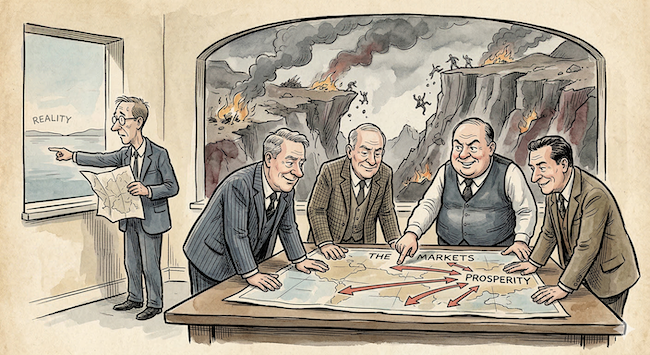
Most investors try to make money by being right about something. But returns only follow if the market is also wrong about the future. You profit when prices are based on a false premise.
Sure, surprises can move markets too. But it’s hard to be right about surprises.
It’s much easier to see where investors are wrong about one of their assumptions. Then position yourself for the reckoning.
Take the sub-prime mortgage crisis for example. Most people now blame leverage and derivatives. But that wasn’t the root cause.
It was the market’s assumption that people’s loan applications documents gave an accurate assessment of their financial position.
As the finance academic Luigi Zingales later demonstrated, if the information on “liars’ loans” had been accurate, all subsequent financial engineering may actually have held up ok. But the market assumed people didn’t lie on their liars loans. What got us into trouble was what we knew that simply wasn’t true.
The markets also “knew” that the UK would not vote for Brexit. That presumption caused chaos in markets after the referendum result.
Last year, markets “knew” that tariffs are inflationary and bad for the economy. So they had a meltdown when Trump imposed whopping tariffs.
So far, those tariffs are proving neither recessionary nor inflationary.
20 years ago, investors “knew” that gold was a barbarous relic. An unproductive asset that didn’t pay dividends. Yet, gold has outperformed stocks over that period..
We all believed the problem of inflation and recessions had been cured during the “Great Moderation,” just before the financial crisis.
We “knew” central banks could spur on inflation anytime by printing money… until that didn’t work after 2008.
And then we knew that printing money wouldn’t lead to inflation during the pandemic… until it did in 2021.
We presumed the energy transition would provide cheap electricity. And that EVs would sell. Both are proving very expensive presumptions indeed for investors and executives who literally bought into that narrative.
We knew the government would bail out the banks… until Lehman Brothers failed.
The almighty US Navy and Air Force were supposed to wipe the Strait of Hormuz clean in a jiffy. Instead, much of the Middle East copped Iran’s retaliation. And the Americans are even asking the Japanese navy to come and get in the way of drones.
We presumed years of war in Ukraine had taught Western defence forces something about drone warfare. But it now seems they weren’t paying attention.
Europe supposedly learned its lesson about relying on Russia for gas. But it merely pivoted to relying on Qatar and the US. The US promptly demanded Greenland. Qatar declared force majeure on gas exports. I mean, who could’ve seen war in the Middle East coming!?
Markets got it all wrong.
They weren’t just ignorant. They were actively wrong about the future.
Believing such false premises would be disproven, in time, was an exceptional investment strategy. Because the market didn’t just move in your favour. It also underpriced the chances at the outset by presuming the opposite to be true.
What do markets “know that just ain’t so” today?
Stocks rest on a long list of iffy looking assumptions today…
They are overvalued, which implies investors are dangerously optimistic about future earnings growth.
We presume that technology is not about to make AI dramatically more efficient in terms of energy and compute usage. They assume governments won’t bow to the luddites who want to slow AI down.
Markets aren’t pricing in an EU and ECB led by Meloni, Le Pen, Orban, and Weidel. Nor do they expect Farage to choose the next Bank of England governor.
Australian bank stock investors presume their latest version of the sub-prime lending scandal is only skin deep and not a systemic problem.
Government bond holders presume there won’t be more deliberate waves of inflation in coming years.
Central bankers presume that the inflation triggered by the Iran war and spiking energy prices is identical to inflation caused by the devaluation of money.
Resources investors presume governments won’t unlock the vast reserves we already know about.
All wrong.
All asking to be exposed.
All waiting to move markets.
The man who knew enough
One of my favourite films is called The Man Who Knew Too Little.
It follows an aspiring American actor who thinks he is taking part in an improvisational acting experience in London. He thinks everyone around him is “just acting.” In reality he has stumbled into a genuine international spy conspiracy.
As you can imagine, his very real enemies are immensely intimidated by his blasé overconfidence.
That’s how many investors behave today. As though they’re just taking part in a simulation.
My strategy is to find what the market is mis-pricing, thanks to false assumptions.
But there’s another way to gain an edge. You can access information others simply don’t have.
Jim Rickards is one of the few analysts capable of doing that. His Rolodex is full of decision makers he knows personally and can talk to.
He wasn’t just in the room when some of the most momentous political decisions about financial markets were made – he made some of them. And so he knows which considerations move the needle.
His CV is full of pioneering analytical methods that are now used by hedge funds and intelligence agencies. He knows their strengths and weaknesses.
And so his edge in financial markets is in making predictions before they’re even on the menu for the rest of us.
One such prediction involves what the US-Israel war against Iran could do for the resource boom underway.
His friend, a man known as “The CEO” is preparing investors accordingly. On Monday, 23 March at 4 pm GMT, “The CEO” is holding an event to share the details of his plan.
Secure your seat for his upcoming event now.
Until next time,

Nick Hubble
Editor at Large, Investor’s Daily