
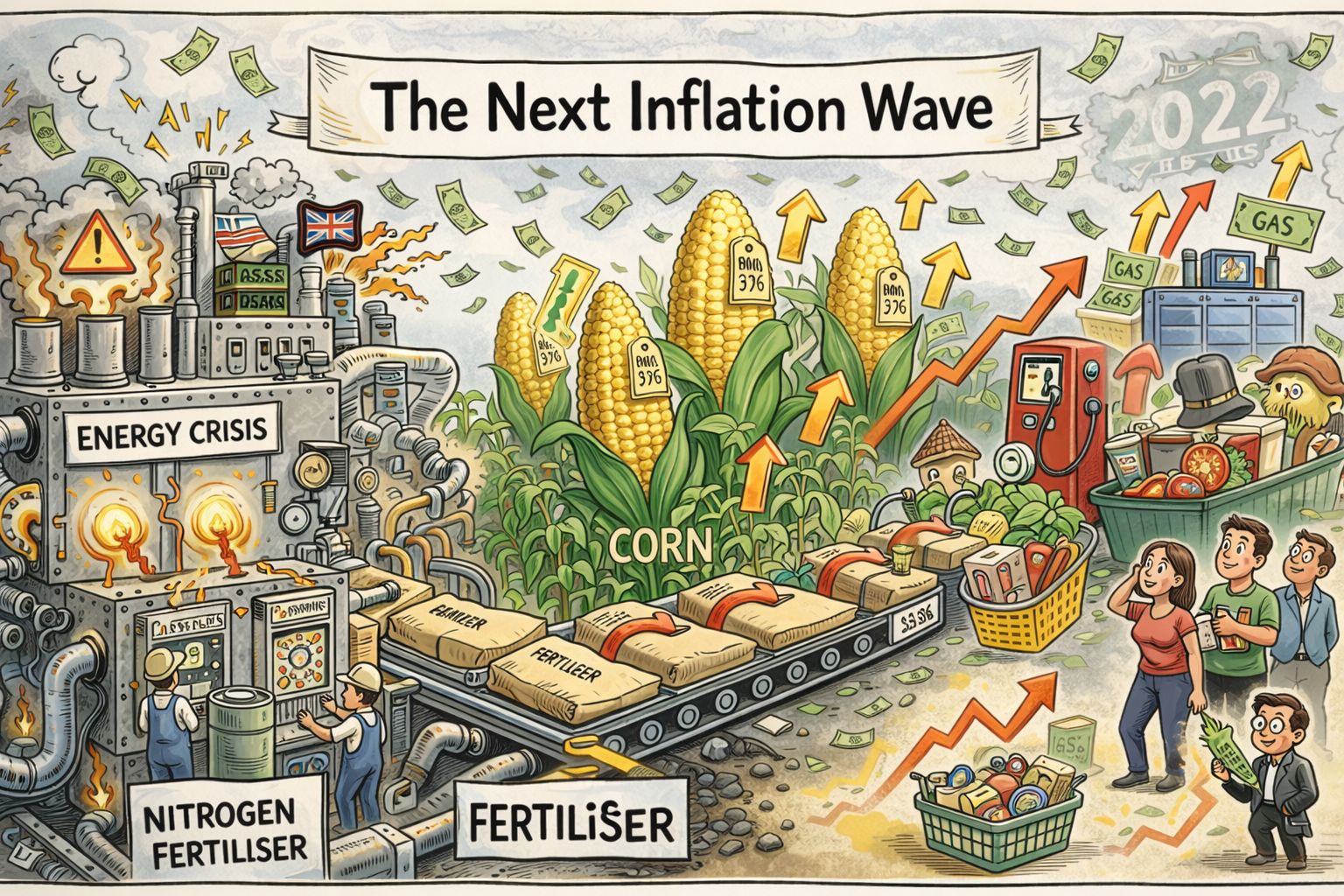
 Publisher’s Note: At first glance, this may look like a distinctly American story: a crop grown in the US, influenced by US policy, and tied to US fuel markets.
But in reality, corn is part of a global system. More importantly, so are the inputs required to produce it.
Nitrogen fertiliser is one of those critical inputs. It’s produced using natural gas, which means its price is directly linked to global energy markets.
When natural gas prices rise — whether due to geopolitical tension, supply disruption, or trade constraints — fertiliser costs follow. And when fertiliser costs rise, food production costs rise with them.
That dynamic doesn’t stay contained within the US.
Global agricultural commodities are priced internationally, and the UK is a net importer of both food and energy. That means increases in input costs — even those originating abroad — tend to flow through into domestic food prices, supply chains, and ultimately inflation.
We saw this clearly in 2022. A disruption to energy markets quickly translated into higher fertiliser prices, which then fed into higher crop prices, and eventually into higher costs for consumers.
The same pattern may now be forming again.
For investors, this matters in two ways.
First, it highlights how interconnected energy, agriculture, and inflation really are. What looks like a niche commodity story is often a leading indicator of broader economic pressure.
Second, it creates opportunities. When input costs rise and supply tightens, certain parts of the market benefit — often before the effects are fully visible in headline inflation or central bank policy.
That is why we pay attention to stories like this. Not because they are localised, but because they are global and because they often signal what may come next.
The most common crop grown in the US is also the single biggest consumer of nitrogen fertiliser. And, thanks to the Farm Lobby, it gets added to everything from petrol to animal feed to candy.
Here’s the thing, 94% of ethanol comes from this crop. And as it gets more expensive, so will petrol.
If you guessed corn, you are right.
And higher corn prices mean inflation for everyone. Besides ethanol, corn goes into the cost of raising animals, particularly beef. It becomes high-fructose corn syrup, which is the ubiquitous sweetener in everything.
The problem is that the price of nitrogen exploded, as you can see from the chart below:
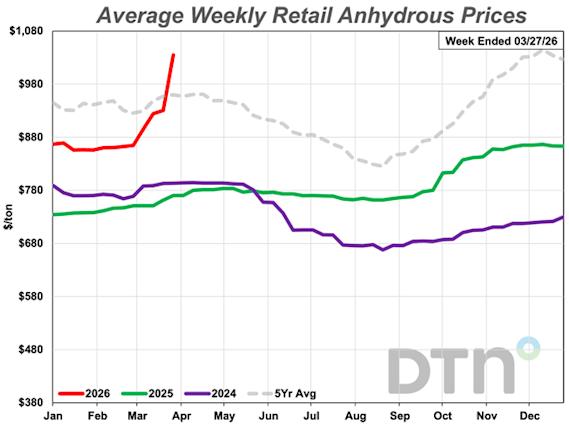
Corn is the most nitrogen-intensive crop in the United States.It consumes about 78% of the nitrogen applied to grain crops like wheat, soy, etc. And the cost of that fertiliser is up over 30% from last year.
Corn needs about 150 pounds of nitrogen fertiliser per acre. In 2025, that was around $59 per acre. Today, according to the US Department of Agriculture, it’s $78 per acre.
The reason that nitrogen fertiliser costs so much today is the war in Iran. Natural gas is critical to making ammonia, which is the feedstock for nitrogen fertiliser. You can see the process in the diagram below:
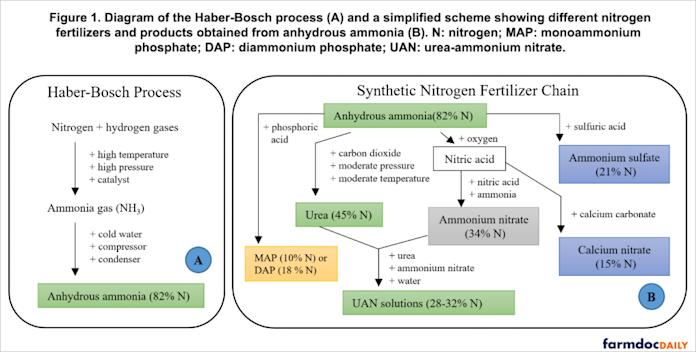
But if you can’t get natural gas, you can’t make fertiliser.
The war in Iran and the closure of the Strait of Hormuz crippled nitrogen fertiliser supplies to the world, including the US
Nitrogen fertiliser made up to 25% of the cost of corn prices. We can expect to see corn prices rip higher like they did in 2022:
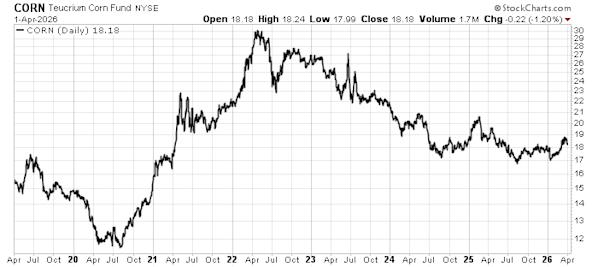
Back in 2022, Russia invaded Ukraine. That cut off Russian natural gas to the world. It spiked the price of nitrogen fertiliser and sent the price of corn to multi-year high prices.
If the past can tell us the future, then it’s going much higher. If we’re going to pay extra on everything due to higher prices, we might as well hedge that cost by making some money.
Best,

Matt Badiali
Editor, Real Wealth Insider