 In today’s Issue:
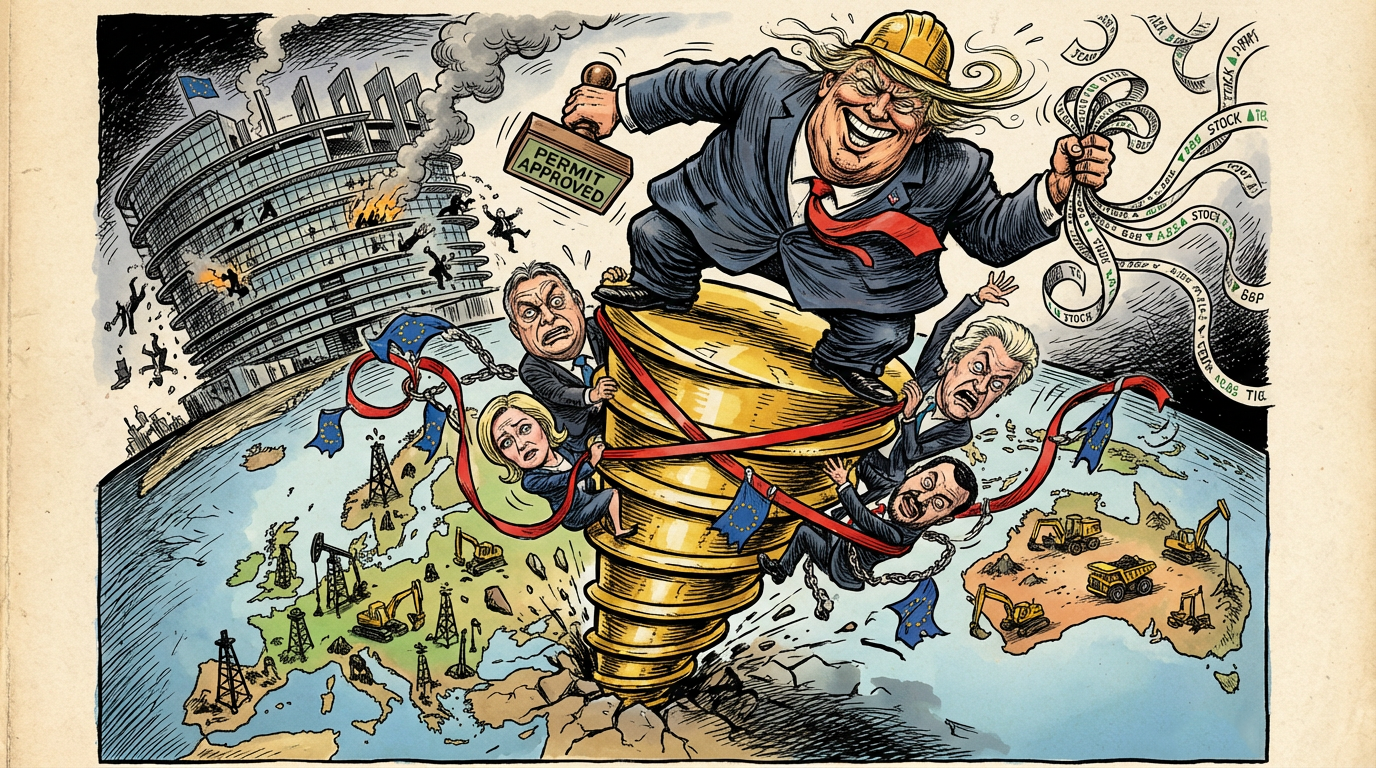
● A world of Trumpian governments
● Why Europe’s populists won’t rule like Trump
● What does political stalemate mean for investors?
Since his rise to power, President Donald Trump has wreaked havoc on the stock market — in both directions, to be fair.
Over at Jim Rickards’ Strategic Intelligence UK, we’ve positioned readers to profit from his temperamental trades.
But Trump is just one man. What if we got a whole bunch of him governing across multiple countries around the world?
It’s not just in governments themselves, either. Get enough Trump understudies across Europe, and you’d begin to see European Trumpists appointed to the European Commission too.
Viktor Orbán could be the next President of the European Commission…
Trump’s man – Kevin Warsh – takes over the US Federal Reserve Bank next month. If we get enough Trumpers in power in Europe, they’d likewise appoint one of their own to lead their central banks. And perhaps even the European Central Bank could be led by a right-wing populist.
Imagine former Italian deputy Prime Minister Matteo Salvini as ECB President…
If polling trends in the UK, Australia, and other countries continue, Trumpians could even be appointed to lead institutions like the WHO (World Health Organisation) and IMF (International Monetary Fund).
Former US President Trump would make for a very entertaining UN Secretary General when the time comes…
It all sounds absurd. But is it really more absurd than the current crop of leaders?
Not if you look into their shady past. As Nigel Farage used to do.
But is it likely that the right will get its own turn at the wheels of power?
The polls show the trend is definitely in favour of the populist right in so many countries. They can’t all be wrong.
However, the populists have one more pitfall they must hurdle over. One that Italian and Dutch populists have already fallen into…
Winner takes the fall
Polling in countless developed countries around the world shows the rise of the populist right. At least, that’s the label. Never mind whether the policies match it. That’s not important anymore.
What is important is the Mexican standoffs they create. The entrance of a third or fourth competitive party makes ruling by coalition the only realistic path to power.
The mainstream legacy political parties know how to take advantage of this.
The Germans call it the “Brandmauer” – a firewall. All political parties refuse to work with Alternative für Deutschland.
The French call it the “cordon sanitaire” – sanitary cordon. The same idea applied to Marine Le Pen’s Rassemblement National.
Do we have a name for it in the UK?
Farage Derangement Syndrome?
I’m not sure what the Australians call it either. But if you think Nigel Farage is unpalatable for too many voters, you should watch a video of Pauline Hanson.
My point is that these populists are far more encumbered than in the US. Trump took over the Republican Party. That’s very different to what Weidel, Le Pen, Farage, and Hanson are up to.
If their polling turns into seats, it’s likely that many will face political stalemates. That means more chaos at a time when government debt is too high, geopolitics are unstable, and the economy is running out of gas, sometimes literally.
The big question I’m focusing on at The Fleet Street Letter is who wins from such a stalemate.
Geert Wilders in the Netherlands got the most seats, but had to abandon his quest to become Prime Minister.
In Italy, the Lega Party achieved electoral victories. But that never gave them a Prime Minister or power. Their coalition partner eventually turned to another party and Lega support drained away.
Here’s the thing…
Polling doesn’t tell the whole story. Even electoral victories don’t necessarily deliver true power. But you can still become the scapegoat for the stalemate and chaos that follows in a coalition government.
I’m not sure the Liberal Democrats have recovered from learning this lesson.
What does political stalemate mean for investors?
In Trump, we’ve had a concentration of power and no reluctance to use it. But Trump’s disciples around the world are probably going to have a very different time of it.
It was fairly straightforward to profit from Trump’s chaos in 2025. You just had to believe him.
He imposed tariffs as he said he would. He triggered a permitting rush for natural resources projects as he said he would.
Those who bought the dip in April 2025 finished 2025 sitting on very large gains. Especially if they bought mining and resources stocks.
2026…
… has been a little more unpredictable. While the US energy sector surged, the mining and resources sector sold off.
Will a similar playbook work during Europe and Australia’s coming political reckoning?
Right-wing populists certainly favour more mining and energy permitting.
At The Fleet Street Letter we’ve started preparing for this… although the sectors were largely wiped clean by environmentalism in Europe, apart from the globally diversified majors.
I suspect Australian energy resources stocks offer the best opportunity right now. They are Asia’s alternative source of energy to the Middle East. And all major parties are more inclined to permit resource projects.
But the movement to permit energy and mining projects in Europe is coming. Governments need the money, and economies need the supply line resilience.
Just be sure to apply prudent risk management to your positions. The volatility Trump is causing will become common in Europe soon.
An awkward question
Before you go, I do have one final odd-ball question for you…
What is the premise of representative democracy?
Should we elect people smarter than ourselves to solve our problems?
That we choose people to represent our will?
That we pick politicians to develop expertise in government and opposition, just as we pick experts to fly our planes and build our houses?
Or is the tradition of electing politicians really just based on an out-of-date notion that we cannot vote for ourselves because of the constraints of time and space?
We wouldn’t all fit in the House of Commons, after all. And having to go there each week to vote would be a nightmare.
Yet in Switzerland, direct democracy by votes on specific issues is not uncommon. The Swiss will soon vote on a population cap of 10 million. Their politicians will get the same number of votes as those they represent – one each.
Imagine if the UK had the same option.
Surely the idea that we need a middleman to run in and out of the chamber for votes is a bit dated?
Let me know: mailbox@southbankresearch.com.
Until next time,

Nick Hubble
Editor, The Fleet Street Letter
PS The world you just read about — fractured politics, stalled governments, unpredictable policy — is exactly the kind of environment that creates paralysis for investors.
It’s not a lack of ideas. It’s a lack of clarity on what to actually do next.