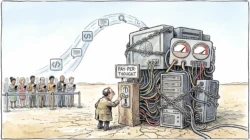
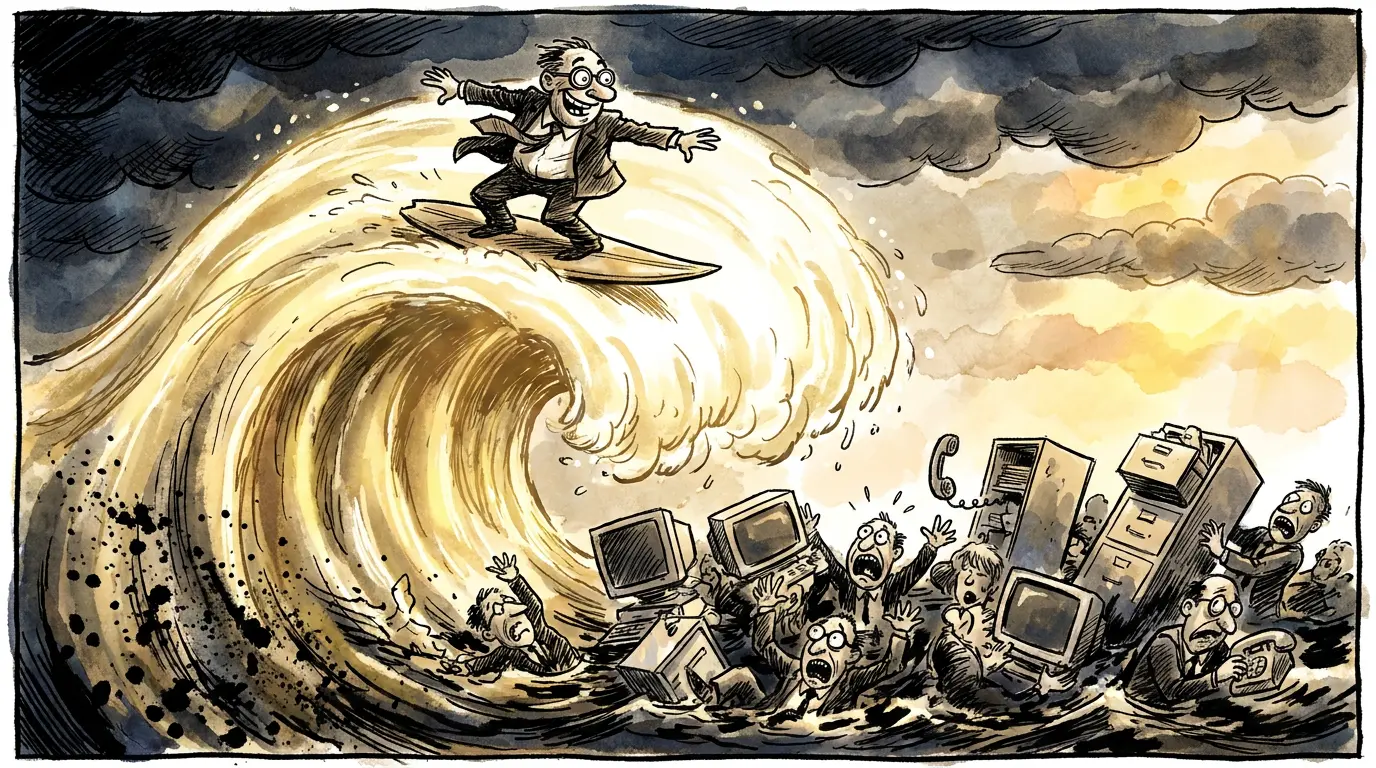
 Every technology you now use without thinking was once dismissed as something sensible people would never need.
The internet was a fad for nerds. Now it underpins almost everything we do and is quite literally rewiring the human brain.
Online and mobile banking was a scam waiting to happen. Now I see 90-year-olds at the supermarket using their phones to tap and pay for their groceries.
The iPhone was a fancy toy that would never replace the physical keyboards BlackBerry dominated with. Now virtually every smartphone is some variation of the same rectangular black screen.
And then there was “the cloud”.
The cloud?
Why on earth would any sensible company hand its data and computing over to someone else when the servers in the office worked perfectly well?
Now more than 94% of businesses use cloud computing in some form and cloud spending will surpass $1 trillion this year.
Nobody seriously debates whether these technologies matter anymore.
Sure, they all have issues. Show me a technology that doesn’t. But the net benefit to society and enterprise cannot be sidestepped, or understated.
Artificial intelligence (AI) is following the same path.
Right now, we’re still in the arguing-about-it phase.
Is it useful?
Is it dangerous?
Will businesses actually adopt it?
Is it another bubble destined to disappear once the hype wears off?
Those are fair questions.
But increasingly, the numbers are beginning to answer them for us.
And this week, Britain’s biggest business lobby group released some fascinating data showing just how important AI could become to the British economy.
Because whether Britain likes AI or not may soon be beside the point.
If we want to remain economically relevant in tomorrow’s world, adopting it may no longer be optional.
Britain’s Investment Letter Since 1938
In 1938, The Fleet Street Letter warned its readers that war was coming to Europe — and even identified September as the critical month.
Since then, its readers have been warned ahead of Black Monday, the dotcom crash and the 2008 financial crisis.
Today, Britain’s longest-running investment advisory is still looking for the “news behind the news” — and the investment opportunities others could be missing.
Click here to discover what The Fleet Street Letter sees coming next.
Capital at risk.
What Does Britain’s Oldest Investment Letter See Coming Next?
It warned readers ahead of Black Monday.
The dotcom crash.
And the 2008 financial crisis.
Now, nearly 90 years after it was founded, The Fleet Street Letter is still searching for the “news behind the news” — and the investment opportunities that could emerge from the next major turning point.
Click here to discover what its editors are seeing now.
Capital at risk.
The execution divide
The Confederation of British Industry (CBI) and Oliver Wyman have published a report called “The adoption decade.”
Its core demand is blunt: make AI adoption a national productivity mission for the next 10 years.
Why the rush?
Between 2008 and 2025, the UK grew about 1.2% a year, with productivity growth of roughly 0.4%.
That’s nearly two decades of treading water.
Against that record, the report’s central scenarios have AI potentially adding between 2% and 5% to UK GDP over the next five to 10 years.
In its own words, “even the more pessimistic scenarios will have a measurable impact on economic growth.”
And importantly, the early gains aren’t expected to come from simply replacing people with machines.
The report expects them to come from making existing workers faster, more productive, and more accurate at their jobs.
It sees AI-related roles growing to around 3.9 million by 2035, which is roughly 12% of the UK workforce.
But there’s one aspect of the CBI’s analysis that really caught my attention.
Because it reinforces something I’ve been saying for some time – and something that ultimately led to the biggest breakthrough of my career.
The CBI says among firms leading on AI deployment, 49% are meeting or beating their return targets, compared to just 15% of the laggards.
That gap is what the CBI calls an execution divide.
Explanation: Early fears around workplace computing often focused on machines eliminating jobs. But PCs also gave skilled workers extraordinarily powerful new tools — spreadsheets for analysts, computer-aided design for engineers and word processors for writers — allowing one person to accomplish work that previously took far longer.
On one side are companies that have figured out how to put AI to work properly. On the other are businesses still tinkering with pilots, sitting on the sidelines, or ignoring the technology through fear or misunderstanding.
CBI boss Rain Newton-Smith says the prize, done right, is “better jobs, rising wages, stronger businesses, and higher living standards.”
I think this “execution divide” is one of the most important ideas in the entire 98-page report.
Three years building Hyperion
The same divide is opening in investing, and I decided long ago which side of it I wanted to be on.
For the last three years, I’ve been planning, developing, and building Hyperion.
It’s my own AI engine, built to hunt across the US and UK markets for the best stocks in the market.
Think about the size of that job.
Tens of thousands of listed securities. Millions of data points. And every day brings price movements, filings, announcements, and information than any human team could hope to process.
I wanted to be able to tear through all of it in a day. And then do it again tomorrow. And the day after that.
That’s exactly the work AI was made for.
It doesn’t sleep. It doesn’t get tired. And it certainly doesn’t fall in love with its favourite stocks.
I remember trawling the web in 2001 over dial-up, armed with Netscape and a lot of patience… particularly when mum or dad would pick up the landline to make a phone call.
Search engines didn’t kill research. They made research exponentially more powerful. And the people who had the best tools – and knew the right questions to ask – gained an enormous advantage.
That’s how I think about Hyperion.
It’s the modern version of the best tool and the right questions, only this time we’re applying it to AI and the stock market.
It is me adopting AI in a way I understand best: applying it to market research, investing, and the hunt for potentially explosive stocks across the UK and US markets.
Now, an engine doesn’t eliminate risk.
Markets still fall, positions still go wrong, and no mechanical model or AI on earth gets every call right. That is impossible.
Anyone promising certainty from AI is selling you an illusion.
What AI can do is completely change the scale of the job.
It changes your coverage, your speed, and your ability to process and extract insight from amounts of data that would be impossible for a human to handle alone.
It can look everywhere at once and get there before the crowd arrives.
That’s what I’ve built with Hyperion.
And tomorrow at 4pm, I’m switching it on and showing it to you live.
Make sure you’re there to see it happen.
(When you sign up for reminders of the event, you’re agreeing to get additional emails about Hyperion.)
A runaway train
AI is a runaway train.
And virtually every transformative technology sets off the same fears in its early days.
Some will run with it, adopt it, and leap ahead of the competition.
That’s what I plan to do, particularly with Hyperion.
Whether others, and whether you, choose to do the same is up to you.
But consider the history.
The fears and hesitation around major technological turning points aren’t new. It happened with electricity, with cars, with the internet… and it’s happening again right now.
Those fears are normal and natural. But eventually, the technology simply becomes part of everyday life.
And the people who waited, and waited, and waited can end up spending years trying to catch up.
I don’t plan on playing catch-up.
And the CBI’s data suggests getting ahead of it all now is the way to go.
The laggards sitting on 15% aren’t victims of the technology.
They’re simply late to it.
Don’t be them.
Again, tomorrow at 4pm GMT, I’m running a live demonstration of Hyperion. I’ll show you first-hand what happens when you take the extraordinary capabilities of modern AI and turn them directly onto the stock market.
Until next time,

Sam Volkering
Investment Director, Southbank Investment Research
|