 Donald Trump posted on Truth Social on Thursday.
Apple, he said, had agreed to work with Intel to design and build its chips in America .
Neither company formally confirmed it, but Intel stock jumped 9% in pre-market trading.
The simplest way to think about this is that the most powerful customer in semiconductors is starting to break up with Taiwan Semiconductor Manufacturing Company (NYSE: TSM).
Or at least diversify away from it.
Most of Apple’s bleeding-edge work will still go to Taiwan. According to various reports, the Intel deal covers the M7 chip, built on Intel’s 18A-P process, with mass production targeted for late 2027 .
That’s a slice of the iPad and MacBook Air product lines, not the entire iPhone business.
But it’s enough to tell us where things are heading.
Every hyperscaler wants its own AI chip.
And I mean every single one.
Google has its TPUs and recently signed Anthropic to a US$40 billion compute deal spanning 5 gigawatts and roughly one million Ironwood chips.
Meta is reportedly in talks with Google to access TPU capacity from 2027.
Amazon’s custom chip business – including Trainium, Graviton, and Nitro – has surpassed a US$20 billion annual revenue run rate. And Trainium3 is already close to being sold out .
OpenAI has commissioned a custom chip with Broadcom alongside its Nvidia, AMD, Trainium, and Cerebras relationships.
Elon’s xAI is building its own chips at the Memphis TeraFab.
And now Apple, the last major holdout, appears to be joining the queue at Intel.
Britain’s Investment Letter Since 1938
In 1938, The Fleet Street Letter warned its readers that war was coming to Europe — and even identified September as the critical month.
Since then, its readers have been warned ahead of Black Monday, the dotcom crash and the 2008 financial crisis.
Today, Britain’s longest-running investment advisory is still looking for the “news behind the news” — and the investment opportunities others could be missing.
Click here to discover what The Fleet Street Letter sees coming next.
Capital at risk.
What Does Britain’s Oldest Investment Letter See Coming Next?
It warned readers ahead of Black Monday.
The dotcom crash.
And the 2008 financial crisis.
Now, nearly 90 years after it was founded, The Fleet Street Letter is still searching for the “news behind the news” — and the investment opportunities that could emerge from the next major turning point.
Click here to discover what its editors are seeing now.
Capital at risk.
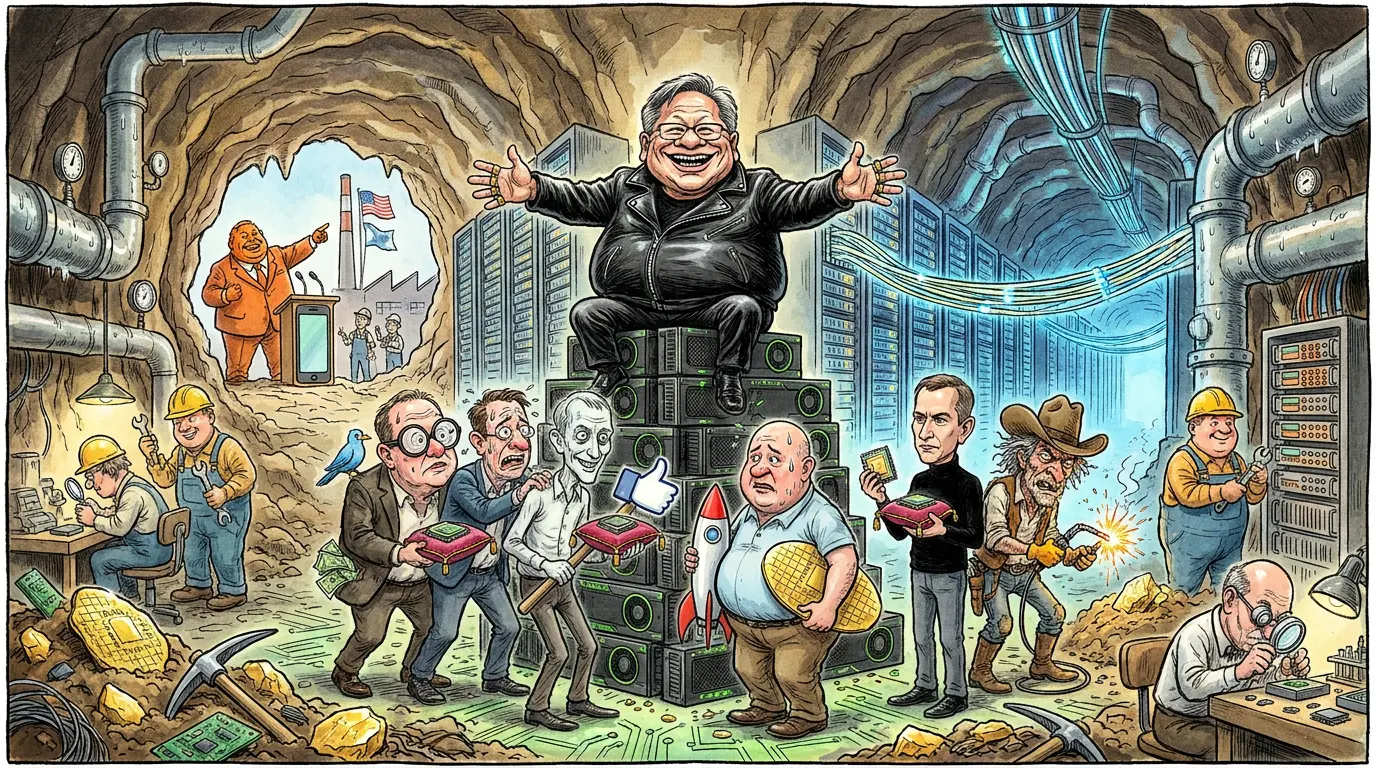
Everyone is building their own chips… Nvidia made US$81 billion last quarter regardless.
If everyone is going custom, you have to ask why.
And if custom chips are the future, you’d expect Nvidia’s growth to be slowing.
Instead, the opposite is happening.
Nvidia’s Q1 2027 revenue came in at a record US$81.6 billion, up 85% year over year.
Data centre revenue alone hit $75.2 billion, up 92%. Forecast for the current quarter is $91 billion . Jensen Huang called it “the largest infrastructure expansion in human history” and said agentic AI has “arrived.”
Custom silicon is brilliant at one job.
Nvidia runs every frontier model across every cloud.
The company is now on an annual product cycle, releasing chips that used to take half a decade to develop every single year.
Yes, the hyperscalers are designing their own chips.
They’re also continuing to buy every Blackwell and Vera Rubin Nvidia can ship.
Then they’ll buy Feynman. And whatever comes after that.
The reality is that they’re all diversifying.
Multi-chip is becoming the new house policy.
Nvidia may give up some economics at the margin on pure inference workloads, but it isn’t giving up the volume required to power the immense AI factories being built around the world.
That’s also why every Nvidia bear has been wrong for the better part of a decade.
Where to look under US$100 billion
Nvidia is worth US$5.4 trillion .
Broadcom, TSMC, Micron, SanDisk, and SK Hynix are all worth hundreds of billions, if not trillions.
They’ve already had their runs.
Most are up several hundred percent over the past 18 months. Some, like SanDisk, have risen by thousands of percent.
But you don’t get a SanDisk-style return from a company that’s already worth US$500 billion or US$1 trillion.
The sub-US$100 billion segment is where the asymmetric opportunity still lives.
Here are a few names worth having on your watchlist:
Cerebras (Nasdaq: CBRS) — around US$51 billion
Newly public after its 14 May IPO, Cerebras surged 68% on day one to a peak near US$385 before settling around US$240.
It’s a pure-play inference story with confirmed OpenAI and AWS partnerships.
Its first earnings report as a public company lands on 23 June, which could be a catalyst if the numbers are strong and new deals emerge.
The question is whether wafer-scale silicon can begin taking share from Nvidia.
Lumentum (Nasdaq: LITE) and Coherent (NYSE: COHR) — around US$66 billion and US$76 billion
These are the photonics-layer players.
Both received roughly US$2 billion investments from Nvidia, alongside multi-year purchase commitments for advanced lasers and co-packaged optics in March 2026.
Both stocks are up several hundred percent over the past year and have pulled back roughly 15% from their June highs.
JPMorgan called the pullback a buying opportunity last week.
Maybe it’s right.
Credo Technology (Nasdaq: CRDO) — around US$50 billion
Credo makes the connectivity products that sit between AI server racks.
Revenue tripled in 2026 to US$1.34 billion.
The risk is the industry’s transition from copper to optical networking.
The opportunity is that Credo has already spent years positioning itself for exactly that shift.
Astera Labs (Nasdaq: ALAB) — around US$71 billion
Astera builds the PCIe retimers, CXL controllers, and Scorpio AI fabric switches that hold rack-scale AI clusters together.
First-quarter revenue reached US$308 million, up 93% year over year.
The AI switching market is projected to reach US$20 billion by 2030.
Modine Manufacturing (NYSE: MOD) — around US$15 billion
This is the pure-play data-centre cooling story.
Data-centre revenue rose 73% in fiscal 2026 to more than US$1.1 billion.
Management is guiding for 50%-70% annual growth in the segment over the next two fiscal years.
Whoever wins the chip war, the racks still need cooling.
Camtek (Nasdaq: CAMT) — around US$9 billion
Camtek makes the optical inspection equipment used to identify defects in high-bandwidth memory before it leaves the fab.
Every HBM4 module heading into a Vera Rubin system, a TPU, or a Trainium passes through inspection equipment like Camtek’s.
It’s the smallest company on this list and arguably the most leveraged to continued tightness in the memory market.
Most of these names have already delivered exceptional returns over the past 12 to 18 months.
But the underlying idea remains intact.
There are now half a dozen credible AI chip developers instead of one dominant player.
The companies supplying them with optics, tooling, cooling, connectivity, and inspection equipment get paid by all of them.
That’s where the asymmetric opportunity still lives.
My focus for the rest of 2026 and into 2027 is simple: Don’t just watch who wins the chip war. Watch who gets paid regardless of the outcome.
Those are often the better investments.
Until next time,

Sam Volkering
Investment Director, Southbank Investment Research
PS The chip-and-shovels question is exactly the sort of thing Nick Hubble and I will be digging into during our live YouTube event on 9 July.
The question we keep hearing from readers is simple: if we had £10,000 to invest today, where would we put it? On 9 July, we’ll answer that.
We’ll walk through the biggest opportunities we see in AI, energy, and global markets, discuss companies like the ones featured in today’s issue, and share several stocks we believe are particularly well positioned for what comes next.
The event is completely free to attend.
Click here to reserve your place.