 We have been infested in the past few days with “unique” news.
I say “unique” because it’s not about inflation, wars, recessions, flash crashes, etc. The market has spent centuries bouncing back from those things, and it will continue to do so.
But what’s unique is that AI, in just a few years, has 2 billion paying customers and many trillion dollar companies.
Out of nowhere.
Imagine that.
Two billion users.
Trillion dollar companies.
The innovation that (hopefully) will come from that.
And the news cadence is so fast that the whole AI story gets confusing from one week to the next.
Here’s what we’ve seen just in the past few weeks or so. These are just bullets because each requires big summaries and discussion.
- The rise of Kimi 3. Unlike the Deepseek moment a year ago, this shows that light weight, open source AI models could be just as good as the trillion dollar companies.
What does this mean for trillion dollar valuations on Anthropic, OpenAI, and even SpaceX?
What does this mean for all the AI infrastructure plays if increasingly powerful models can do more with less compute?
- The Chinese ASML. A trillion dollar monopoly … no longer a monopoly?
- The NVDA / Open AI circular deal? Is this what bubbles are made of?
- The Chinese Micron. Does Micron deserve its trillion dollar valuation then?
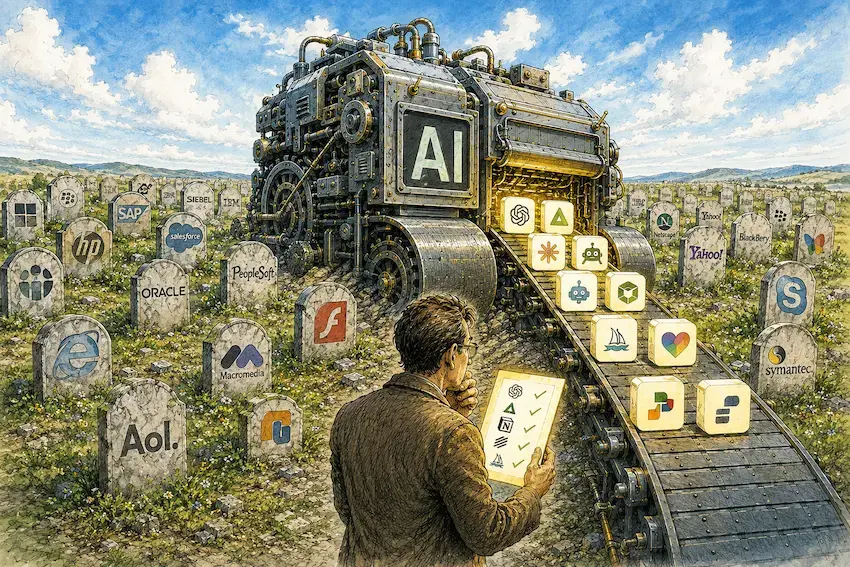
- The release of Claude Fable. All of intelligence just became a software issue. And Fable is the software.
What does this mean for every single company, from Adobe, to H&R Block, to Intuit, to Microsoft, when Claude can do you better.
Some more on that last one:
On Saturday night I put in this prompt into Claude Opus 5, using Claude Code on ultracode mode.
I want you to build a first-person shooter at the level of the most recent Call of Duty games. It should be utterly perfect, visually beautiful, with every single thing done at AAA quality – from textures to physics to anything you could think of.
Fan out sub-agents and have sub-agents tackle each one individually so that the game is utterly perfect. You should /loop on each item and have a separate sub-agent check it visually to ensure it looks triple A. That separate sub-agent should be a really harsh critic, and if it doesn’t look triple A, it should keep going.
Don’t stop until each sub-agent is utterly wowed with the quality when compared with the actual Call of Duty game. It should literally compare them side by side blind and say which one looks better. Do this in ThreeJS. /loop until it’s utterly perfect. Fan out sub-agents and ultracode.
I let it run for 10 hours.
The result was a complete first person shooter game at arguably the quality level of Call of Duty.
I stopped it at 10 hours. If I had let it run for 20 hours it would be even better.
I posted a video about the game and the game itself to play at https://operation-blackout-trailer.vercel.app/
The reason I did it was to:
- Learn. Since I just gave you the prompt, you guys should try it also.
- It shows me that software that once cost millions to develop can now be developed for less than $100.
In other words, software is disposable.
|
And that means the entire way we value companies is going to change.
Because increasingly, intelligence itself is becoming a software question.
For instance, instead of hiring an ad agency, Nike can just use a future version of Claude by saying, “Make me the best super bowl commercial.” And Nike will save millions and get a better result.
Will this happen?
I’ve spoken to Nike’s head of marketing, and I’ve spoken to people at their ad agencies. The first is excited, and the second is scared.
The world will be a better place.
Britain’s Investment Letter Since 1938
In 1938, The Fleet Street Letter warned its readers that war was coming to Europe — and even identified September as the critical month.
Since then, its readers have been warned ahead of Black Monday, the dotcom crash and the 2008 financial crisis.
Today, Britain’s longest-running investment advisory is still looking for the “news behind the news” — and the investment opportunities others could be missing.
Click here to discover what The Fleet Street Letter sees coming next.
Capital at risk.
What Does Britain’s Oldest Investment Letter See Coming Next?
It warned readers ahead of Black Monday.
The dotcom crash.
And the 2008 financial crisis.
Now, nearly 90 years after it was founded, The Fleet Street Letter is still searching for the “news behind the news” — and the investment opportunities that could emerge from the next major turning point.
Click here to discover what its editors are seeing now.
Capital at risk.
But first, there are going to be a lot of valuation hiccups as we absorb all of this news plus who knows what news will be coming next week.
I compare this to the internet bubble of the 1990s. Not the bubble itself, but the fact that we are seeing the rise of a technology still in its infancy that is going to drastically change the world in ways we can’t even predict from one week to the next.
And that creates a problem for investors…
If the implications of AI are changing from one week to the next, how on earth are you supposed to keep track of which companies are winning, which are losing, and where the money is moving next?
You can’t.
At least, not on your own.
Which is why I think the timing of what my colleague Sam Volkering unveiled earlier today is so interesting.
If you watched Sam’s presentation, you’ll know I’m talking about Hyperion.
Sam has spent the last three years building an AI-powered investment engine designed to scan and rank around 1,800 investable stocks across the US and UK markets.
Think about that in the context of everything I’ve just told you.
Kimi K3 arrives. Chinese semiconductor companies emerge. Nvidia signs another enormous AI deal. Claude gets more capable. Suddenly an entire software business model looks vulnerable.
While you and I are still trying to understand what one development means, another one lands.
Hyperion doesn’t have that problem.
It can process millions of data points across the market and continually look for the stocks where the numbers suggest something is beginning to happen.
That doesn’t mean an AI should be deciding what you buy.
Sam doesn’t believe that, and neither do I.
Hyperion gives him a shortlist, not a buy list.
He still applies the research, experience, and human judgement before anything becomes a recommendation.
But in a market changing at the speed I’ve described today, having a machine capable of looking everywhere at once is one hell of an advantage.
And as of today, Hyperion is live.
If you missed Sam’s presentation, I’d strongly recommend you take a look at what he’s built here.
Because if AI really is about to rewrite how we value companies, using AI to help find the companies benefiting from that upheaval makes an awful lot of sense.
Best,

James Altucher
Contributing Editor, Investor’s Daily