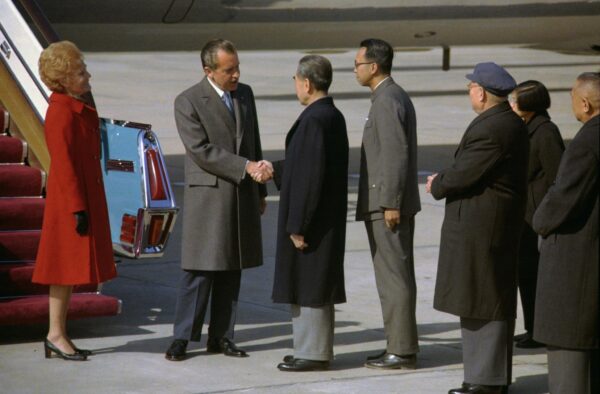
On 21 February 1972, Richard Nixon stepped off Air Force One onto the tarmac in Beijing, walked down the red-carpeted stairs, and shook hands with Premier Zhou Enlai.
In that moment, 22 years of frozen silence between the world’s richest nation and its most populous one began to thaw.
He came home with a document called the Shanghai Communiqué.
On paper, it was vague. Non-binding. Full of diplomatic language and carefully managed ambiguity.
In reality, it became the starting gun for the largest peacetime economic expansion in modern history.
Within a decade, Boeing was selling 747s to Chinese airlines. The Coca-Cola Company had opened a plant in Shanghai. American multinationals were carving out positions inside a market that, before Nixon’s red-carpet handshake, Western companies couldn’t legally access.
At the time, it was described as “the week that changed the world”.
That sounded like hyperbole back then.
In hindsight, it was probably accurate.
Then…
On 14 May 2026, Donald Trump walked down the red-carpeted stairs of Air Force One in Beijing and, shortly afterwards, shook hands with President Xi Jinping, ending nine years without a sitting US president on Chinese soil.
And just like Nixon, he came home with a document.
This one is being called a historic Joint Fact Sheet by the White House.
But beneath the branding, it’s another vague, non-binding statement of mutual intent.
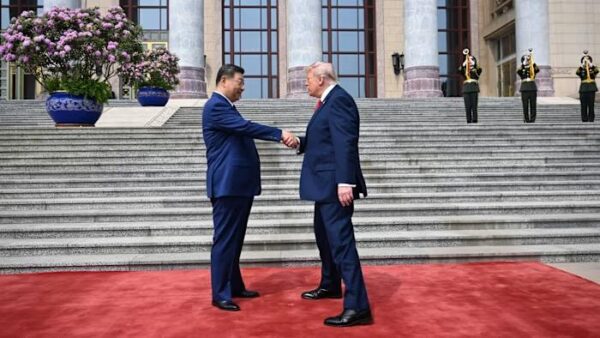
I believe the long-term consequences of Trump’s visit, some 54 years after Nixon’s, will eventually be viewed in a remarkably similar light.
My view is that this trip may prove to be another starting gun for one of the largest economic expansions in modern history.
Give this a decade, and I think you’ll see China grow dramatically through renewed access to the most advanced AI technologies America has to offer.
At the same time, I think the US economy expands to an entirely different scale as it not only leads the global AI arms race but also dominates it.
And as that unfolds, the “new industrial” AI stocks could move in much the same way the great industrial and multinational winners did after Nixon’s visit to China in the 1970s.
The companies building the infrastructure, chips, optics, memory, robotics, and compute backbone of the AI era may end up becoming the defining winners of the next economic cycle.
And believe me, you want some skin in that game.
Because if this thesis plays out, we’re unlikely to see another opportunity of this scale for another 50 years.
Forget AI, America’s No.1 forecaster says a bigger boom is coming:
“I’ve invested $1 million of my own money to prepare for this…”
He predicted the Financial Crash, both Trump victories and 2025’s record rare metals surge that saw stocks soar as much as 645%
Now discover the move he is making as America seeks to unlock a home grown fortune potentially worth trillions on Friday, May 15th
Find out what that move is right here >>
Capital at risk
Poultry, beef, and an industrial boom for the ages
One of the more fascinating details about Trump’s visit is that he effectively brought an entire Air Force One full of CEOs with him.
Three in particular represent companies with a combined market capitalisation north of $10 trillion.
Jensen Huang of Nvidia.
Tim Cook of Apple.
And Elon Musk of Tesla and SpaceX.
Alongside them were executives from Micron Technology, Qualcomm, Meta, and Coherent, among others.
And according to the official White House fact sheet, two new institutions were chartered: the US-China Board of Trade and the US-China Board of Investment.
The agreement tells us China will buy 200 Boeing jets, the first major Boeing order from China since 2017.
It tells us China has agreed to at least $17 billion a year in US agricultural imports through 2028.
It talks about poultry, beef, fairness, and reciprocity.
What it doesn’t talk about is artificial intelligence.
It doesn’t mention semiconductors.
It doesn’t mention Nvidia.
But make no mistake, that was absolutely central to getting this deal done.
While the envoy was touring Chinese cultural sites on Thursday, reports emerged that Washington had quietly cleared sales of Nvidia’s H200 AI chip to roughly 10 major Chinese technology firms, including Alibaba, Tencent, ByteDance, and JD.com.
Remember, until last week, selling the H200 into China was effectively banned on “national security” grounds.
This is exactly the kind of deal Nixon would have recognised.
Formal agreements that say very little publicly, while the real handshakes, concessions, and dealmaking happen quietly behind the scenes, opening the door to enormous economic activity on both sides.
And where this ultimately leads, in my view, is an industrial boom for the ages.
Charge whatever you want
My view is that we’re standing on the edge of what I’d call the Intelligence Revolution.
An economic and technological shift as important as the Industrial Revolution, or the rise of the internet.
And in terms of scale, I think it could end up bigger than both of them combined.
One of the other major developments from this envoy was movement around rare earth metals and critical mineral supply coming out of China.
On the Chinese side of the ledger, Beijing loosens restrictions around rare earths and critical minerals.
That helps ease US shortages of yttrium, scandium, neodymium, indium, and key rare earth processing equipment.
On the American side, Nvidia regains access to the world’s largest AI market outside the United States.
Boeing lands its biggest Chinese order in nearly a decade.
Micron Technology, Qualcomm, and Coherent all get a pathway back into China without the same level of blockade risk.
And if I’m right about where this is heading, the AI infrastructure names already running hot – Nvidia, Micron, Coherent, and others – could get another major leg higher the moment Chinese hyperscaler demand starts showing up in earnings calls.
My expectation is that this becomes a nine-to-12-month runway.
And if this process moves forward without major political hurdles, then whatever investors thought were extraordinary earnings over the last few quarters may end up looking small compared with what comes next.
Because when you control the most important technology on the planet, you can start charging almost whatever you want for it.
Nixon went to China in 1972, and the people who understood what they were really looking at made fortunes.
Most people didn’t understand it at the time.
This time may not be any different.
But, if you can see what just happened here, and position yourself around the companies building the infrastructure behind it, then I think the next several decades could create the same kind of generational wealth opportunities all over again.
Until next time,

Sam Volkering
Investment Director, Southbank Investment Research
PS Nixon’s trip to China helped unleash one of the biggest economic booms of the last century.
I believe Trump’s visit could end up doing something similar, only this time around AI, semiconductors, critical minerals, energy, and industrial infrastructure.
One veteran investor believes this could become a once-in-a-generation supercycle, and he’s reportedly invested more than $1 million of his own money preparing for it.
You can see exactly where he thinks the biggest opportunities could emerge next, right here.