 In today’s Issue:
- The end of a 45-year tailwind for investors
- Something familiar this way comes
- Could higher interest rates pop the AI bubble?
Some financial trends unfold so slowly that we stop noticing them. Some cycles take so long to play out that we begin to presume the turning point will never come.
For 45 years, interest rates around the world fell.
The double-digit rates of the early ‘80s are inconceivable to us now.
And 2020’s below-zero interest rates would’ve been considered impossible in the ‘80s.
|
One of the biggest risks investors face today is mistaking a 45-year decline in interest rates for a trend that will continue indefinitely. Because rates move in cycles. They will rise again. And that process may have begun already.
If we’re at the beginning of a multi-decade uptrend in interest rates, this completely reverses the rules of investing. It upends everything financial advisors have been taught for decades. It brushes away the presumptions upon which financial models are based.
For example, a set-and-forget 60/40 portfolio of stocks and bonds makes no sense if interest rates are beginning a long-term uptrend.
To figure out how your investment allocations should change to adjust for this, check out last week’s live-stream recording here. It explains why investors need to wake up now, before it’s too late.
But today, I want to point out something far more urgent than a 45 year trend reversal.
Forget AI, America’s No.1 forecaster says a bigger boom is coming:
“I’ve invested $1 million of my own money to prepare for this…”
He predicted the Financial Crash, both Trump victories and 2025’s record rare metals surge that saw stocks soar as much as 645%
Now discover the move he is making as America seeks to unlock a home grown fortune potentially worth trillions on Friday, May 15th
Find out what that move is right here >>
Capital at risk
Interest rate cycles always end in a crisis
The 45-year downtrend in interest rates wasn’t steady.
It’s the brief upswings in rates during those years that should interest investors right now. Because each time rates rose, someone, somewhere went bust. Usually in spectacular fashion.
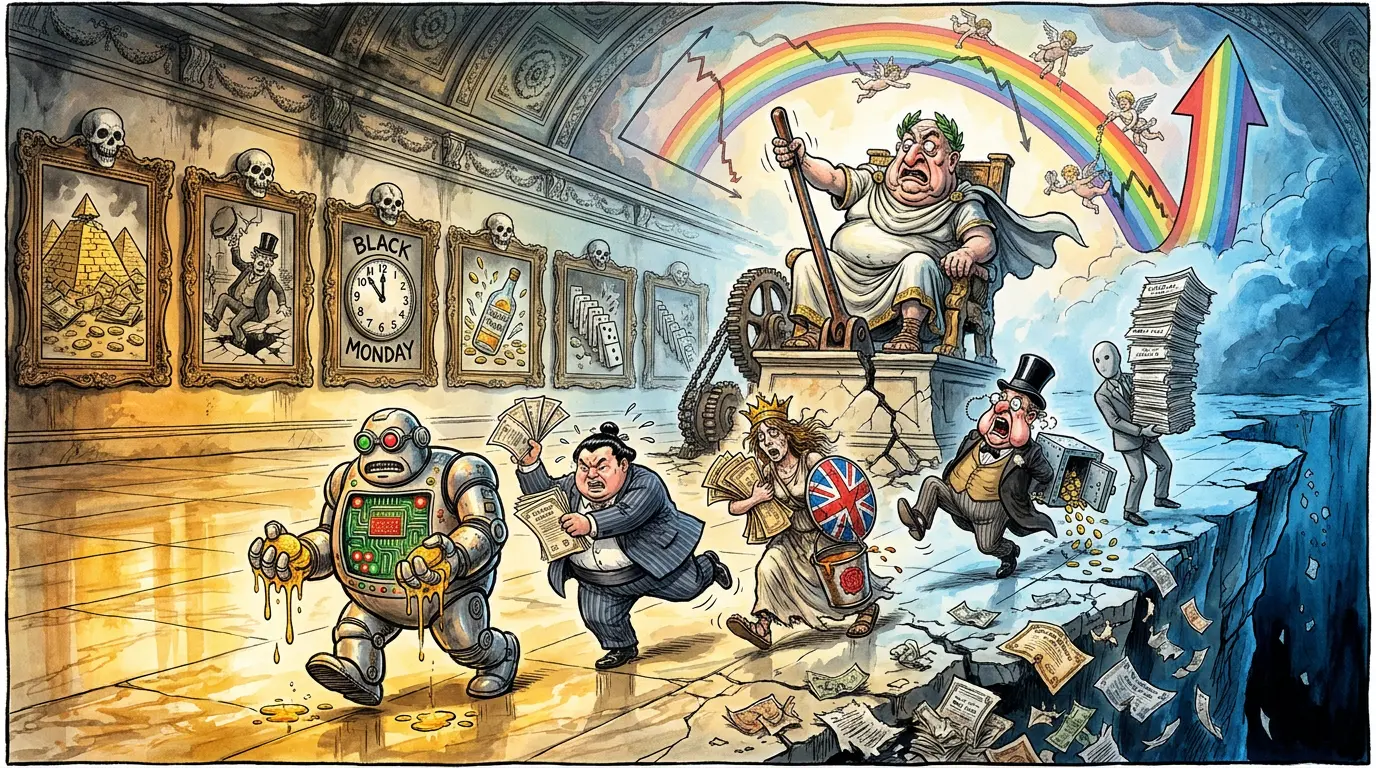
The Latin American debt crisis of 1982 marked the peak in interest rates, back then.
In 1984, rates spiked again. The US bank Continental Illinois almost went bust. Its rescue created the “too big to fail” mantra that became so important in subsequent years.
When rates jumped in 1987, Black Monday wiped out 22.6% of the S&P500.
In 1994, rates rose and triggered what’s known as the Tequila Crisis in Mexico.
The Long-Term Capital Management (LTCM) crisis and Russia’s default in 1998 coincided with a brief surge in rates.
The Dot.Com bubble popped after rates rose.
The 2008 bubble popped after rising rates slowed the US housing market.
2018 saw a serious crash in stocks over tight monetary policy too, although rates barely got off the ground.
None of this upset the downtrend. Each spike in rates peaked a little lower than the last.
Every time higher interest rates triggered a crisis, central banks would step in. They’d force interest rates lower to try and prop up financial markets and the economy. And so we’d push on to yet another lower-low in interest rates.
Interest rates can only go so low
During COVID, we reached an absurd low in interest rates. Bond yields went below zero on some bonds.
At the peak in late 2020, an unprecedented US$18 trillion of sovereign debt traded with negative yields. Investors were paying to lend money to the government.
They subsequently got routed. Interest rates spiked. Inflation even hit double digits in the UK, and bonds crashed.
The big question now is whether 2020 was a genuine long-term bottom in rates.
Has a new long-term upcycle begun?
Will we see decades of ever higher interest rates?
It may be the most important question for long-term investors today. And I’m not sure what the answer is.
My more immediate worry is this: Investors are presuming that the periodic crises of the old cycle are gone too.
Just because interest rates may be entering a long-term uptrend doesn’t mean each bout of rising rates won’t still trigger crashes, followed by periods of falling rates.
The difference is that those declines may no longer take rates to fresh lows.
Instead, each crisis may begin from a slightly higher peak than the last.
Who will go bust after the recent upswing in interest rates?
In 2023, several US banks went bust after rates were raised rapidly to rein in inflation.
The rate shock crashed the value of the bonds the banks were holding. Deposit withdrawals forced them to realise those losses. And so they went bust.
This proved that rate spikes can still end in a crisis.
But since the brief US banking crisis in 2023, bond yields have surged higher again… including in places that are not used to higher rates, like Japan.
If the old rules still apply, it’s about time to begin wondering where the next crisis will begin.
Will the AI bubble pop as the vast allocation of capital is exposed as unprofitable?
Will the Japanese bond market meltdown trigger a sudden repatriation of capital to Japan?
Will Labour’s fiscal folly trigger another Liz Truss moment?
Will it be another banking crisis, or perhaps a passive ETF meltdown?
But does it really matter who blows up first given it always triggers broader market mayhem? And the first victim is not necessarily the one that falls hardest.
Until next time,

Nick Hubble
Editor, The Fleet Street Letter
PS If I’m right that we’re entering a very different interest-rate cycle, then the biggest risks may not be where investors expect them. Former CIA economist Jim Rickards believes one part of today’s market is especially vulnerable — and that a collapse there could ripple through almost every portfolio. He’s just released a new presentation explaining why, and the three AI stocks he says investors should avoid. You can watch it here.