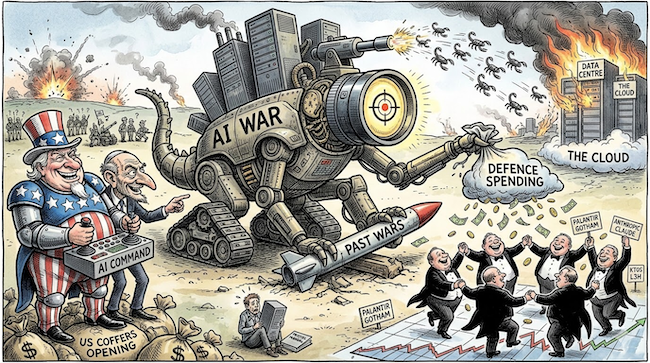
 On Saturday, the United States and Israel launched Operation Epic Fury, a coordinated strike campaign against Iran.
I’m kind of loving the names of these “operations”.
I wonder if the next one will be: Operation Laser Goes Pew Pew Pew
Anyway, the Department of War says it was the largest concentration of military firepower in thirty years.
Tomahawk cruise missiles, stealth fighters, HIMARS launchers, and hundreds of drones lit up the skies over Tehran.
But buried in the headlines about regime targets and retaliatory missile barrages is a story that clearly shows where the future of warfare lies.
This wasn’t a traditional military strike in the historic sense.
It was the first conflict in history where artificial intelligence sat at the centre of the kill chain. Where autonomous drones saw their combat debut for the US military, and where data centres became legitimate targets for retaliatory strikes.
It’s no longer just about taking out the physical enemy. It’s about taking out the one you can’t see too.
Algorithms in the command post
CENTCOM (US Central Command) confirmed the first ever combat deployment of LUCAS drones, low-cost autonomous attack systems reverse-engineered from Iran’s Shahed-136 drones.
Built by Phoenix-based Spektreworks, each unit costs around US$35,000, a fraction of the cost of a Tomahawk.
Task Force Scorpion Strike, a newly formed drone squadron under US Special Operations Command, launched them with autonomous coordination and swarm capability.
That alone rewrites the economics of warfare. But it’s the intelligence layer underneath that matters most for investors.
Palantir Technologies (PLTR) was reportedly at the heart of operations. Its Gotham platform and AI-powered Ontology system fused satellite imagery, intercepted communications, sensor feeds and open-source intelligence into a real-time digital twin of the battlefield. Commanders weren’t reading static briefings. They were watching a living map of Iranian military infrastructure, updated in seconds by machine-learning systems.
Then there’s the large language model layer. Reports indicate Anthropic’s Claude was used for intelligence synthesis, target identification and combat simulations.
CENTCOM reportedly used Claude to process intercepted communications, identify weaknesses in the IRGC command chain and generate strike scenario models.
This came despite the Pentagon officially banning Anthropic’s technology just 19 hours before the first strikes, after CEO Dario Amodei refused to remove ethical guardrails around autonomous weapons.
OpenAI moved fast. Within hours of the ban (before Operation Fury officially kicked off), Sam Altman announced a new Pentagon contract for classified AI deployments.
The Department of War also holds contracts with Google and xAI.
I think this says it all.
AI models are now core military infrastructure, and any company building them is in the defence business whether they like it or not.
When Data Centres Become Bomb Targets
Iran’s retaliation has been equally shocking.
Iran’s retaliation didn’t just target military bases. Drones and missiles hit U.S. installations across Bahrain, Kuwait, Qatar and the UAE. But they also struck Amazon Web Services data centres.
AWS confirmed drone strikes hit two facilities in the UAE, sparking fires and forcing emergency power shutdowns.
A third facility in Bahrain suffered infrastructure damage from a strike nearby. Google, Microsoft and Oracle all operate facilities in nations now under bombardment. It’s no coincidence that Anthropic’s Claude experienced outages throughout the day.
Data centres have joined the list of critical infrastructure targets alongside power grids, airports and military bases.
The implications for defence spending, redundancy planning, and AI infrastructure investment are enormous.
Consider the companies that benefit.
On the drone and autonomous systems side, AeroVironment (AVAV) supplies the Switchblade munition already deployed with US forces. Kratos Defence (KTOS) builds the Valkyrie tactical drone and is competing for the Air Force’s massive Collaborative Combat Aircraft contract.
Anduril Industries, still private but expected to IPO this year, operates the Lattice AI platform connecting drones, sensors and weapons into a unified network. And its Roadrunner interceptor solves the absurd economic mismatch of firing a US$4 million Patriot missile at a US$30,000 drone.
On counter-drone defence, the Israeli Iron Beam laser system has gone operational, and DroneShield (listed on the Australian stock exchange) provides AI-driven detection and electronic countermeasures.
L3Harris Technologies (LHX) is scaling directed-energy and electronic warfare systems. Epirus, another private company, has developed solid-state high-power microwave systems designed to fry drone electronics at range.
Then there’s a whole bunch of optics and photonics companies that were up double digits on Monday simply because lasers had been observed in use taking down missiles in defence systems.
If AI is used in war, and AI is also a target in war, then you know that AI is going to be a default layer of war forever.
It’s a part of this inflection point I’ve been writing about where AI only accelerates from here. There is no bubble. If anything, even more money is coming, once the U.S coffers open up for more defence (war) spending that will no doubt direct itself to AI and autonomous systems.
AI is now embedded in every facet of modern life, and as of this weekend, it is embedded in modern warfare.
The companies building the drones, the next-gen defence systems, the military data centres and those running the intelligence models are entering a melt-up that could last years.
This conflict has made one thing permanently clear.
The age of AI warfare is here.
Until next time,

Sam Volkering
Investment Director, Southbank Investment Research
P.S. The same artificial intelligence systems now guiding drone swarms and battlefield intelligence are beginning to transform something far older than warfare: the hunt for gold.
Algorithms can now analyse satellite imagery, magnetic surveys and geological archives in seconds, producing detailed underground maps that once took geologists years to assemble.
One company is already using this technology to locate massive deposits around the world — and according to Jim Rickards, it could be sitting on access to a potential $390 billion fortune.
You can see how the AI works, and why it could change the economics of gold discovery, in his latest briefing here.