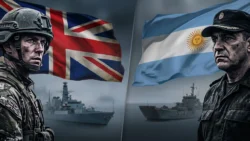
 England play Argentina tonight for a place in the World Cup final. But the real contest between these two old rivals is happening 8,000 miles south of Atlanta, and the prize is worth a heck of a lot more than a trophy.
You know those people who start making excuses before the game has even begun?
The ones who tell you their shoulder is sore, they haven’t played in years, or they were out late last night… all before you’ve even kicked a ball.
We all know one. We all hate playing against them.
Just turn up, play hard, and if you’re rubbish, you’re rubbish. No one cares.
Well, that’s Argentina right now.
Except they’re not making excuses about football. They’re warming up for another round of complaints about the Falkland Islands.
Funny timing, isn’t it?
Their foreign minister has spent the week insisting the Falklands rightfully belong to Argentina. And purely by coincidence, of course, it comes as England and Argentina prepare to meet on one of football’s biggest stages.
Personally, I think they’ve got bigger things to worry about. Their World Cup run has come without facing a FIFA top-10-ranked side and has been helped along nicely by a few generous refereeing decisions, VAR interventions, and what many fans would describe as FIFA’s rather charitable interpretation of the rulebook.
|
After all, when the world’s biggest football star is sitting at home, ratings go down. Ticket sales go down. FIFA’s bottom line goes down.
So there’s a lot at play right now. And while it’s admittedly a stretch to conflate the geopolitical brouhaha surrounding the Falkland Islands with a single game of football, it does feel as though tonight’s winner might just claim the political upper hand in what’s shaping up to be an oil boom for the ages.
Britain’s Investment Letter Since 1938
In 1938, The Fleet Street Letter warned its readers that war was coming to Europe — and even identified September as the critical month.
Since then, its readers have been warned ahead of Black Monday, the dotcom crash and the 2008 financial crisis.
Today, Britain’s longest-running investment advisory is still looking for the “news behind the news” — and the investment opportunities others could be missing.
Click here to discover what The Fleet Street Letter sees coming next.
Capital at risk.
What Does Britain’s Oldest Investment Letter See Coming Next?
It warned readers ahead of Black Monday.
The dotcom crash.
And the 2008 financial crisis.
Now, nearly 90 years after it was founded, The Fleet Street Letter is still searching for the “news behind the news” — and the investment opportunities that could emerge from the next major turning point.
Click here to discover what its editors are seeing now.
Capital at risk.
A million quid for every islander
It’s the first time England and Argentina have met at a World Cup since 2002, and you know the history as well as any football fan.
The Hand of God in 1986. Beckham’s red card in 1998. His redemption from the penalty spot four years later.
But this semi-final carries bigger stakes than most.
Argentina are the reigning champions. This could well be Messi’s farewell World Cup. FIFA would no doubt love to see Messi lining up against France and Kylian Mbappé in the final.
Standing in the way are the Three Lions.
And if we’re talking football alone, England probably have the upper hand. It hasn’t been this close to coming home since it actually came home in ’66.
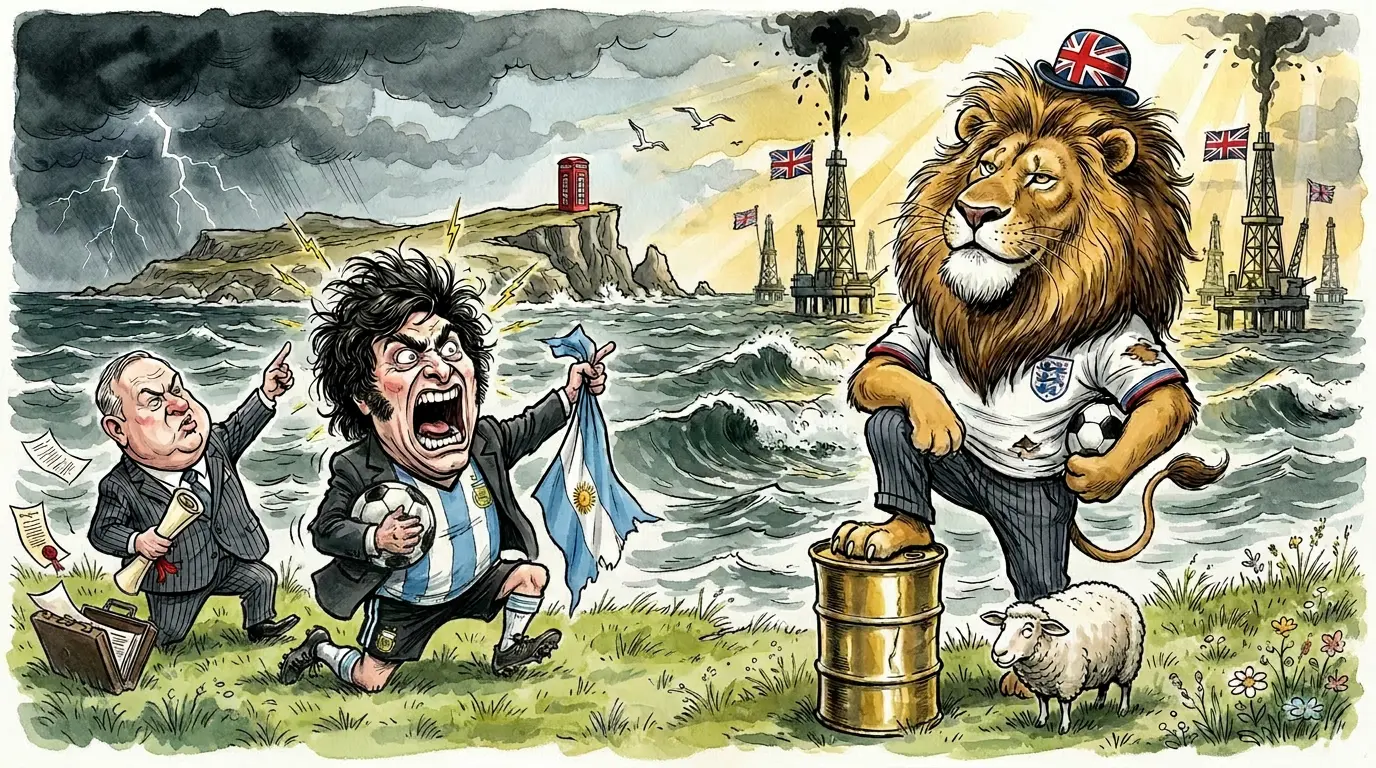
So naturally—with impeccable timing—Argentina’s foreign minister chose the weekend before the match to publish a lengthy essay demanding Britain enter talks to hand over the Falkland Islands.
Pablo Quirno described the islanders as an “artificially implanted” population and declared the 2013 referendum—in which 99.8% of Falklanders voted to remain British—illegitimate. Three people voted no out of 1,516. Some occupation.
Meanwhile, members of the Argentine squad were filmed last week singing that they’d win the World Cup “for the Malvinas”, while President Milei declared back in April that the islands “were, are and will always be Argentine”.
But this isn’t really about football. At least, not entirely.
It’s happening because the market—and increasingly the world—is waking up to the fact that there’s a heck of a lot of economic potential sitting in and around the Falklands.
Because right now there’s an oil boom taking shape in the Falklands.
In December, after 15 years of delays, financing dramas and false starts, the Sea Lion project finally got the green light.
Rockhopper Exploration [LON:RKH.L] discovered the field back in 2010. Now, with Israel’s Navitas Petroleum as operator on a 65% stake and Rockhopper holding the rest, Phase 1 is funded and under way, targeting 170 million barrels at a peak of around 50,000 barrels per day, with first oil expected in 2028 .
Estimates put total recoverable oil across the wider field north of 700 million barrels.
For the Falkland Islands, population just under 3,700, the project is expected to generate around £4 billion. Call it a million quid per islander. That’s the sort of sovereign windfall Norway amassed a fortune under..
And Sea Lion looks like just the start. The neighbouring PL001 licence is estimated to hold 3.1 billion barrels of oil across multiple prospects , with explorers now farming into the basin the way majors piled into the North Sea in the 1970s.
Maybe Labour, in its extreme ignorance, shuts down the North Sea. The good news is there’s a whole new oil boom waiting in the South Atlantic—stretching all the way down to the Weddell Sea.
Argentina’s response has been to brand the licences fraudulent, declare the whole thing “unlawful” and “clandestine”, and promise to use every diplomatic measure available to stop it. Which, given the drilling is happening anyway, amounts to little more than writing angry essays and wagging an angry finger.
The Arctic just showed us how this ends
Now let me explain why none of this surprises me, and why I think the next few years down south play out very differently from how Westminster—and the market—currently imagine.
In 2021, the European Union backed a moratorium on new oil and gas drilling in the Arctic on climate and environmental grounds. Norway hated it because the northern Barents Sea holds much of its remaining oil and gas reserves.
Fast forward less than five years.
The Iran war has just delivered one of the biggest oil and gas supply disruptions in modern history.
And last Thursday, the head of the International Energy Agency—the same outfit whose net-zero roadmap claimed the world needed no new conventional oil projects—stood up in Brussels and urged the European Union to reconsider the Arctic ban, saying, “the world needs every drop of oil from Norway ”.
And therein lies my point for everyone who thinks I’ve got rocks in my head for even suggesting that oil in Antarctica (yes, the cold place at the bottom of the earth) could become an untapped oil boom for the United Kingdom.
A drilling ban lasts exactly as long as energy security allows it to.
The moment national security and economic prosperity are on the line, the lines on the map get redrawn in the blink of an eye.
Sure, the UK government has ruled out new oil and gas licences in the North Sea and kept Sea Lion at arm’s length while the Falkland Islands, as a devolved territory, pressed on regardless.
But that’s now.
When the UK’s energy crisis gets worse, Labour loses power, and oil and energy become the political platform to run on, my bet is that Britain’s Antarctic position ages about as well as the Arctic moratorium has.
When the barrels start flowing in 2028 and the Treasury runs the numbers on a secure, friendly source of supply flying the Union Jack, attitudes in London will change very quickly.
If you haven’t yet seen my full case for how this plays out—how the world’s drilling bans crack under the weight of energy security, and what that means for Britain’s most overlooked territorial claims—you should take a look here.
If I’m right, the Arctic’s about-face is only the beginning. It could ultimately unlock a £45 trillion windfall for the United Kingdom when Britain finally drills for the oil sitting beneath the Antarctic ice.
Which brings us back to tonight.
Argentina knows exactly how big the prize in those southern waters is. That’s why its foreign minister is writing essays instead of talking football.
Oil is likely only the beginning of what Britain’s territorial waters could hold down there—from fisheries to critical minerals sitting on the seabed.
So yes, they’re snarky. They’re getting on the offensive before kick-off. And they’re trying to position themselves as the victims.
But if you asked the people of the Falklands, I suspect they’d all agree on one thing:
2-0 to England.
One for football. One for oil.
Until next time,

Sam Volkering
Investment Director, Southbank Investment Research
PS One thing I’ve learnt covering energy markets over the years is this: governments are remarkably good at changing their minds when they run out of options.
Five years ago, Arctic drilling bans were supposedly settled policy. Today, Europe’s energy establishment is openly calling for more production.
That’s why Jim Rickards has been looking much further south. He believes Britain’s greatest energy opportunity isn’t sitting in the North Sea at all—it’s sitting beneath the ice and waters of Britain’s southern territorial claims.
If he’s right, investors paying attention today will have a very different view of Britain’s energy future than the rest of the market. You can see Jim’s full case here.