 In today’s Issue:
- Don’t laugh at me, Argentina
- OPEC’s phantom oil is still flowing strong
- If the North Sea, Falklands and Arctic can be drilled, where’s next?
Growing up, I walked past that newspaper headline more than a thousand times.
It dominated a framed front page of The Guardian or The Times, carefully protected behind glass. My grandparents kept it hanging on the wall in their living room for decades.
Below the headline was an unrelated picture of my dad, smiling. That’s the only reason the front page got pride of place. I doubt my grandparents even noticed the headline.
But nobody bothered to explain any of this to me. So I grew up presuming my dad had sunk the Argentine warship General Belgrano during the Falklands War.
And that he subsequently had to explain to the press why he’d done it.
Living in a half-German, half-English household, this wasn’t considered particularly out of the ordinary…
My confusion was only made worse by the fact that my dad was pictured floating in the water…
Once I’d grown up—literally—I was able to read the fine print beneath the picture of my dad.
Apparently, he hadn’t sunk an Argentine warship with his bare hands while dressed only in Speedos.
He had qualified for the Commonwealth Games in Brisbane and even carried the England flag.
There was a story about him somewhere else in the newspaper. But they’d put his picture on the front page next to the article about the Belgrano.
Years later, we moved to Brisbane, where I spent my teenage years.
Years after that, one of my dad’s fellow Commonwealth Games teammates ended up delivering my own child in London.
Anyway, newspapers’ habit of cramming multiple unrelated stories onto a single front page has a lot to answer for.
A trick I’ve shamelessly borrowed today to suck you into an equally unrelated story.
You see, the real reason the Belgrano was sunk had nothing to do with my father. It had everything to do with oil.
At least, so the story goes…
Britain’s Investment Letter Since 1938
In 1938, The Fleet Street Letter warned its readers that war was coming to Europe — and even identified September as the critical month.
Since then, its readers have been warned ahead of Black Monday, the dotcom crash and the 2008 financial crisis.
Today, Britain’s longest-running investment advisory is still looking for the “news behind the news” — and the investment opportunities others could be missing.
Click here to discover what The Fleet Street Letter sees coming next.
Capital at risk.
What Does Britain’s Oldest Investment Letter See Coming Next?
It warned readers ahead of Black Monday.
The dotcom crash.
And the 2008 financial crisis.
Now, nearly 90 years after it was founded, The Fleet Street Letter is still searching for the “news behind the news” — and the investment opportunities that could emerge from the next major turning point.
Click here to discover what its editors are seeing now.
Capital at risk.
There’s no conspiracy theory like an oil conspiracy
The first investment newsletter I ever read was about oil. It alleged that OPEC countries were about to run out of the stuff. This was about 20 years ago, mind you…
You see, under OPEC rules, how much oil a country can sell each year depends on the size of its reserves. Bigger reserves allow you to sell more oil. And in that part of the world, oil revenues are political currency.
The editor of the newsletter alleged that OPEC governments were inflating their reserve figures in order to be allowed to sell more oil each year.
The evidence? They hadn’t spent a cent exploring for more oil, yet their reserve estimates never seemed to decline despite vast annual production.
The global economy was banking on vast phantom oil reserves flowing out of the Middle East for decades to come. But within a few years, the editor wrote, OPEC would abruptly run out of oil instead.
It was all very convincing.
And it turned out to be wrong.
These days, the world is so awash with black gold that President Trump can clog up the Strait of Hormuz without causing a proper panic.
But not everyone has been smart enough to ensure sufficient domestic supply.
Oil isn’t just energy, it’s independence
The Europeans, for example, have effectively destroyed their domestic oil and gas industries. Only Norway dodged the bullet. Even North Sea production has slowed to a trickle compared with its heyday.
As a result, Europe is now at the mercy of Putin’s Russia, Trump’s America, and Khamenei’s Iran. It continues to fund its adversaries by buying their oil and gas.
The UK has been here before. In the 1950s and 1970s, our reliance on foreign oil put us in a pickle.
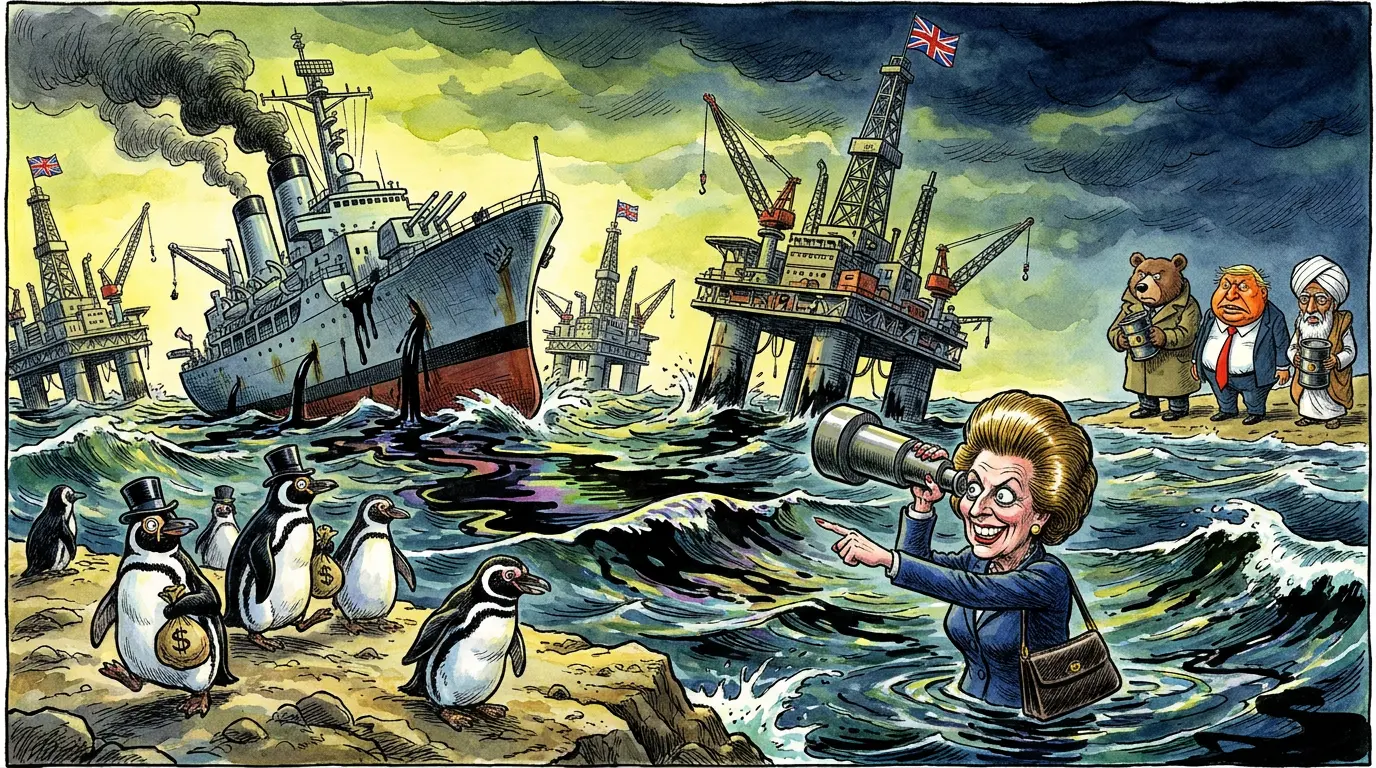
Back in the 1970s, there was speculation that large oil reserves could be found around the Falkland Islands. That’s why Argentina invaded, the conspiracy theorists claimed. They wanted to secure their own energy independence too.
There didn’t appear to be much meat on the bones of the story. At least not until recently.
Yet the oil really was there all along.
The Falklanders have largely kept their natural resources policy at arm’s length from Westminster over the decades. Having confirmed that Ed Miliband couldn’t stop them, they set about approving development of the vast oilfields in their territorial waters.
Construction has officially begun on the Sea Lion oilfield in the North Falkland Basin. The Falklanders are now on track to receive around £80,000 in tax revenues per islander each year at peak production. That’s about 15 times Norway’s current level.
The Argentines have also begun producing vast amounts of gas from their Vaca Muerta formation.
Now, even the Europeans are getting jealous.
Ed Miliband may now be willing to approve new North Sea oil projects, according to recent newspaper reports of “private conversations”.
The International Energy Agency is urging Europeans to reverse their ban on Arctic oil drilling to ensure they have domestic supplies.
Now, I’m not sure why the Arctic deserves more protection than anywhere else.
But if the Arctic gets the go-ahead, then there’s somewhere else with even greater promise on the menu.
It could make the Falklands’ oil projects look tiny. And it could transform the UK into an independent nation once again through energy independence.
Check out the details, and how to profit from them, here.
It’s strange how fast political opinion can shift on saving the planet. Then again, it has taken far too long.
|
Until next time,

Nick Hubble
Editor, The Fleet Street Letter