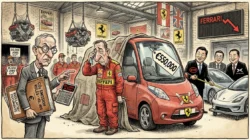
When the first Ferrari Luce images dropped overnight from Rome, my first thought was that someone at Maranello had lost a bet.
I won’t lie, but as one incredible meme online very correctly outlined, I think Ferrari just made the Nissan Leaf Pro Max…
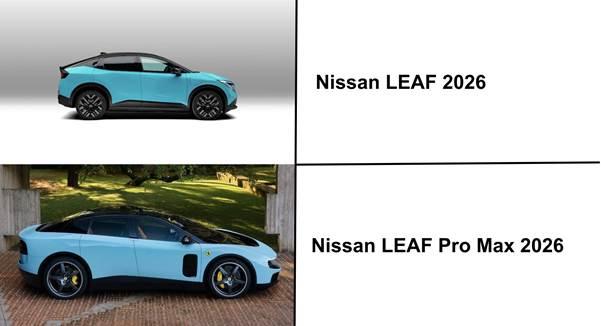
My second thought was that legacy European carmakers as we’ve known them might genuinely be cooked.
The Luce is Ferrari’s first all-electric car. It’s a four-door, five-seat, 1,035-horsepower wedge of glass and aluminium designed in collaboration with Jony Ive and Marc Newson’s LoveFrom studio in California.
Yes, this is the same LoveFrom reportedly helping OpenAI design its next generation of AI devices…
Good luck with that, OpenAI.
By the way, Ferrari has slapped a €550,000 (roughly US$640,000) price tag on it. And the reaction was so bad that in pre-market trading following the US Memorial Day long weekend, Ferrari N.V. (NYSE: RACE) was down more than 2.5%, wiping around US$1.5 billion off its market cap.
I’m about 99% sure they’re not going to sell US$1.5 billion worth of these things.
And yes, I know beauty is in the eye of the beholder.
But c’mon… this is the most un-Ferrari Ferrari ever thought up.
You also have to ask: why the hell does one of the world’s most iconic luxury carmakers decide to build a €550,000 car that nobody wanted and nobody asked for?
I’ll tell you why…
European Union regulations and Net Zero zealotry.
Britain’s Investment Letter Since 1938
In 1938, The Fleet Street Letter warned its readers that war was coming to Europe — and even identified September as the critical month.
Since then, its readers have been warned ahead of Black Monday, the dotcom crash and the 2008 financial crisis.
Today, Britain’s longest-running investment advisory is still looking for the “news behind the news” — and the investment opportunities others could be missing.
Click here to discover what The Fleet Street Letter sees coming next.
Capital at risk.
What Does Britain’s Oldest Investment Letter See Coming Next?
It warned readers ahead of Black Monday.
The dotcom crash.
And the 2008 financial crisis.
Now, nearly 90 years after it was founded, The Fleet Street Letter is still searching for the “news behind the news” — and the investment opportunities that could emerge from the next major turning point.
Click here to discover what its editors are seeing now.
Capital at risk.
Here’s a horrendously ugly car because… EU regs
Ferrari didn’t wake up one morning and decide its customers were desperate for a silent four-door shooting brake.
The Luce exists because European regulators have spent the last decade tightening the noose around the necks of every carmaker selling vehicles on the continent.
The rule is simple. Every manufacturer’s entire fleet must average below a CO2 emissions target, measured in grams per kilometre.
Miss the number, and the EU fines you €95 for every gram over the limit. That’s multiplied across every car sold that year.
For example, a 5g/km miss across 100,000 cars would mean €47.5 million in fines. Multiply that across the volumes of the Volkswagen Group, and you’re suddenly staring at industry-wide penalties that could run into the billions.
Every EV a carmaker sells drags that fleet average lower, because EVs count as zero-emissions vehicles.
So the V12s, AMG V8s, and Lamborghini howlers people actually love can only continue existing if enough electric cars sit alongside them to offset the emissions averages.
In other words, the EVs nobody really wants are subsidising the cars enthusiasts still do want.
That’s why the Luce exists.
That’s why Mercedes-Benz built the electric AMG GT 4-Door EV.
Nobody was crying out for these things.
Nobody was begging Ferrari to build a silent electric shooting brake.
This is what happens when giant carmakers start allocating capital to appease Net Zero zealots inside the EU Parliament.
Compliance cars.
That’s all they really are.
And honestly, Ferrari should have seen this coming years ago anyway.
Back in October 2025, when Ferrari first showed the Elettrica concept at Capital Markets Day and revised its 2030 EV mix down from 40% to 20% of sales, the stock fell 15% on the Milan exchange.
That was Ferrari’s worst trading day since its 2016 IPO.
The shares were above US$500 last July. They closed Friday at US$347.
All Ferrari had to do was design something breathtaking.
They had one job.
So Ferrari drops the ball, while the EU continues choking one of its most important manufacturing industries…
What happens next?
Well, as I’ve written before, it only gets worse if nothing radical changes.
Volkswagen is cutting 35,000 jobs. The CEO of VW, Oliver Blume, is planning even deeper cuts, a reduction in annual capacity and may even be selling production facilities to Chinese maker, Xpeng.
Stellantis is now partnering with Leapmotor to build Chinese EVs at its Spanish plant in Zaragoza.
Meanwhile, XPeng’s European exports went from 398 cars in January 2024 to 6,006 in April 2026. That’s a fifteen-fold increase in just over two years.
And those numbers are likely only going one direction from here.
What you’re watching in real time is the European auto industry effectively handing the keys to its competitors because regulation, constraints, and bureaucratic idiocy have convinced themselves they’re saving the world.
The China threat is real
Now, to be fair, China has its own emissions regime too, known as the NEV credit system.
But it’s a fundamentally different beast.
Chinese regulators built a framework designed to grow the domestic EV industry, not punish carmakers into oblivion.
Compare that with the EU, where the regulatory structure increasingly looks designed around climate accounting rather than global competitiveness.
The result?
European brands are spending billions building cars their customers don’t actually want simply to satisfy compliance targets, while Chinese competitors are building cars people do want, at prices European manufacturers can’t match, backed every step of the way by the Chinese state.
This is what I mean when I say European carmakers are competing with one hand tied behind their backs.
Sometimes both.
Ferrari is the luxury-end version of the problem.
Volkswagen Group, Mercedes-Benz, Renault, and Stellantis are the mass-market version.
Every one of these companies is competing globally against rivals operating inside systems specifically designed to help them win.
And if nothing changes, Europe loses.
The legacy European auto industry is already in serious decline.
I’m not saying Volkswagen disappears tomorrow.
But the slow erosion is already underway, and Europe’s regulatory environment is accelerating the problem rather than fixing it.
Mercedes-Benz Group AG (ETR: MBG) trades on a price-to-earnings ratio of roughly five.
Volkswagen AG (ETR: VOW3) trades closer to four.
At first glance, those look like value stocks.
They’re not.
They’re value traps.
Because there’s no value in a company whose long-term relevance is deteriorating faster than its ability to grow out of the problem.
Ferrari is slightly different.
Ferrari’s moat is the badge, the brand, and the waiting list, not some awkward EV sitting alongside one of the most exclusive automotive line-ups in the world.
In that sense, as I’ve said before, Ferrari is less a car company and more a luxury brand.
But if you like the idea of investing in carmakers, and you’ve got the stomach for it, then the real opportunity may sit with the Chinese manufacturers likely to dominate Europe over the next decade.
BYD, XPeng, and the broader Hong Kong-listed Chinese auto sector are where many of the next generation of vehicles are being built.
The Luce is ugly.
But ultimately, it’ll just become a strange little footnote in the long history of one of the world’s great brands.
What matters more is what the Luce represents.
Because the reason it exists at all tells you far more about the direction of the European car industry than any quarterly earnings report ever could.
Europe spent fifteen years writing rules that slowly strangled one of its champion industries.
And now we’re watching the consequences unfold in real time.
Until next time,

Sam Volkering
Investment Director, Southbank Investment Research