|
Editor’s Note Bill Bonner has never been one to shy away from questioning the people and institutions shaping the global economy. In today’s essay, he turns his attention to Silicon Valley’s most powerful figures and the extraordinary influence they now wield over financial markets. But behind the colourful personalities lies a more serious question for investors: What happens when a company’s ambitions extend far beyond making a profit, and how can shareholders judge whether those ambitions are creating genuine value? Bill explores the tension between doing good and making money, and why traditional measures of financial success still matter, even in the age of artificial intelligence. One final note before today’s essay… It’s Thanksgiving in the US. As such, US markets are closed for the day, and only open half day on Friday. |
 Man is a strange species. Sometimes stupid. Sometimes smart. Handsome. Ugly. But mostly, he is “funny.”
Neither always good nor always bad, he is ready to be blown this way or that, depending on the prevailing winds.
And the gusts we have been following for many years are those coming from about $70 trillion of fake-money capitalism whooshed into the US economy since 1971.
What this ersatz money has wrought is, in general, our beat. It has distorted every industry, cooked every price, flattered every profit, and disguised every loss.
And what seems particular to our era, when the fenders and bolts seem to be falling from the chassis, is that the people at the steering wheel are also nuts.
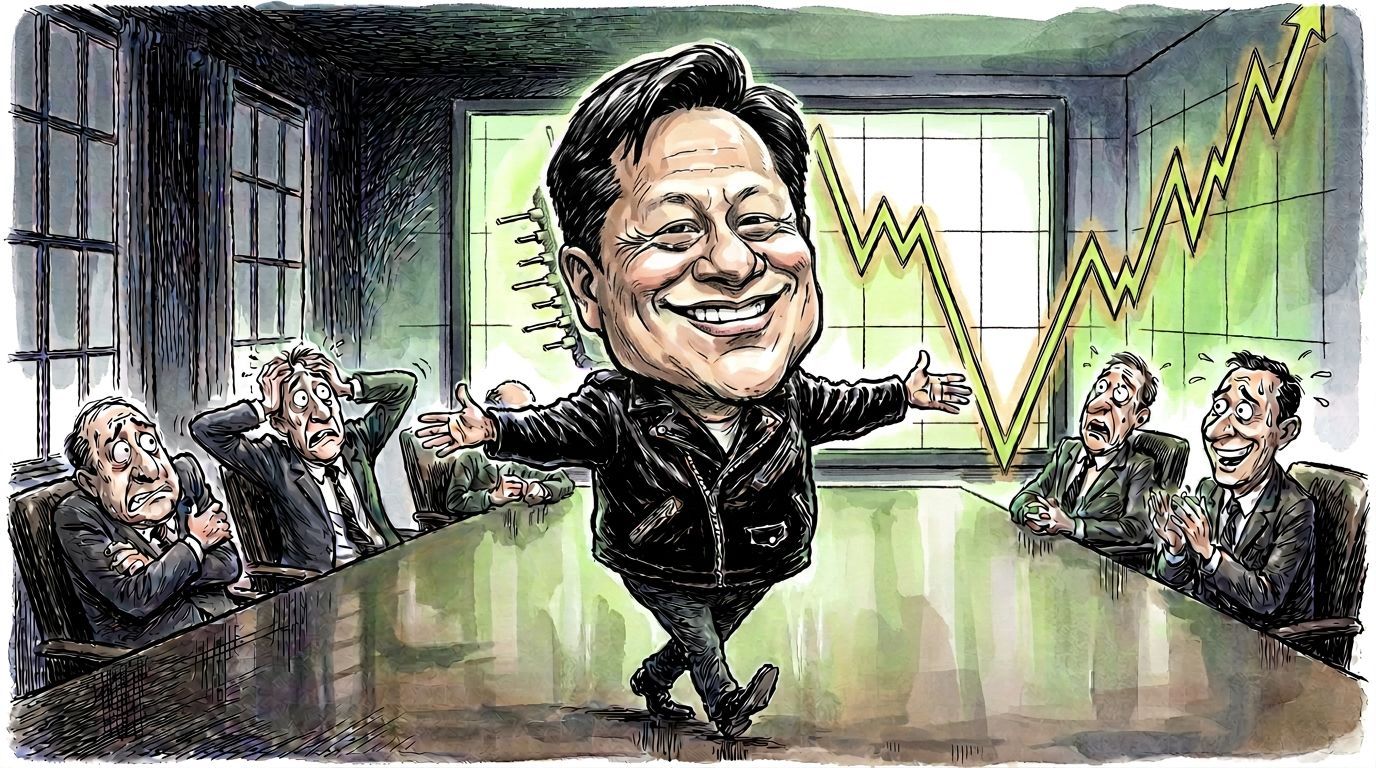
Take Jensen Huang, for example. He is no man made of ordinary clay… but an extraordinary fellow who is somehow able to conduct several amorous affairs while simultaneously running the biggest company in the most challenging and promising industry in world history.
In 1938, The Fleet Street Letter warned its readers that war was coming to Europe — and even identified September as the critical month. Since then, its readers have been warned ahead of Black Monday, the dotcom crash and the 2008 financial crisis. Today, Britain’s longest-running investment advisory is still looking for the “news behind the news” — and the investment opportunities others could be missing. Click here to discover what The Fleet Street Letter sees coming next. Capital at risk. It warned readers ahead of Black Monday. The dotcom crash. And the 2008 financial crisis. Now, nearly 90 years after it was founded, The Fleet Street Letter is still searching for the “news behind the news” — and the investment opportunities that could emerge from the next major turning point. Click here to discover what its editors are seeing now. Capital at risk. Britain’s Investment Letter Since 1938
What Does Britain’s Oldest Investment Letter See Coming Next?
That alone makes him one for the record books…
But in addition, he is said to be outrageously obnoxious. An article by David French in the New York Times tells us that he ruled the company through “grotesque bullying and humiliation.”
He is alleged to have told one of his executives that his mother should have aborted him.
Another, he reportedly threatened to rip his arms off and beat him to death with them.
Still another, and in keeping with his anatomical approach to business leadership, he allegedly threatened to rip off the top of his head so he could “pee on your brain.”
Not the way they teach you at Harvard Business School. But apparently effective.
Press reports tell us that his return to the company boosted its market value by $1 trillion. CEOs of the world, take note.
French puts Huang at the top of a list of “the world’s weirdest men,” along with Peter Thiel and Elon Musk. They are the ones who control trillions of dollars… and much of the world’s economy.
He might have added Dario Amodei to the roster. The chief of Anthropic is a whole different kind of odd. His sister, Daniela, says the two played games as children in which they “tried to save the world.” The odd thing is that they never grew out of it.
Weirdness doesn’t bother us. So what if Peter Thiel thinks the “Antichrist” walks among us? Who cares if Elon is high on drugs? But altruism, like a nail in the driveway, is bound to cause trouble.
The whole army of Anthropic employees, who call themselves “Ants,” think they are doing the world a favour. They work “996,” twelve hours a day, six days a week.
Amodei puts the odds that AI may wipe out humanity as high as 25%. If they really thought they were saving the world, you’d think they would be willing to work Sundays too. But maybe Armageddon will wait until Monday?
Doing good should never be allowed to get in the way of doing well. Many of the Ants have become rich through the IPO. They are said to be transforming whole neighbourhoods in San Francisco.
Wall Street Journal:
Anthropic’s new millionaires turbocharge San Francisco’s red-hot housing market
And now, in their cushy new digs, they are still trying to save the world… from themselves. By day, they build more and more powerful machines. And then, after dark, the lights flicker and the monsters come alive.
Harper’s Magazine:
An Anthropic employee used its proprietary LLM Claude to solve a 167-year-old math problem concerning the hidden patterns of prime numbers; “To me this is a human triumph,” commented an MIT mathematician, who previously remarked that “an AI that can prove the Riemann hypothesis is not one I’d want to meet.”
Anthropic was launched in 2021, not as a money-grubbing business but as a “public benefit corporation.” The Ants don’t risk their own money. And they are well paid for their time. But they answer to no one… but other Ants. It is a unique corporate set-up. The sheep investors have little say in the price of lamb chops.
One of the leading sources of finance was Sam Bankman-Fried, also a believer in “effective altruism,” who is now serving a 25-year sentence in a federal penitentiary for his role in promoting the common good.
And so, the Amodeis join the uplifting crowd, a long list of do-gooders including Pol Pot, Marx, Rousseau, Mao, the Jacobins, the Bolsheviks, the Inquisitors, Cromwellians, and many more.
Since its founding, the company has lost $121 billion. On the numbers, it appears that the Amodeis, frère et sœur, have so far done not good, but bad… reducing the world’s real wealth by the aforementioned $121 billion (including non-cash accounting charges).
The insects aren’t concerned. The numbers don’t matter to them. The Ants think they are saving the world from rogue AI. But the trouble with the reality of goodness is that it is like so many other things in life: it doesn’t scale very well.
Give a beggar a dollar, you may be helping him… or not. But try to save your own brother from a drinking problem, and it’s likely to be a humbling experience.
Even a little bit of altruism, practised close to home, can be mind-achingly difficult. Try it on a large scale… and you are in a world of bluff, boondoggle, and BS. All you really have to go on are the numbers.
If you are making money, you are probably making the world a better place; you are offering goods or services that are worth more than they cost to produce.
If you are consistently losing money, you should probably do something else.
Best,
Bill Bonner
Founder, The Agora
Publisher’s Note: Our Investment Director, Sam Volkering, has uncovered something that could make Silicon Valley’s trillion-dollar ambitions look rather modest. It has nothing to do with AI, robots, or eccentric billionaires.
Instead, it involves a stretch of British territory that the Telegraph has called “the most valuable piece of real estate on Earth.”
Sam believes the vast energy resources beneath it could help transform Britain’s economic future, potentially unlocking trillions of pounds in wealth. And he’s identified one little-known British company, trading for less than £1 a share, that could be positioned to benefit.
It’s a high-risk opportunity, but the potential rewards could be extraordinary.
The Ford family owns a special class of shares representing less than 2% of the carmaker's outstanding shares. How much voting power does that special share class carry?
|