 A reader emailed last week with a question that may be one of the best I’ve had in a while.
They’d seen the $2 trillion-odd figure attached to the SpaceX IPO and asked the obvious question:
Where does all that money come from?
Are pension funds and ETFs going to sell down everything else they own just to pile into one stock?
And if they do, what breaks along the way?
It’s a brilliant question.
The honest answer is that most people, including plenty who’ve been investing for years, have never had it properly explained to them.
We all hear about these monster IPOs. But almost nobody knows how one actually works, including plenty of seasoned investment professionals.
So, with SpaceX having filed its IPO prospectus on 20 May, and a Nasdaq debut pencilled in for as early as 12 June under the ticker SPCX, this feels like exactly the right moment to pull the whole thing apart.
Consider this an IPO anatomy lesson on how a mega IPO actually works.
$1.75 trillion is not the cash pile
First, let’s kill the biggest misconception.
When you read that SpaceX is worth $1.75 trillion, or even $2 trillion at the top of the reported range, that is not the amount being raised. Not even close.
Valuation, the massive number in the trillions, is simply the share price multiplied by every share in existence.
The actual money raised in the IPO is a much smaller slice.
SpaceX is reportedly looking to bring in something around $75 billion, which would itself be a historic record, but it’s a rounding error against the headline valuation.
The company issues a batch of new shares, the underwriters price them to meet demand, and that sale is the cash that lands in the bank.
Here’s the simple version…
Say a company sells 700 million new shares at $105 each. That’s roughly $75 billion raised.
But if there are around 16 billion shares in total once you count everything that Elon, the staff, and the early backers hold, then 16.7 billion shares multiplied by $105 gets you to that $1.8 trillion-plus valuation.
The valuation is the whole pie.
The raise is the one slice they cut off and sell.
Of course, that’s only the indicative IPO price. It could be higher, just as we recently saw with the Cerebras IPO.
Why the sticker price keeps moving
Cerebras was initially priced around $125, but such was the demand that it ended up at $185.
If SpaceX says $105 now, come crunch time, the IPO price might actually be $150. And if there are 16.7 billion shares at $150, you get to a $2.5 trillion valuation.
This is also why SpaceX did a 5-for-1 stock split in early May, dropping the per-share value from around $526 to about $105.
Splitting doesn’t change what the company is worth or who owns what. It just makes the share price more digestible.
Ten shares at $105 feels a lot more approachable to a retail investor than two shares at $526, even though it’s the same amount of money.
Get the price into a friendly range, and you widen the pool of people willing to have a punt on day one.
Who actually gets the shares?
Now to the part that frustrates most ordinary investors.
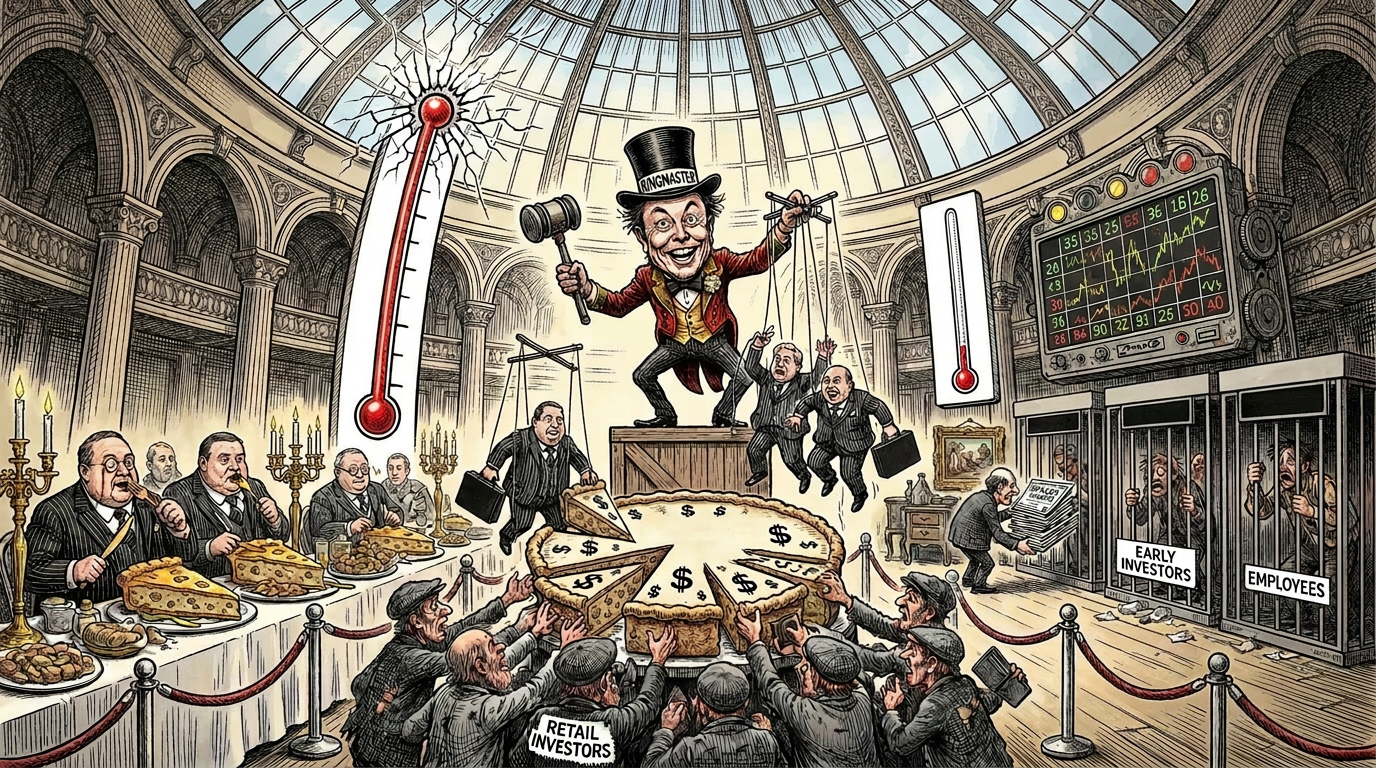
In a hot IPO, the shares are spoken for long before they ever touch a public exchange.
The lead underwriters, names like Morgan Stanley and Goldman Sachs, spend the IPO roadshow taking meetings and gathering orders from their biggest clients.
Those big clients are index funds, sovereign wealth funds, active fund managers, hedge funds, and the deepest-pocketed family offices you’ve never heard of.
They place their bids, a book of offers gets built, and the allocations get carved up between them.
Usually, retail investors aren’t part of this process.
Historically, you’ve been locked out entirely until the stock opens for trading on the exchange, and by then the price has often jumped well above the IPO price.
You end up buying from the institution that received the cheap allocation and is happy to offload some shares for a quick win.
This is precisely why we keep banging on about alternative ways to play these mega IPOs through suppliers and ecosystem companies that benefit from the event, rather than chasing the shiny headline ticker on day one.
There is a twist worth flagging with SpaceX, though.
Lookout for an email…
It’s said that up to 30% of the offering could be reserved for individual investors, which would be unusually generous for a deal this size.
In fact, I know this is true because I’ve already received emails from brokers expecting to receive allocations for individual investors.
It’s worth watching closely as the final terms are sorted, but I would expect that if you have an account with a major broker such as Hargreaves Lansdown, Interactive Investor, or Interactive Brokers, you’ll probably receive an email asking whether you’d like to participate.
Retail allocations aside, there’s another layer investors should understand.
Lock-ups, index buying, and the first-day circus
Once the stock lists are made, three forces start pulling in different directions. Understanding them explains why mega IPOs can be so volatile in their early months.
The first is the lock-up effect, which can create selling pressure over time.
Existing shareholders, employees, and early backers sitting on enormous paper gains generally can’t sell for a set period after listing, usually between 90 and 180 days.
This prevents them from dumping shares and crushing the stock in week one.
SpaceX has structured this somewhat unusually, with certain early-release provisions allowing some holders to sell before the full 180 days are up.
Importantly for the stock’s stability, Elon Musk has said he won’t be selling a single share and has exempted himself from the early-release provisions entirely.
As each lock-up window expires, those shares become tradeable and can flood into the market.
That’s why newly listed stocks often experience weakness around the 90-day and 180-day marks.
The second force pushes in the opposite direction.
Because of a recent Nasdaq rule change, SpaceX could become eligible for inclusion in the Nasdaq-100 as little as 15 days after listing.
The moment it joins a major index, every passive fund tracking that index is forced to buy it, whether the manager likes the stock or not.
That demand can absorb a significant amount of selling pressure just as lock-ups begin to expire.
In practice, many funds will need to trim existing holdings to make room for SpaceX as it finds its place in the index.
The third force is pure human nature.
That’s hype and FOMO (fear of missing out).
We’ve seen it countless times before.
When Arm listed in 2023, it closed its first day up 25%.
Alibaba popped 38% on its debut back in 2014.
Even Saudi Aramco, the previous IPO record-holder at US$25.6 billion raised, climbed on day one and reached a US$2 trillion valuation by its second trading session.
The lesson is always the same.
The easiest money is usually made by the people who received allocations before the opening bell.
By the time you and I can click “buy,” much of the low-hanging fruit has often already been picked.
The most useful comparison may actually be CoreWeave.
Don’t judge an IPO by day one
When CoreWeave IPO’d, it priced below its expected range, opened flat, and did very little on day one.
Anyone who called it a flop was proven wrong within months, because the stock went on to rally more than 250% as the AI infrastructure story caught up with it.
A mega IPO’s first day tells you a lot about sentiment and positioning.
It tells you very little about where the business might be trading three or five years from now.
So with a mega IPO like SpaceX, treat it as the starting gun on a six-month period where lock-ups, index buying, and hype all fight for control.
The share price will often whip around for reasons that have very little to do with the underlying business itself.
Waiting for the dust to settle is difficult, but it can save you from making emotional decisions in often irrational markets.
And remember, the best way to play a mega IPO is often through the surrounding ecosystem: suppliers, infrastructure providers, and companies exposed to the same underlying theme.
Quite often, they end up being the bigger winners for individual investors like you and me.
Until next time,

Sam Volkering
Investment Director, Southbank Investment Research