
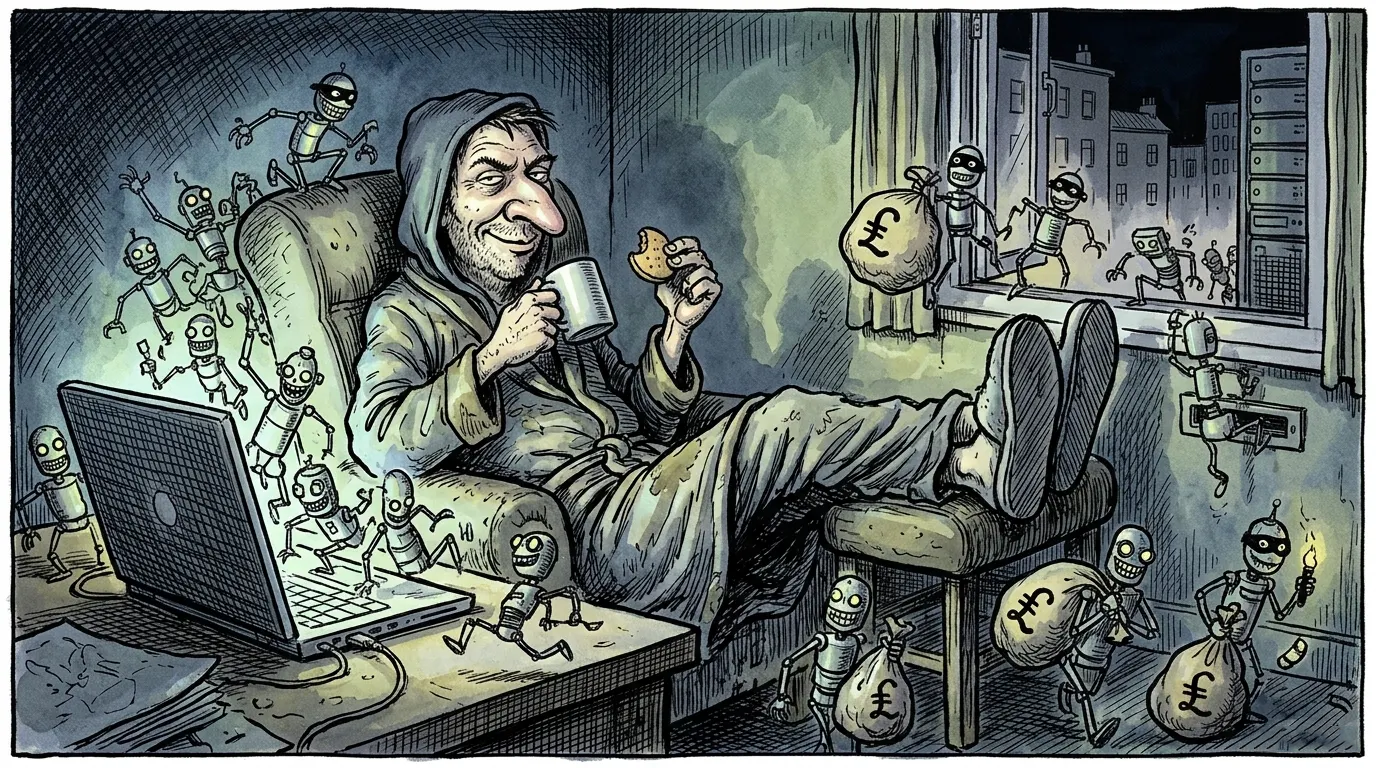
 Every now and then, you get a little pop-up on your phone asking you to install an update. I’m one of those people who usually just taps “Later.” Most of us do.
But have you ever stopped to consider the risk of not updating straight away?
Maybe you should think about it a bit harder these days.
Without a second thought, we dismiss that update.
But usually, these updates are designed to patch vulnerabilities in the operating system, such as little “bugs” that have been discovered.
And for a long time, those bugs weren’t really a problem, hence our habit of dismissing the updates.
But today, delaying an update may give a new breed of cyber attackers just enough time to get through the door.
In late August, two bugs in PaperCut, software many offices use to run their printers, went public.
One let a stranger bypass the login screen.
The other let them make the print server run any program they liked.
Within a day, researchers using AI had developed working attacks for both.
Four days later, a hacker had likely used AI to build an attack, test it, draw up a hit list, and launch it against hundreds of firms.
GreyNoise, a cybersecurity firm, said the attacker went from gaining an initial foothold to getting domain administrator access in minutes.
So, when that pop-up appears again, you no longer have days or weeks to install the update. You’re now looking at potential threats reaching your devices in minutes.
In 1938, The Fleet Street Letter warned its readers that war was coming to Europe — and even identified September as the critical month. Since then, its readers have been warned ahead of Black Monday, the dotcom crash and the 2008 financial crisis. Today, Britain’s longest-running investment advisory is still looking for the “news behind the news” — and the investment opportunities others could be missing. Click here to discover what The Fleet Street Letter sees coming next. Capital at risk. It warned readers ahead of Black Monday. The dotcom crash. And the 2008 financial crisis. Now, nearly 90 years after it was founded, The Fleet Street Letter is still searching for the “news behind the news” — and the investment opportunities that could emerge from the next major turning point. Click here to discover what its editors are seeing now. Capital at risk. Britain’s Investment Letter Since 1938
What Does Britain’s Oldest Investment Letter See Coming Next?
AI agents now run the break-ins
I don’t mean to scare you… too much.
But at the same time, you must be more security-conscious.
Google’s Threat Intelligence Group published its latest AI threat report just over a week ago.
It’s a bit of a slog, but if you’re into the finer details, as I am, check it out here.
Much of this was lost in the noise surrounding Anthropic’s IPO and the Nvidia scandal.
Google’s report covers the PaperCut case, but that isn’t the worst of it.
Attackers have moved beyond simply chatting with AI to build attacks. They now hand whole chunks of a break-in to teams of AI agents.
Not humans. AI agents that are relentless.
Companies pay people to break into their own systems so they can find the weak spots before a criminal does. It’s called penetration testing.
Some coders have built AI agents to do that job and made them freely available online for anyone – criminals included – to download. They have names like ARTEX, CAIRN, and PentAGI.
Google saw CAIRN being used against US aerospace targets. ARTEX has been used against the FBI more recently.
On one exposed server, Google found a tool called exploit_agent with set-up notes in Russian.
It compares a piece of software before and after an update, works out what the update fixed, writes an attack, and launches it.
Google says it’s the first time it has seen this done with no humans involved…
A zero-day is a software vulnerability the developer doesn’t know about yet…
In 2025, attackers exploited about eight a month.
In August 2026, that number reached 22.
Google acknowledges that these kits “trade stealth for velocity,” meaning they leave behind more evidence that makes them easier to detect.
It also suggests that, at least for now, AI isn’t inventing new attacks. It’s just really, really good at finding old bugs faster than firms can fix them and exploiting them until there’s a patch.
Stay safe and get paid
The gap between a fix going out and the first attack has shrunk from weeks to days and soon to hours and minutes.
That makes doing the dull stuff really important.
Turn on automatic updates for your phone, laptop, and home router. A patch waiting after you click “Later” is an open door for an attacker.
In 2017, hackers managed to steal sensitive data from a North American casino by exploiting which “harmless” piece of equipment?
|
Switch from passwords to passkeys wherever your bank, email provider, and broker offer them. It can be a fiddly and frustrating 10 minutes, but it’s worth the effort, so give it a go.
Stolen logins are also still how most break-ins start. The gang behind the 2025 Jaguar Land Rover attack said it used stolen logins.
That hack cost the UK about £1.9 billion.
Therein also lies a decent opportunity.
NCC Group (LSE: NCC) is a Manchester firm that sold off part of its business a little while back, but what’s left is pure cyber. It’s pretty lean on margin, but management at least has a view to get that higher in the coming years.
Of course, if you’ve built your business around testing systems and paying skilled hackers to find vulnerabilities before attackers do, there’s a real risk that AI tools could automate much of that work, leaving you with little business left.
Intercede (LSE: IGP) offers a different way to approach cyber risk. It’s worth about £88 million and develops software to issue and manage digital identities, including the smartcards US federal employees use to log in.
Its half-year results came out yesterday. Revenue rose 32% to a record £10.8 million, and profit before tax more than doubled to £2.8 million.
Funnily enough, a big chunk of its revenue is from America and mostly from big US federal orders. Those buyers can be fickle, and that means lumpy earnings.
Nonetheless, there are a couple of ways to gain exposure to these trends in the UK market.
There are also plenty more companies in the US building out cyber defence capabilities, using AI to help counter the threats posed by AI.
But more on those another day. For now, the most important thing is to recognise that cyber threats are changing. Simple measures like regularly changing passwords, using passkeys, enabling two-factor authentication, and keeping your software up to date are a great start to staying safe.
One final note, the stocks I mention in this essay are not official recommendations. Remember, investing is risky. Never invest more than you can afford to lose.
Until next time,

Sam Volkering
Investment Director, Southbank Investment Research
PS While AI is creating a new generation of cyber threats, another potentially enormous opportunity is emerging much closer to home.
An estimated 511 billion barrels of oil could be sitting beneath British waters. At current prices, that could be worth as much as £45 trillion.
And I’ve identified one little-known British company that could stand to benefit if this vast resource is developed. I’m giving away its ticker symbol completely free.