On 1 November 1976, six economists arrived in London.
A Greek.
An Australian.
A New Zealander.
A German.
An American.
And a Brit.
They checked into Brown’s Hotel in Mayfair, under false names.
Then they staged a coup.
Chancellor Dennis Healey had to cancel his holiday trip to his cottage in County Kerry, Ireland, to try to fight them off. He was on the tarmac when he got the call to turn back.
The coup was ultimately successful.
Prime Minister Callaghan had to explain to the country that the government wasn’t the one making the decisions anymore.
Why not?
Because the IMF bailout was contingent on meeting certain “conditions” put forward by the economists delivering their ultimatum.
Callaghan said, “The alternatives” to those conditions were “even more savage cuts in public expenditure and a massive rise in unemployment.”
The government had to cut regardless. With the IMF support, less could be cut.
Yet the IMF got the blame for the cuts they demanded…
This irony is incredibly important.
The IMF helped the UK avoid more severe cuts, yet history blames them for the cuts that were made.
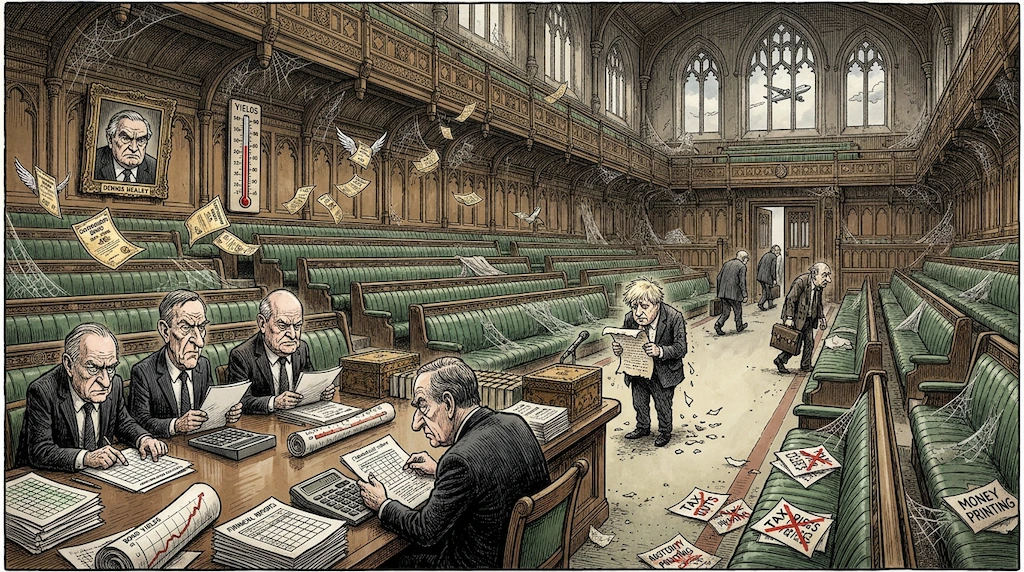
Back in the 70s, the politicians in Westminster wanted to continue debating, as though they mattered any longer.
But the truth is just as Dianna Abbott said on Sky News a few days ago: “If the British government is gonna be completely dominated by the bond market, MPs might as well go home.”
We don’t have a choice between Labour, Reform UK, and the Conservatives.
We have a choice between bond markets and the IMF.
Britain’s Investment Letter Since 1938
In 1938, The Fleet Street Letter warned its readers that war was coming to Europe — and even identified September as the critical month.
Since then, its readers have been warned ahead of Black Monday, the dotcom crash and the 2008 financial crisis.
Today, Britain’s longest-running investment advisory is still looking for the “news behind the news” — and the investment opportunities others could be missing.
Click here to discover what The Fleet Street Letter sees coming next.
Capital at risk.
What Does Britain’s Oldest Investment Letter See Coming Next?
It warned readers ahead of Black Monday.
The dotcom crash.
And the 2008 financial crisis.
Now, nearly 90 years after it was founded, The Fleet Street Letter is still searching for the “news behind the news” — and the investment opportunities that could emerge from the next major turning point.
Click here to discover what its editors are seeing now.
Capital at risk.
What’s left to try out?
We’ve tried Liz Truss’ tax cuts. That didn’t go down well.
Under Sir Keir Starmer, we raised taxes. Yields went up even more.
The pro-growth policies of several governments convinced no one.
Even supposed austerity didn’t work 10 years ago.
We tried printing money in 2020. That caused double-digit inflation.
Now we’ve got the threat of politicians who think they aren’t in hock to the bond markets. They’ll soon find out the hard way.
But what else is there?
What policies are left?
To figure out what’s really going on, and what happens next, you first need to understand what everyone else has misunderstood…
The GDP illusion
The trouble with GDP is that it includes government spending.
Public spending cuts, therefore, make GDP go down.
This makes cutting spending seem like a rather poor solution to the debt problem. Your spending might be going down. But so too is your GDP. So the debt-to-GDP ratio might not even fall.
Indeed, this happened in the countries that pursued austerity. Greece’s GDP experienced a full-on depression under the IMF’s tutelage.
That’s because, even in the private sector, a lot of GDP is just further down the supply chain of government spending.
So, how do you square the circle? How does austerity actually work?
The answer is to ignore government statistics and think conceptually.
Only some part of GDP actually pays net taxes. The rest of the GDP is like a parasite, living off the taxes the first segment produces.
We don’t really know for sure what their relative size is. GDP statistics don’t separate out what part of the economy is indirectly dependent on government spending. But the quip that follows the metaphor is obvious: the parasite has outgrown the host.
That’s what a fiscal crisis is. The producing part of the economy is too small relative to the part that lives off taxing the productive part.
Austerity is about shrinking the size of the parasitic part relative to the size of the productive part.
But, because GDP doesn’t distinguish between them, we don’t really know whether it’s working.
It looks like it’s a doomed policy, because GDP initially shrinks thanks to the government cuts. But this ignores the crucial distinction within GDP between the tax-paying segment and the tax-dependent.
It also takes time to work because growth takes time. Much longer than a prime minister’s career, these days…
And, worst of all, the existing debt must still be serviced. The sins of the past are atoned for. That’s why the German word for debt is guilt. Ironically, UK government bonds are called gilts…
The IMF is not so flush with cash right now
The IMF was created to deal with individual countries experiencing a fiscal crisis in isolation. It wasn’t designed to deal with a synchronised systemic international fiscal crisis. It doesn’t have the money.
And its most important financial backer is the US. Which could get a bit awkward for all those European countries on the edge of the fiscal cliff right now…
Of course, European countries could always follow President Trump’s economic model, which delivered impressive GDP growth rates. And the potential for great investment returns like these. (Remember that all investing is risky. Never invest more than you can afford to lose.)
The IMF might struggle to bail out everyone. But the IMF does have the methods we know all too well.
When Yanis Varoufakis was made Greek finance minister, he tried to win over the IMF, EU, and ECB with economic theory. He tried to explain that cuts would only worsen the economy by destroying GDP.
As Varoufakis tells the story, the delegates would politely listen to him and then return to number crunching on the size of the cuts needed.
That is the shift the UK faces next.
A shift from political debates and economic theory to a simple accounting problem.
As the economist Milton Friedman explained, government spending is the only metric that matters because it must be paid for, whether through taxes, inflation, or borrowing.
Labour’s entire economic ideology is to swap between those three options whenever the electorate or the bond market realises the existing one isn’t working.
Now we’ve got too much of all three.
Someone call the IMF.
Until next time,

Nick Hubble
Editor, The Fleet Street Letter