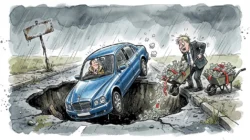
 Stocks are pricing in a boom in defence spending
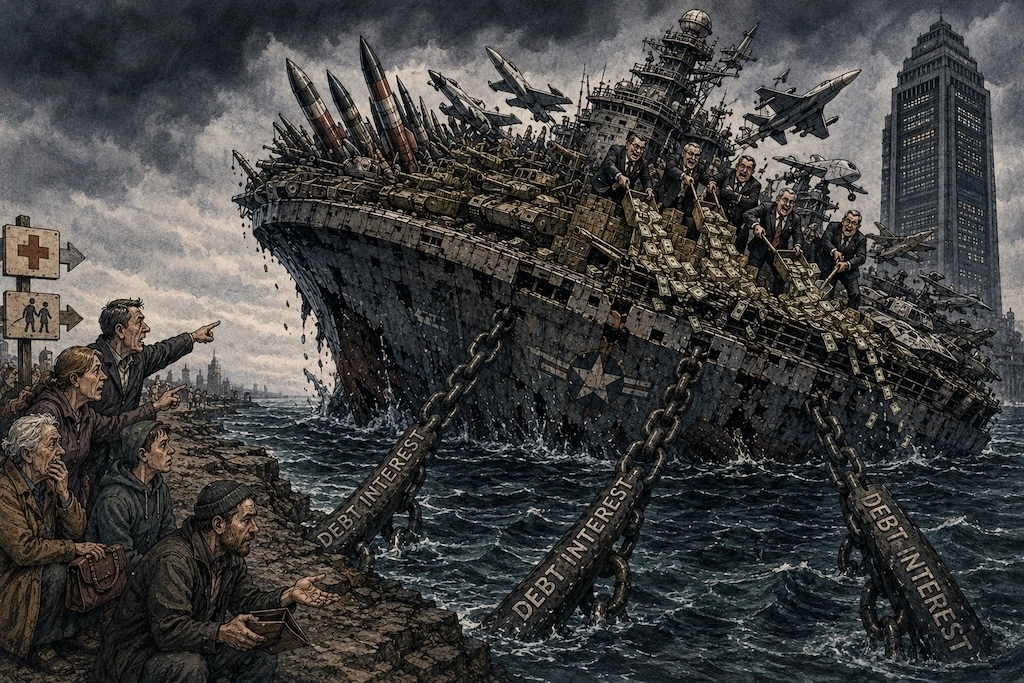
- We already spend more on debt interest than defence
- This is how empires fall
In 2019 I predicted a defence spending boom. It’d be led by pacifist Japan’s rearmament. And would cause defence stocks to soar.
Our report featured “a wild panda, the Abominable Snowman and ten stocks to profit from Japan’s rearmament.”
Since then, defence spending around the world has surged. And defence stocks were amongst the few to keep up with the AI bubble.
The iShares defence industry ETF (ITA) doubled since 2023. European defence companies like Rheinmetall outperformed everything since the war in Ukraine. And drone stocks went berserk.
But the recent surge in bond yields signals the boom is over.
In the coming years, politicians will have to choose between guns and butter. And we all know which one voters prefer.
This disappointment is going to hurt
A false dawn for defence spending would be especially important to investors.
The stock market is banking on vast defence spending promises. It has priced them in, meaning defence stocks are riding high on the presumption of large future earnings.
But these won’t eventuate if government budgets continue to come under pressure.
And that disappointment will cause share prices to plunge, hard.
It’s a classic bubble scenario. Overoptimistic projections that turn to disappointment.
But what makes me so confident?
Britain’s Investment Letter Since 1938
In 1938, The Fleet Street Letter warned its readers that war was coming to Europe — and even identified September as the critical month.
Since then, its readers have been warned ahead of Black Monday, the dotcom crash and the 2008 financial crisis.
Today, Britain’s longest-running investment advisory is still looking for the “news behind the news” — and the investment opportunities others could be missing.
Click here to discover what The Fleet Street Letter sees coming next.
Capital at risk.
What Does Britain’s Oldest Investment Letter See Coming Next?
It warned readers ahead of Black Monday.
The dotcom crash.
And the 2008 financial crisis.
Now, nearly 90 years after it was founded, The Fleet Street Letter is still searching for the “news behind the news” — and the investment opportunities that could emerge from the next major turning point.
Click here to discover what its editors are seeing now.
Capital at risk.
Why defence budgets will be cut
We all know the reasons why governments want to spend more on defence. Ukraine and Iran have exposed so many weaknesses.
The West is short on artillery shells, missiles and manpower.
Just when Germany’s Bundeswehr had replaced its broomsticks with real gun turrets, a small team of Ukrainian drone operators thrashed NATO’s legacy weapons in war games.
Defence forces don’t just need more money. They need a revamp. And that’ll be expensive.
But it doesn’t matter what governments want to spend money on. There is no limit to that.
The question is what resources it can muster and what the priorities are.
The equation for defence spending now looks bad on both counts.
Since World War II, the government’s first priority has shifted from defence to providing welfare. Healthcare, pensions, social security, and countless other programs are now considered an inexorable part of the government’s purpose.
These days about 2% of polled Brits believe defence should be a government priority.
The ranking is highest amongst Liberal Democrats at 3%…
Would you go to debtors’ prison to defend your neighbour?
Defence spending isn’t just a side issue in theory and by preference. Western governments are in so much debt that another priority has elbowed out defence spending in practice too.
The annual debt interest bill exceeds £100 billion compared to a defence budget of roughly £57 billion.
It’s not just us. The Telegraph reported in March that, “the world’s wealthiest countries spent $2.1 trillion (£1.6 trillion) on debt interest payments last year, dwarfing the $1.2 trillion they spent on military equipment.”
That’s before the recent bond yield surge, which will eventually add trillions to the cost of borrowing.
Where will the money come from? Who is willing to pay more tax to finance better defence?
Probably less than 3% of Liberal Democrats.
My prediction is that defence spending will fall to pay for a ballooning interest bill.
In the 15 years after the IMF bailout, our defence spending halved as a share of GDP.
Other countries that have gone through fiscal crises notably cut defence spending dramatically. Spain, Portugal, and Italy cut by 10-35%.
The Greeks used their German bailout funds to pay for German-made submarines. They didn’t go down well.
Anyway, if you believe that, eventually, the government will run out of other people’s money, you have to admit that applies to defence spending too.
Incredibly ironic given the bond market was created to fight wars…
This is just how empires fall
The cycle of history is clear. Countries that overextend themselves with a large military eventually go broke.
Only outsized militaries that finance themselves by plundering other nations are viable…for a while.
But I can’t see Western governments doing that. Let alone Japan…
The ultimate irony is that my prediction of Japan’s constitutional change is coming true, at last. Just when the Japanese abandon pacifism, they’re going to face a fiscal reckoning that undermines their defence spending.
So, when it comes to defence stocks, it was buy the rumour in 2019, and sell the news today.
Instead, it’s time to move onto what governments will be backing in coming years. In fact, they have no choice. For the same reason that defence spending will be cut.
They need the money that you’ll be making off these opportunities.
Until next time,

Nick Hubble
Editor, The Fleet Street Letter