
 In today’s Issue:
- Investing is a science, not an art
- The laws of physics apply to stocks after all
- Unfashionably large gains on offer
For centuries, people have debated whether economics is a science or a humanity. A natural science or a social science.
Economics isn’t really governed by hard and fast laws like physics. Human behaviour is too odd for that.
And yet, economists like to pretend they are scientists. They use the same types of equations, for example. And do lots of maths to try and look scientific.
So, which faculty do they belong in?
It might seem like an academic question. And it is, in a way.
But I once got kicked out of an economics PhD program for the lack of physics-like maths in my research topic. This after they’d accepted me on a very detailed research proposal…
Having wasted three years of my 20s doing research that suddenly wasn’t acceptable anymore, I disappeared from the university unannounced and unexplained.
I thought nobody had noticed. Until a few years ago, when the university sent me a bill for a laptop they never gave me and a fob key I never received.
Anyway, having quit my studies back in 2016, I went back to working as a financial newsletter writer. Which begs the question….
Is investing a science or an art?
Is investing a science like physics? Or a humanities student studying the bizarre behaviour of people?
At first glance, finance is a hard science. It certainly looks that way if you study it at university.
Unless you happen to be studying it in 2008, as I was. Everything we learned during the day was disproven on the evening news…
If we ask a real expert, it’s no longer clear what investing is all about.
Having made and lost his fortune in the South Sea stock market bubble, Sir Isaac Newton famously said, “I can calculate the movement of the stars, but not the madness of men.”
Perhaps investing belongs in the arts after all.
As entertaining as the madness of men may be, I have good news for the scientifically minded.
Investing might not obey laws like physics and chemistry do. But it does obey them eventually.
What I mean is best captured by the famous investor Benjamin Graham. He wrote the investing version of the Bible. And famously said this: “In the short run, the market is a voting machine, but in the long run, it is a weighing machine.”
Weights and measures obey hard physical laws.
The point is that prices in financial markets can diverge from what’s inherently true. But not forever.
From this we can derive…
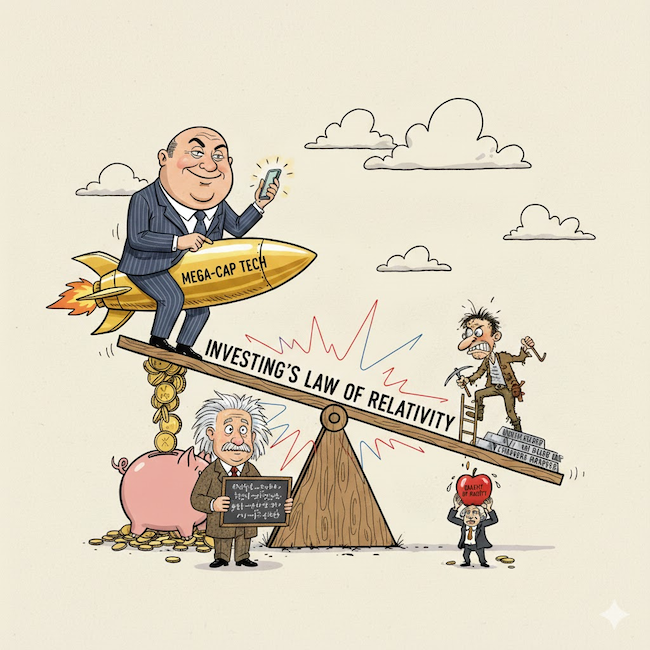
Investing’s own Law of Relativity
It’s not as ironbound as the version you’ll find in physics. Although physics does assume away the countless interferences of reality too.
It imagines a vacuum in some experiments, for example. Which is the sort of thing an economist would do in their research…
Investing’s Law of Relativity is quite simple. The relative price of assets cannot get too far out of kilter.
I recently heard an analyst say that gold is now a risky investment because “nothing can go up forever.” This is wrong, because the value of money steadily declines each year. So the price of gold really will go up forever.
But this observation also makes the point you need to understand. The gold price can’t outperform other prices forever. Even if it never falls in price, other assets would have to rise faster at some point to bring balance to the relative value.
The devaluation of money thanks to inflation raises a problem that our Investing Law of Relativity fixes. Unlike in physics, there is no constant measure in finance. Everything is always fluctuating in value. Even cash.
Imagine conducting physics if gravity kept changing or the amount of millimetres in a centimetre grew. That’s what investors have to deal with.
The only meaningful measures in finance are relative measures. Hence the law of relativity.
The gold price to silver price ratio is a good example. Or the gold price to oil price ratio. Or the gas to oil price ratio.
These relationships are bound by physics. Their supply in the earth’s crust. Their cost of mining and transportation. And their usefulness.
It’s easy to understand why the price of oil and gas cannot diverge continuously over time. They are substitutes, to a great extent. If one gets cheaper, more people buy it, which bids it back up.
But relative pricing also extends to less tangible assets…
For example, consider stocks and bonds. The more stock prices go up, the more attractive bonds become in relative terms. If only when you compare the dividend yield to the bond coupon returns.
As a result, the relative prices oscillate around each other. One performs well…then the other catches up.
This creates oscillations in relative prices.
Oscillations in investing are like frequency to musicians
Because I’ve only ever learned to play two songs on the bagpipes, I don’t know anything about the science of music. But I was told that frequency defines pitch.
Well, oscillations in relative prices define investors’ returns. Investors can buy what’s performed poorly and avoid what’s outperformed. Then wait for the laws of physics to kick in. The result should be music in their portfolio.
It’s been that way for gold and silver prices lately. Not to mention the past 400 years, at least. Each time the gold or silver price surges ahead, it’s a signal that the other one is about to catch up. One cannot outperform the other indefinitely.
Within stockmarkets, it’s the same. Sure, certain sectors can outperform the others, for a while. But doing so indefinitely would be a violation of investing’s Law of Relativity. At some point, the oscillation must kick in.
The underperformers catch up or the outperformers crash back down to earth like an apple falling on Sir Isaac Newton’s head. You can’t defy Investing’s Law of Relativity.
The same goes for house prices. The more expensive house prices in one part of the country get, the higher the chance they will crash or that house prices in the rest of the country will catch up. That’s why house prices in different parts of the eurozone are always catching up to each other in booms and busts.
If you agree with all this, what does it mean for investing today?
Oscillations to look for
Large American tech companies have outperformed all other stocks for years. They left behind many other notable sectors. US healthcare stocks, commodity companies, emerging markets, oil and more.
The strategy is simple: rotate into what has underperformed and wait.
By far the greatest opportunity right now is this one.
That’s true for a simple reason.
If you’re trying to profit from the oscillation of different asset classes, then you are agnostic about their characteristics. You buy because they are undervalued relative to the outperformance of other assets. Not because you like them.
But different asset classes do still have very different characteristics. Compare silver and gold, for example. Silver is far more volatile. When it catches up to gold on a relative basis, it soars fast.
So, the opportunity to profit is better when silver is undervalued relative to gold than vice versa.
So goeth the theory. What about the practice?
Back in September, I told my subscribers at Strategic Energy Alert that “silver is now the better option.” Since then, the gold ETF GLD is up 28% while the silver ETF SIL is up 121%.
Not bad.
The good news is that the comparatively undervalued sector of the market is also the more volatile one right now.
Which means outsized gains are now on offer for those willing to be unfashionable…like me.
Until next time,

Nick Hubble
Editor at Large, Investor’s Daily
P.S. If investing really is about spotting what’s still out of balance — before the oscillation corrects — then this is exactly the moment to pay attention.
James Altucher is breaking down one such mispricing in an upcoming briefing, where he connects this idea of relative value to a live opportunity that hasn’t caught the market’s attention yet. If you want to see where he believes the next swing could come from — and why — you’ll want to register for the briefing ahead of time.