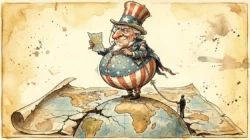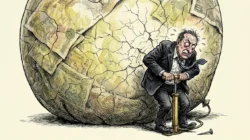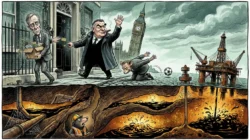
 Almost a decade ago, I wrote a two-part essay about the secret agreement that carved up the Middle East and helped ignite a century of conflict over oil.
It traced how Britain and France drew lines on a map, how Churchill pivoted the Royal Navy from coal to oil and suddenly needed to control the supply, and how the Americans later arrived with their own playbook for energy dominance.
At the time, it felt like a history lesson.
But it was also a roadmap.
Because the story from a decade ago is the same story today. The same story in the 1940s, the 1950s, the 1980s and the 1990s.
Not much really changes. What changes is what the world remembers.
And what’s happening right now in the Middle East looks eerily familiar. At the very least, it’s the latest chapter in a century-long struggle for control of the world’s most important resource.
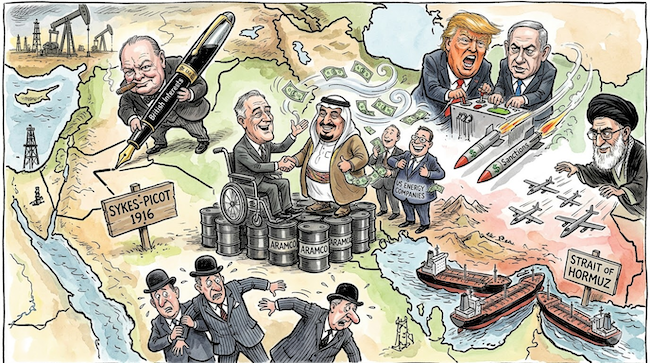
On 28 February, the United States and Israel launched Operation Epic Fury, a coordinated strike campaign against Iran that killed Supreme Leader Ali Khamenei and levelled military infrastructure across the country.
Iran retaliated with missiles and drones, hitting energy facilities across the Gulf, closing the Strait of Hormuz and dragging a dozen nations into what is now the largest oil supply disruption in history.
Crude oil surged past US$110 a barrel. Roughly 20% of global supply has been taken offline. Qatar has shut its LNG facilities, Saudi Aramco’s Ras Tanura refinery has gone dark, Kuwait Petroleum has declared force majeure, and more than 200 tankers now sit anchored at the edge of the Strait waiting to move.
It’s so bad that according to Politics UK, “The AA and RAC are advising drivers to conserve fuel and cut back on non-essential journeys amid fears soaring oil prices will increase petrol costs,”
The official line from Washington is that this is about nuclear weapons. Iran was enriching uranium beyond civilian use, the window to act was narrowing, and preemptive strikes were the only option.
Maybe. But we’ve heard this story before.
The Sykes-Picot playbook
On 16 May 1916, Sir Mark Sykes and François Georges-Picot signed a secret agreement that would define the next hundred years of conflict in the Middle East.
The deal divided the collapsing Ottoman Empire into British and French spheres of influence. Britain took Mesopotamia (modern Iraq), Palestine and access to the Persian Gulf. France took Syria and Lebanon.
The motivation was oil. Churchill had already shifted the Royal Navy from coal to oil. He understood that if Britain wanted to rule the seas, it needed access to reliable petroleum supplies.
But fuelling the most powerful fleet on Earth required something more than access. It required control.
Churchill told Parliament in 1913, “Safety and certainty in oil lie in variety and variety alone”
The Anglo-Persian Oil Company, eventually BP [LON:BP], was Britain’s first foothold.
After World War I, the San Remo conference formalised the carve-up. Britain took control of Iraq’s oil. France got 25%. The Americans got nothing.
But the United States had its own strategy.
Where Britain relied on colonial influence, America used dollar diplomacy.
By the 1940s, the Standard Oil Company of California (now Chevron [NYSE:CVX]) had secured Saudi oil rights. Its subsidiary eventually became Saudi Aramco, today the most valuable company on Earth.
President Franklin Roosevelt soon declared that the defence of Saudi Arabia was vital to the defence of the United States.
That statement has shaped U.S. foreign policy in the Middle East for the past 80 years.
From backing Iraq during the Iran-Iraq war in the 1980s to the invasion of Iraq in 2003, many major interventions in the region ultimately trace back to securing energy supply.
WMDs, nuclear threats, and the question that won’t go away
In 2003, George W. Bush told the world that Iraq possessed weapons of mass destruction. Tony Blair stood shoulder to shoulder with him.
Years later, inspections confirmed what many suspected.
There were no WMDs.
Now, in 2026, Trump insists Iran was on the verge of building a nuclear weapon. Yet his own Director of National Intelligence testified to Congress that Iran was not building one.
Envoy Steve Witkoff claimed Tehran was a week away from the bomb. Defence officials simultaneously said they’d already destroyed Iran’s nuclear capability in strikes last year.
The contradictions are extraordinary. And the pattern feels familiar.
This time, however, the alignment is different. In 2003 it was America and Britain standing shoulder to shoulder.
In 2026, it’s America and Israel.
Now, there is one meaningful difference between Iraq then and Iran now. Iran actually does have a nuclear programme. It has enriched uranium beyond civilian levels and restricted international inspectors.
But whether Iran was actually building a nuclear weapon, or even close to one, remains deeply contested, even inside the White House.
And that’s where the story begins to look familiar again.
Because the moment the first missiles hit Tehran, the oil price spiked.
The Strait of Hormuz carries roughly 20% of the world’s oil supply, and the moment conflict threatens that chokepoint, markets react instantly.
So you have to ask a simple question.
If Washington knew this would send oil prices higher, why strike now? Why risk rising fuel costs heading into mid-term elections?
The answer, at least according to the administration, is simple.
Short-term pain for long-term gain.
And that long-term gain will show up in very specific places: oil markets, commodities supply chains and ultimately in who controls the energy flows of the region.
But there’s another difference between this conflict and the Middle Eastern oil wars of the past.
In 2003, the UK marched in lockstep with the United States. Blair and Bush were inseparable. British companies, military forces and diplomacy were deeply embedded in the campaign.
In 2026, Britain isn’t even in the room.
Prime Minister Keir Starmer initially refused US requests to use British bases for strikes on Iran. When he eventually relented, Trump publicly called him a loser, compared him unfavourably to Churchill (an idol of Trump’s), and posted that the UK’s aircraft carriers were no longer needed.
The irony is extraordinary.
Churchill once centred Britain’s military strategy on Middle Eastern oil, at a time when America wasn’t even at the table.
A century later, Britain has been told to sit down while America runs the latest chapter of the same campaign.
Whether Starmer was right to hesitate or not isn’t the point. The result is the same. Britain has been sidelined. And when the dust settles, it will be American and Israeli interests that shape whatever comes next.
For UK investors, that matters.
Because it means British industry takes a seat on the bench too. The companies positioned to benefit most from disrupted oil markets and the long-term geopolitical shift are overwhelmingly American.
And that’s exactly where we’re heading tomorrow…
Because if this war really is about oil, and I suspect it largely is, then the companies making the biggest gains today aren’t the old Sykes-Picot beneficiaries like Shell and BP.
They’re a new breed of energy giants. Some of them are already seeing their share prices surge as the global energy power balance begins to shift again.
Tomorrow, we follow the money.
Until then,

Sam Volkering
Investment Director, Southbank Investment Research
P.S. If the past century of Middle Eastern conflict teaches us anything, it’s this: the real power in geopolitics isn’t ideology. It’s resources.
Oil shaped alliances, wars and entire foreign policies for more than 100 years. Nations fought to control it because whoever controlled the resources controlled the future.
Now something remarkable may be happening in the United States.
Instead of fighting over resources abroad, Washington is beginning to unlock the enormous wealth already sitting beneath its own land. In fact, a recent Supreme Court decision could open the door to monetising what some estimate to be a $150 trillion stockpile of metals, minerals and natural resources across federal lands.
And if that happens, the biggest beneficiaries won’t necessarily be the oil majors or defence contractors dominating today’s headlines.
They could be a handful of little-known mineral rights companies positioned right at the centre of this shift.