 “When there’s blood on the street…”
“Buy the dip…”
“Cash is king…”
“Never try to catch a falling knife…”
These are just some of the many investing clichés you hear all the time. And I will admit I’m guilty of using them from time to time.
But they’re all nonsense.
A waste of your time.
They’re the kinds of things that condition investors to make the biggest mistake in the market.
That mistake is doing nothing when markets turn against you.
Right now, the market is in what some would call a bear market. Some would say a big correction. Maybe even a market crash!
In reality, it’s just the modern market doing modern market things. It’s volatile, it’s hugely narrative-driven, and it’s got a heck of a lot of retail investors floating around. But it’s got a heck of a lot more algorithmic and bot-based trading, which amplifies the wider sentiment.
That’s why we see blow-off tops blow off harder than ever before, and why we see major corrections look like the market crashes of yesteryear.
Amplification is what you’re seeing now. A big ol’ tech sell-off amplifying the fear of AI, the risks of AI and the market’s belief that none of the massive investment in infrastructure right now will ever pay off.
The common cliché I see getting thrown around is that the spending and build-out of AI now are akin to the fibre companies from the dot-com boom and bust.
It’s not even close to being the same thing.
Added to that, the sell-off here is happening directly to companies that are a) growing at an astronomical rate, b) seeing margins improving, and c) generating record profits.
But they’re also spending big, in many cases spending more than they’re making in insanely good profits. They’re bringing forward spending now, using debt so they don’t fall behind the competition in this build-out.
It is a race, a race to see who can build and access the most and fastest computing power in the land. We’re really seeing this massive debt-fuelled build-out happen in big tech, too, and the market is rinsing them for it.
As a point to consider, too, sure, a company like Google looks like it’s probably changing how it operates. It’s spending hundreds of billions on building out AI infrastructure, but it also sits on about $265 billion in cash.
Yep, cash. A quarter of a trillion in cash. Not total assets, not current assets, just cold, hard cash.
Amazon has about $143 billion in pure cash. Meta about $83 billion. Microsoft about $65 billion. Even SpaceX has $90 billion in cash.
So when you hear “cash is king”, it doesn’t mean you and your portfolio. It means Google.
The reason I point that out is because these companies are some of the best companies in the world. And the market is treating them like Pets.com in the 1990s.
So to say what we’re living through at this moment in the markets is an opportunity is an understatement for the ages. As I say, it’s the amplification of misplaced fear.
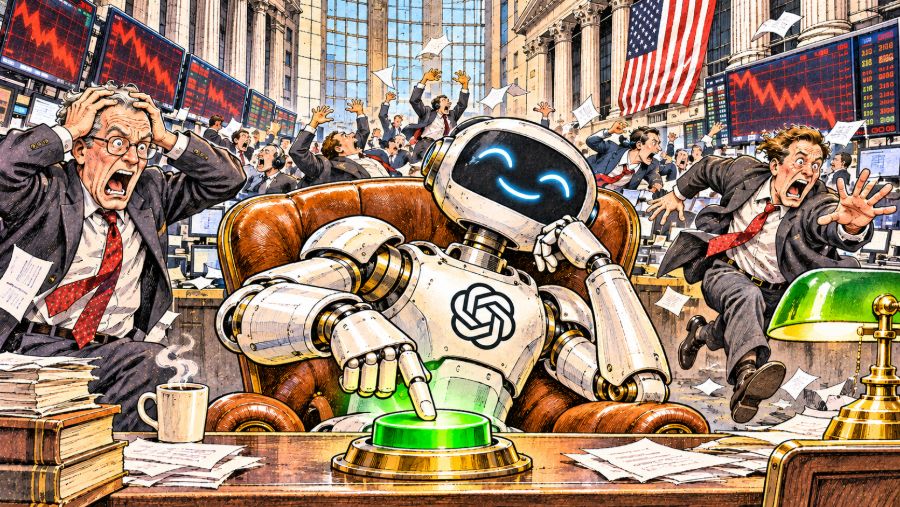
But it also makes it bloody hard as an individual investor to search for the right ticker, load up your investment account with capital and then hit that BUY button.
Find out what your friends and family think as well. Share this email with them so they can answer today’s poll and subscribe as well. |
What you see playing out in the markets right now can be paralysing.
When it’s a sea of red, the initial reaction is often to sell or do nothing. The hardest thing in the world is to BUY.
That’s because emotion and bias get in the way.
And look, I get it, we’re all human. These thoughts creep in. They mess with your brain and the motor functions that allow your index finger to tap the buy button or click that mouse.
Which is exactly why we should consider using the tools at our disposal to remove our humanity from the equation in moments like this.
There’s a great irony in play here. A big part of why the market is in somewhat of a capitulation mode is due to the “AI trade” pulling the broader market down as fear creeps in over the great AI build-out.
Yet it’s in AI that we could use right now to help us invest more intelligently in this market. Because it’s AI investing that can help you remain cold, clinical and active in a market where there’s a lot of red right now and a lot of paralysing fear.
It’s why today you’ll see an interview with the man who can only be described as “the godfather of AI investing”. This MIT alumnus developed an AI investing system that’s been used by major hedge funds and investment brokers, and has even managed funds for moments exactly like we’re seeing in the market now.
We didn’t intend for the markets to be acting like this on the very day we go live with the interview. But I’d almost call it serendipitous, because it’s markets like these where AI investing can rise to the top and prove its worth.
It’s the ability of AI to cut through the fear and the noise, crunch the data and provide the analysis that helps you make smart, clinical moves aimed at profiting over the long term from moments like this.
The biggest mistake investors make is to do nothing at all.
AI investing can help correct that, stopping you from making that mistake.
We’ve seen the market deliver opportunities like this before. Most notably, I recall April 2025 being one of those big moments. I see this as another.
Of course, there are never any guarantees in investing. No matter what approach you take, you should only ever invest with money you are comfortable losing.
But I believe those best positioned to profit from this opportunity will be the ones who embrace AI in their investing, as I have done, as our notoriously secretive guest has done, and as some of the biggest money managers in the world have done.
AI might be the cause of the fear right now, but it could also be part of the solution for investors like you.
Until next time,
Sam Volkering
Investment Director, Southbank Investment Research